
Official statement
Other statements from this video 8 ▾
- □ Le contenu dupliqué pénalise-t-il vraiment votre site sur Google ?
- □ Le contenu dupliqué freine-t-il réellement le crawl de votre site ?
- □ Faut-il vraiment s'inquiéter des alertes de duplication dans Google Search Console ?
- □ La balise canonical : pourquoi Google ignore-t-il parfois vos instructions ?
- □ Faut-il privilégier la balise HTML ou l'en-tête HTTP pour déclarer une URL canonique ?
- □ Pourquoi Google ignore-t-il votre balise canonical et comment le corriger ?
- □ Pourquoi fusionner des pages similaires améliore-t-il le SEO même sans duplicate content ?
- □ Faut-il vraiment fusionner vos pages pour améliorer votre SEO ?
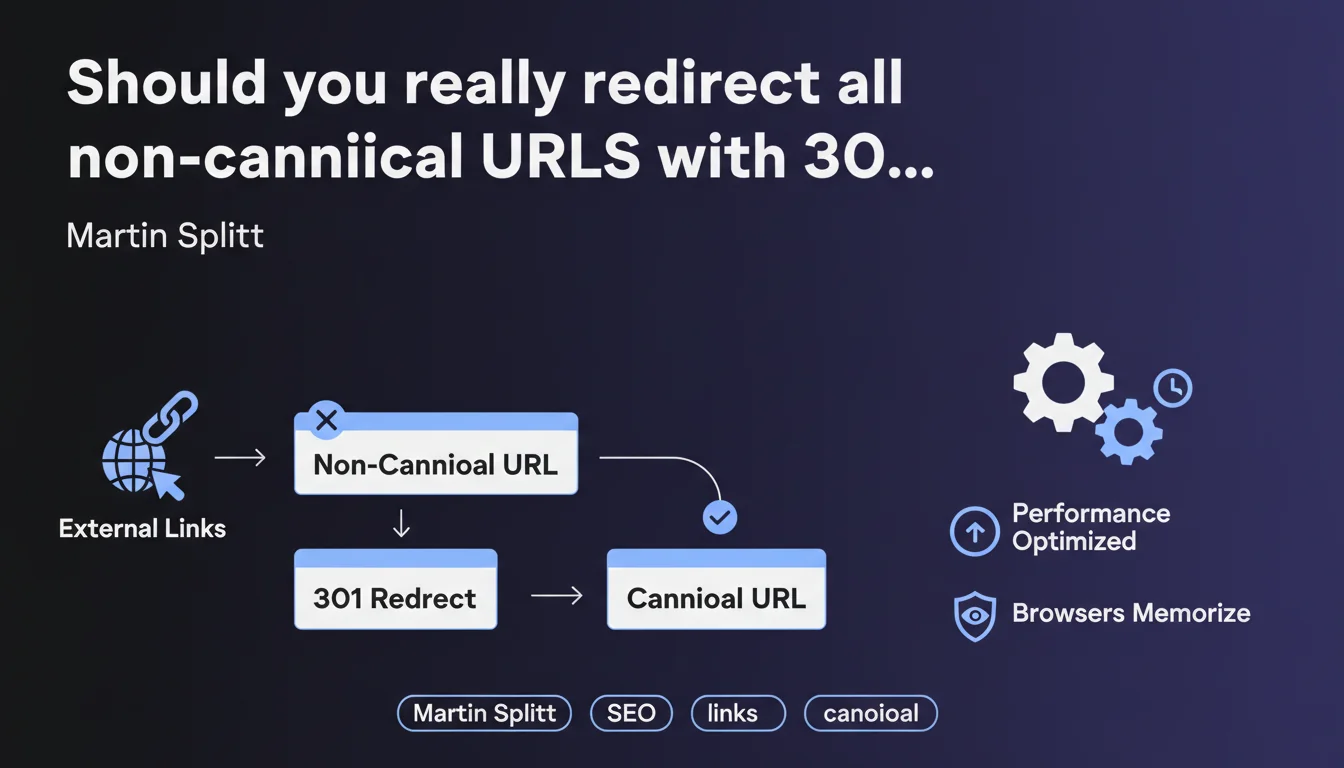
Google recommends setting up 301 redirects to canonical URLs for external links pointing to non-canonical variants. The argument advanced: browsers memorize these redirects, which avoids unnecessary network round-trips and improves performance. A clear directive that nonetheless raises implementation questions depending on your architecture.
What you need to understand
What does "non-canonical URL" actually mean in this context?
A non-canonical URL refers to any variant of the same resource that isn't the reference URL you've chosen. Think of versions with or without www, with or without a trailing slash, with or without HTTPS, or even with superfluous tracking parameters.
When an external link points to one of these variants rather than your canonical URL, Google suggests redirecting with a 301. The idea: consolidate the signal toward a single, unique URL while preserving performance.
Why does Google insist on the performance impact?
The mention of performance relies on a behavior of modern browsers: they cache 301 redirects. Concretely, a user who clicks a link to a redirected URL for the first time will experience an initial network round-trip, but subsequent visits will be instantaneous.
Google therefore links SEO and user experience: a properly configured 301 redirect avoids repeated latencies and improves Core Web Vitals, particularly LCP. It's an argument that goes beyond simple ranking signals.
How does this statement differ from rel=canonical?
The rel=canonical tag tells Google which version to index, but triggers no redirect on the browser side. A user landing on the non-canonical URL stays there — no consolidation of the external link signal.
The 301 redirect, meanwhile, forces passage to the canonical URL. It's a server-side directive, not merely a suggestion for search engines. It transfers PageRank and unifies the user experience.
- Non-canonical URLs are variants of the same resource (www, trailing slash, protocols, parameters)
- A 301 redirect transfers traffic and PageRank to the reference URL
- Browsers memorize 301s, eliminating network round-trips for repeat visits
- This approach complements rel=canonical by consolidating user experience too, not just indexation
- Google explicitly links this practice to performance and Core Web Vitals
SEO Expert opinion
Is this recommendation applicable to all websites?
On paper, yes. In real-world practice, it depends on your architecture. If your site already has a clean redirect system and your canonical URLs are well-defined, you're probably already compliant.
The problem emerges when you inherit a poorly configured site with dozens of URL variants indexed, or when your historical external links point to obsolete versions. There, auditing and implementing systematic 301 redirects can become a massive undertaking.
Does the performance argument really hold up?
Yes, but with nuances. Modern browsers do indeed cache 301 redirects — it's documented and observable. So you do gain speed on repeat visits.
However, [To be verified]: the real impact on Core Web Vitals depends on your technical stack. If your server takes 200ms to process a redirect because your .htaccess file contains 5,000 rules, you lose out. Google's recommendation assumes an optimized infrastructure.
What about sites with dynamically generated parameters on the client side?
Let's be honest, Google's statement remains unclear on this use case. If you manage a JavaScript application that generates URLs with fragments or session parameters, configuring server-side 301s quickly becomes unmanageable.
In this context, prioritizing strict canonical management via tags and JavaScript may prove more pragmatic. Google's recommendation addresses mainly traditional sites with predictable, static URLs — not complex SPAs.
Practical impact and recommendations
What do you need to do concretely to apply this directive?
Start by auditing your backlinks. Identify external links pointing to non-canonical variants: versions without www, with superfluous trailing slash, HTTP protocols instead of HTTPS. Tools like Ahrefs, Semrush, or Search Console give you this data.
Next, configure 301 redirects on the server side. Apache and Nginx support generic rules that capture all variants and redirect to the canonical URL. Test each redirect to avoid loops or chains.
What mistakes should you absolutely avoid?
Don't confuse 301 with 302. The 302 redirect is temporary, browsers don't cache it and Google doesn't transfer PageRank in the same way. Always use 301 for permanent canonicalization.
Also avoid redirect chains. If A redirects to B which redirects to C, you lose PageRank and degrade performance. Always configure a direct redirect from A to C.
How do you verify that your redirects are properly configured?
Use an SEO crawler (Screaming Frog, Oncrawl, Botify) to simulate Googlebot behavior. Verify that each non-canonical variant returns a 301 code and points to the reference URL.
Also test with browser tools: Chrome DevTools' Network tab shows HTTP codes and redirects. Make sure caching works properly by revisiting a redirected URL after the first visit.
- Audit backlinks to identify non-canonical URLs receiving external links
- Configure 301 redirects on the server side (Apache, Nginx, CDN) to canonical URLs
- Avoid 302 redirects and multiple redirect chains
- Test each redirect to detect loops or configuration errors
- Verify with an SEO crawler that all variants redirect correctly
- Monitor Core Web Vitals post-deployment to measure performance impact
❓ Frequently Asked Questions
Une redirection 301 transfère-t-elle 100% du PageRank ?
Peut-on utiliser des redirections 302 pour les URL non-canoniques ?
Que faire si mes backlinks pointent vers des milliers de variantes d'URL ?
Les redirections 301 impactent-elles vraiment les Core Web Vitals ?
Faut-il rediriger même si j'utilise déjà rel=canonical ?
🎥 From the same video 8
Other SEO insights extracted from this same Google Search Central video · published on 12/11/2024
🎥 Watch the full video on YouTube →
💬 Comments (0)
Be the first to comment.