
Official statement
Other statements from this video 8 ▾
- □ Le contenu dupliqué pénalise-t-il vraiment votre site sur Google ?
- □ Le contenu dupliqué freine-t-il réellement le crawl de votre site ?
- □ Faut-il vraiment s'inquiéter des alertes de duplication dans Google Search Console ?
- □ La balise canonical : pourquoi Google ignore-t-il parfois vos instructions ?
- □ Faut-il privilégier la balise HTML ou l'en-tête HTTP pour déclarer une URL canonique ?
- □ Pourquoi Google ignore-t-il votre balise canonical et comment le corriger ?
- □ Faut-il vraiment rediriger en 301 toutes les URL non-canoniques pour le SEO ?
- □ Faut-il vraiment fusionner vos pages pour améliorer votre SEO ?
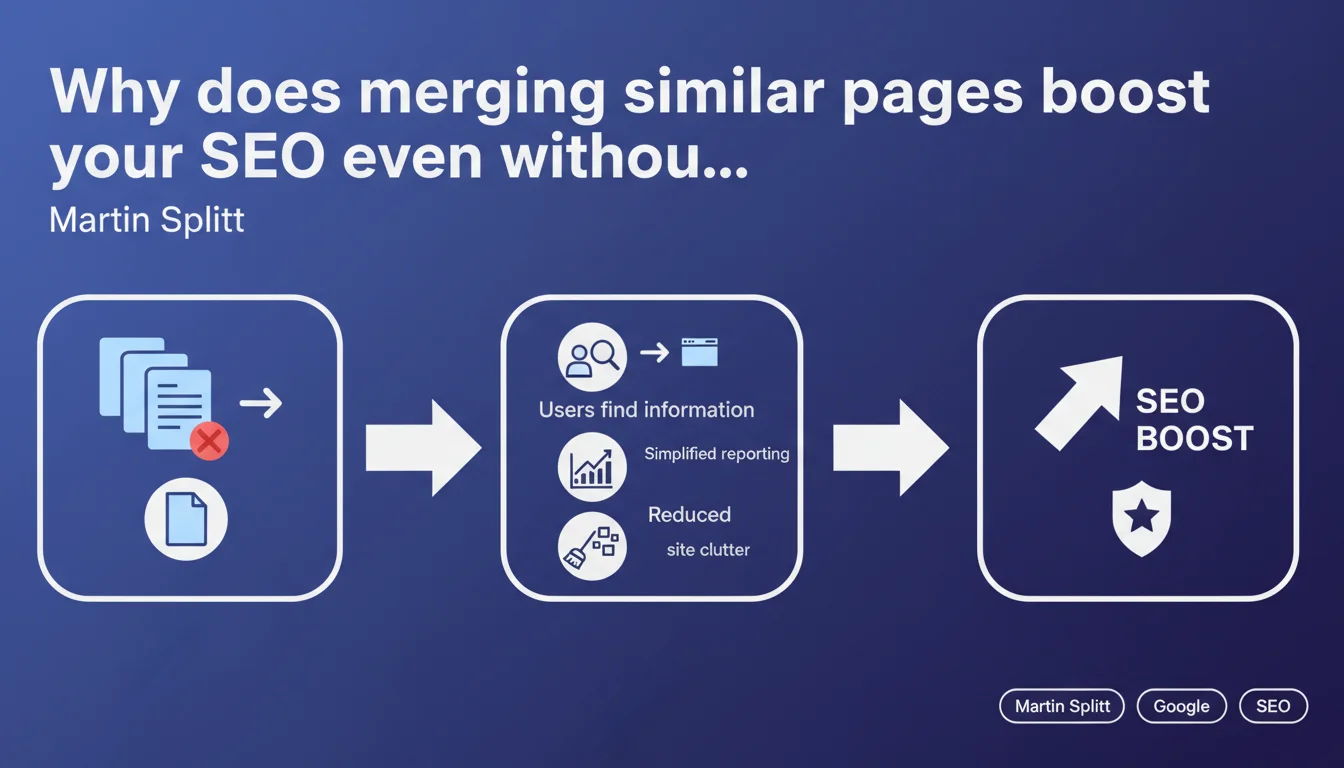
Google recommends combining very similar pages even if they aren't technically considered duplicates. Merging enhances user experience, simplifies analysis in Search Console, and reduces noise in your site architecture. It's a clear signal: similarity hurts SEO, not just strict duplication.
What you need to understand
What's the real difference between similar pages and duplicate content?
Google draws a crucial distinction here. Duplicate content refers to identical or near-identical content that the algorithm groups through canonicalization. Similar pages, on the other hand, have enough differences to be indexed separately — but not enough to justify their existence in the eyes of users or Google.
In practice? Think product sheets that differ only by color, or service pages broken down by city with 80% shared content. Technically distinct. Strategically flawed.
Why is Google pushing you to merge these pages?
Three official reasons: user experience, reporting clarity, and reducing clutter. Translation: too many similar pages dilute your signals, fragment your traffic, and muddy your performance data. Google dislikes managing 50 pages that say essentially the same thing with minor variations.
The word "clutter" is telling. It suggests each page consumes crawl budget, generates noise in the index, and weakens your site's thematic focus. Fewer similar pages means stronger signals concentrated on the pages you keep.
What are the risks of ignoring this recommendation?
Officially, nothing dramatic — Google doesn't mention penalties. But the indirect consequences are real: authority dilution, backlinks scattered across multiple weak URLs, traffic spread too thin, and difficulty identifying top performers in Search Console.
- Internal cannibalization: multiple similar pages compete for the same queries without any dominating
- Reduced SEO efficiency: optimization efforts and links disperse instead of concentrating
- Weakened quality signal: a site with lots of near-identical content appears less authoritative
- Unreadable reporting: impossible to accurately measure performance of a topic spread across 10 URLs
SEO Expert opinion
Does this recommendation actually reflect what we see in the real world?
Largely, yes. Sites that merge similar pages often see traffic consolidation on the retained URLs and improved overall rankings on their target queries. The dilution theory isn't myth — it's measurable.
But — and this is a big but — it hinges on search intent. If your similar pages address distinct intentions, even slightly, merging them could backfire. Example: "SEO audit" vs "technical SEO audit" vs "e-commerce SEO audit." Similar? Yes. Worth merging? Not necessarily if each query has its own volume and audience.
When should you IGNORE Google's advice here?
Let's be honest: Google speaks for the average user, not advanced long-tail strategies. If you have 50 similar pages each targeting a precise local or semantic variant, and each one drives qualified traffic, leave them alone.
The real test? Your data. If your similar pages cannibalize each other and none truly perform well, merge them. If each one captures a distinct segment with solid metrics, keep them. [To verify]: Google provides no threshold for acceptable "similarity" — it's deliberately vague.
The hidden pitfall: merging alone isn't enough
Too many SEOs merge similar pages by simply stacking content carelessly. Result: an unwieldy, poorly structured page that underperforms even more than before. Merging must come with strategic rewriting: unified angle, clear hierarchy, precise intent targeting.
Practical impact and recommendations
How do you identify similar pages to merge on your site?
Start by pulling all your indexed URLs from Search Console or a Screaming Frog crawl. Spot pages sharing primary keywords, similar structures, or near-identical titles. Semantic clustering tools (Ahrefs, SEMrush, or even Python scripts with TF-IDF) speed up the process.
Next, dig into GSC data: which pages are fighting for the same queries? Which have impressions but zero clicks? Those are often prime candidates for merging — they exist in the index without delivering differentiated value.
What's the best method for merging effectively?
Step 1: Choose your master page — the one with the best history, most backlinks, or strongest rankings. This is the one that stays and absorbs content from the others.
Step 2: Rewrite the consolidated content. Don't just copy-paste blocks from the pages you're retiring. Restructure around a cohesive editorial angle, with logical H2/H3 hierarchy. Add depth where it's lacking.
Step 3: Redirect all old URLs to the master page using permanent 301 redirects. Verify backlinks follow the redirect properly. If internal links still point to old URLs, fix them to avoid unnecessary hops.
What mistakes should you absolutely avoid?
- Never merge without analyzing search intent behind each page — you risk losing qualified traffic
- Don't forget to redirect old URLs — leaving 404s or orphaned pages kills accumulated authority
- Avoid creating an unwieldy catch-all page: successful merging requires structured rewriting, not raw assembly
- Don't ignore user signals post-merge: monitor bounce rate, time on page, and conversions — a drop means the merge was poorly conceived
- Never merge pages performing well individually just to "clean up" your architecture — traffic data trumps structural aesthetics
Merging similar pages is an underestimated SEO lever — but it demands method and analysis. The goal: concentrate signals, clarify your offering, and boost UX. Done poorly, it destroys earned traffic. Done right, it unlocks hidden potential.
If your site has dozens (or even hundreds) of potentially mergeable pages, the audit and implementation can quickly grow complex. Between semantic analysis, choosing master pages, strategic rewriting, and managing redirects, the project requires solid expertise. Partnering with a specialized SEO agency can be wise to execute this overhaul methodically and secure the authority transfer safely.
❓ Frequently Asked Questions
Est-ce que fusionner des pages similaires peut faire baisser mon trafic ?
Comment savoir si deux pages sont trop similaires selon Google ?
Faut-il fusionner même si les pages similaires génèrent chacune du trafic ?
Que faire des backlinks pointant vers les pages supprimées après fusion ?
Combien de temps faut-il pour voir les effets d'une fusion de pages ?
🎥 From the same video 8
Other SEO insights extracted from this same Google Search Central video · published on 12/11/2024
🎥 Watch the full video on YouTube →
💬 Comments (0)
Be the first to comment.