
Official statement
What you need to understand
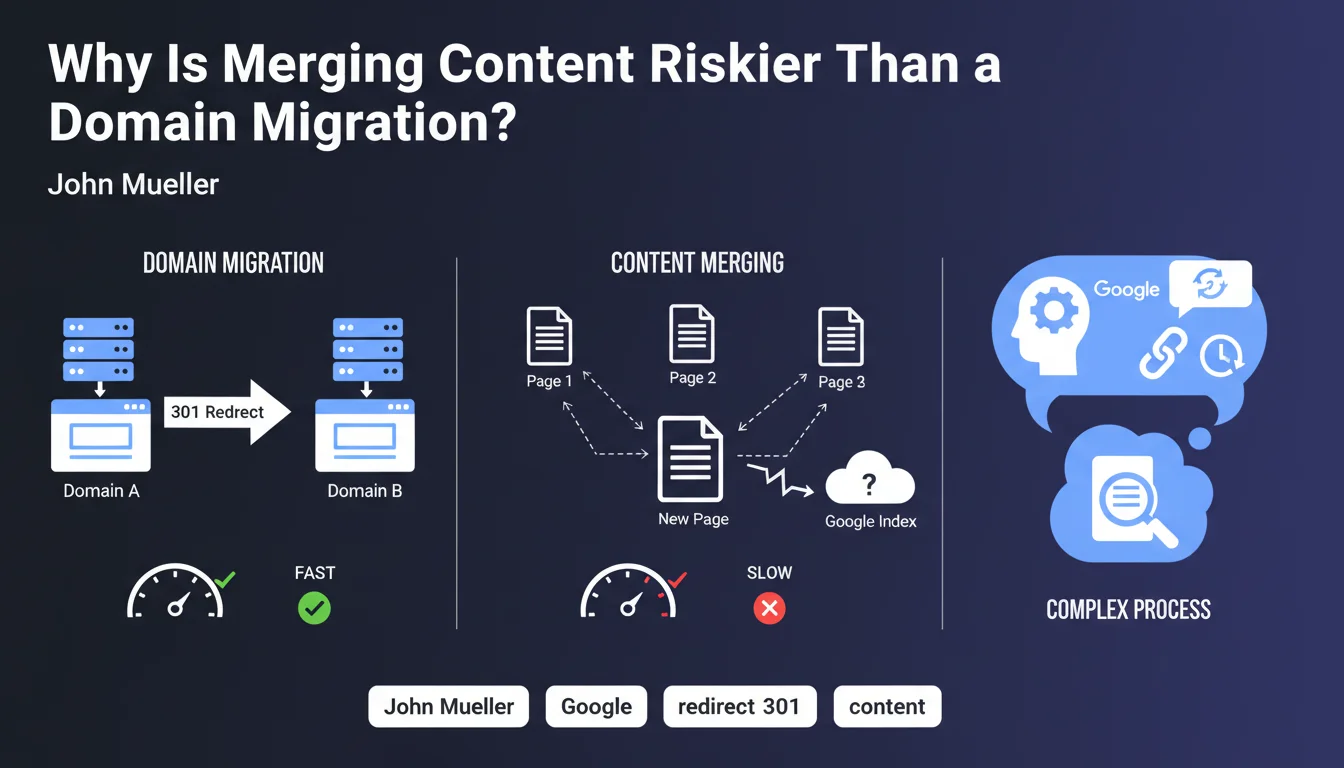
Contrary to what many SEO professionals think, merging multiple pages into one is more complex for Google than a simple domain change. During a classic transfer (domain A to domain B), each URL has a direct and unique correspondence.
In the case of content consolidation with a reduction in the number of URLs, Google must understand that several historical pages now point to a single destination. This consolidation process requires more time for analysis and algorithmic processing.
A particularly interesting phenomenon concerns differentiated display depending on user context. Results may show the new URL in anonymous browsing, but continue to display the old page in featured snippets or when connected to Gmail.
- Processing mergers takes longer than classic migrations
- 301 redirects don't guarantee an instant switchover in all contexts
- Google may deliberately display old URLs if a user specifically searches for them
- Featured snippets may keep the old URL longer than standard organic results
SEO Expert opinion
This statement is perfectly consistent with field observations from recent years. Content consolidations effectively generate longer periods of uncertainty, with mixed signals in Search Console and unpredictable ranking fluctuations.
The important nuance concerns Google's intentionality in preserving old URLs. When a user types exactly an old address, Google considers that they're expressing a specific intent and may choose not to force the redirect in the SERPs. This behavior is logical from a UX perspective but can confuse SEO professionals.
In cases of large-scale mergers (dozens or hundreds of pages), it's not uncommon to observe phases of temporary regression lasting 2 to 6 months. The consolidation signal must propagate through the entire link graph, which takes time.
Practical impact and recommendations
- Plan realistic timelines: for a content merger, allow a minimum of 3 to 6 months before complete stabilization, compared to 4 to 8 weeks for a simple migration
- Monitor multiple contexts: check results in anonymous mode, when logged in, and specifically featured snippets which evolve differently
- Favor progressive mergers: rather than merging 50 pages at once, proceed in waves of 10-15 pages to better control the impact
- Document mappings precisely: maintain a detailed table of old URLs to new ones to track the transition URL by URL
- Use the Search Console coverage report: to identify old URLs that persist in the index and understand why
- Don't panic if old URLs appear: this is normal Google behavior, especially if someone searches for them directly
- Truly consolidate the content: the target page must integrate valuable elements from all source pages, not just a technical redirect
- Maintain 301 redirects indefinitely: even after visible consolidation, these redirects remain essential for historical signals
💬 Comments (0)
Be the first to comment.