
Official statement
Other statements from this video 8 ▾
- □ Le contenu dupliqué pénalise-t-il vraiment votre site sur Google ?
- □ Le contenu dupliqué freine-t-il réellement le crawl de votre site ?
- □ Faut-il vraiment s'inquiéter des alertes de duplication dans Google Search Console ?
- □ La balise canonical : pourquoi Google ignore-t-il parfois vos instructions ?
- □ Faut-il privilégier la balise HTML ou l'en-tête HTTP pour déclarer une URL canonique ?
- □ Pourquoi Google ignore-t-il votre balise canonical et comment le corriger ?
- □ Faut-il vraiment rediriger en 301 toutes les URL non-canoniques pour le SEO ?
- □ Pourquoi fusionner des pages similaires améliore-t-il le SEO même sans duplicate content ?
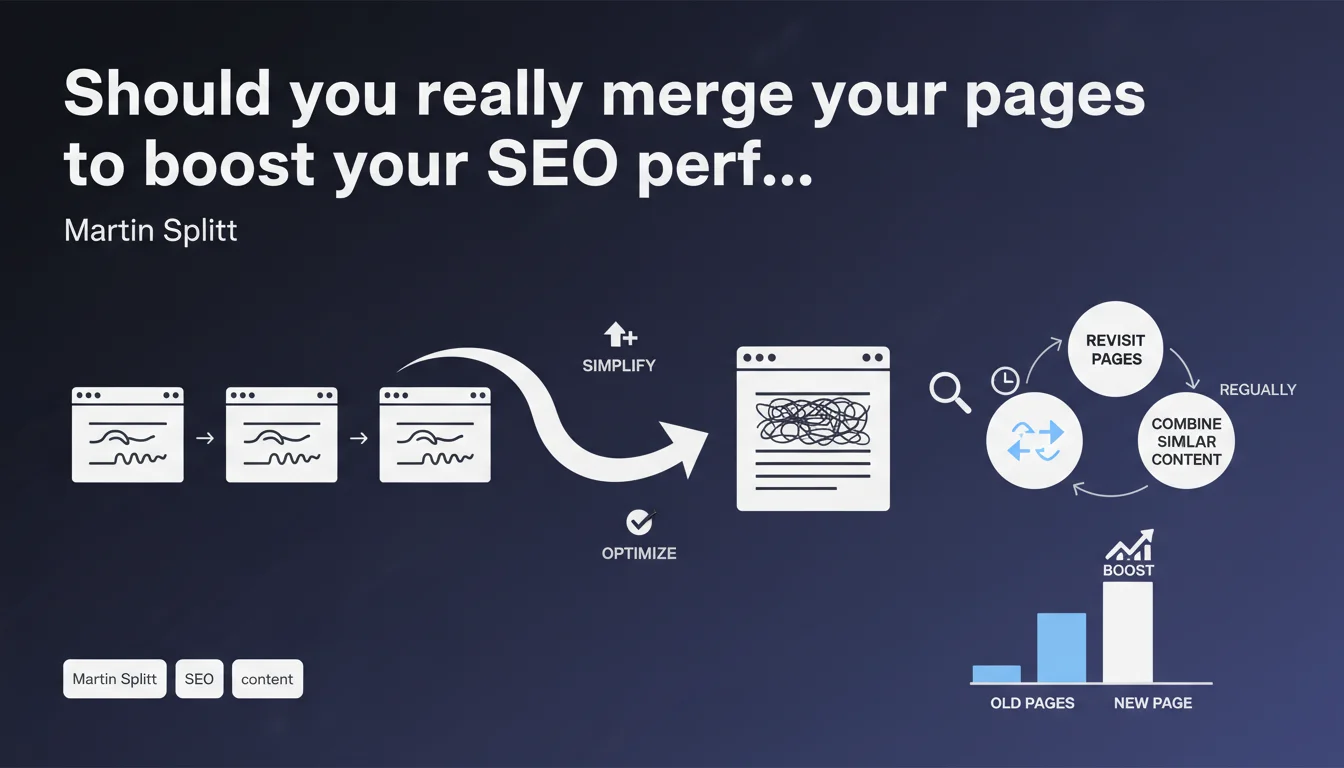
Google recommends regularly revisiting your pages to identify similar content worth merging or simplifying. This practice aims to reduce cannibalization, concentrate authority, and maintain a coherent site over time. In practice: fewer pages, but higher-performing ones.
What you need to understand
Why does Google insist on regularly reviewing your content?
The accumulation of pages over time inevitably creates redundancies and outdated content. When two or three pages target the same queries with slightly different angles, Google doesn't know which one to prioritize.
This dilution of authority results in keyword cannibalization: multiple URLs compete for the same rankings, fragmenting your ranking potential. Google prefers consolidated content that demonstrates clear expertise rather than several mediocre variations.
What does "simplify and combine" concretely mean?
Simplifying means first eliminating unnecessary content: hollow sections, pointless repetitions, outdated content that no longer provides value. Combining means merging pages dealing with related topics into a single comprehensive piece of content.
The goal: concentrate relevance signals (backlinks, engagement, history) on a single URL rather than dispersing them. This consolidation strengthens the page's thematic legitimacy in Google's eyes.
How often should this review take place?
Google deliberately remains vague about the frequency. For an active editorial site, a quarterly review of main pages is a good compromise. For a less dynamic corporate site, a semi-annual audit is sufficient.
What matters most is establishing a sustainable process rather than a one-time action. A living site requires ongoing maintenance, not just an annual cleanup.
- Cannibalization dilutes authority across multiple similar URLs
- Merging content concentrates relevance signals on a single page
- Simplification eliminates hollow sections that add no value
- A regular process (quarterly or semi-annual) beats a one-time effort
- This approach aligns with quality over quantity logic
SEO Expert opinion
Is this recommendation truly new?
Let's be honest: Google has been repeating this message for years in different forms. What's changing is the growing emphasis on consolidation rather than relentless content production.
In the field, we observe that sites having drastically reduced their indexed page count — through intelligent merging — often saw their average rankings improve. The signal is clear: 50 solid pages beat 500 mediocre ones.
What nuances should be added to this advice?
Merging is not always the solution. When two pages target distinct search intentions, keeping them separate remains relevant — even if the topics seem close. The danger is creating catch-all pages that lose focus.
Another critical point: a poorly executed merge (bad 301 redirect, lost internal linking) can destroy traffic instead of gaining it. [To verify]: Google provides no numerical threshold to determine when merging becomes riskier than beneficial.
In which cases does this rule not apply?
E-commerce sites with similar product pages rarely need to merge: each reference deserves its own URL for obvious reasons. The same applies to news sites where chronological history matters.
Paid landing pages can also justify their distinct existence even with similar content if they correspond to specific marketing campaigns. SEO is not the only consideration.
Practical impact and recommendations
What should you concretely do to audit your content?
Start by exporting your complete list of indexed pages via Google Search Console. Filter by topic or main keyword to group similar content. Identify clusters where multiple URLs compete for the same queries.
Then analyze your performance metrics: impressions, clicks, average position. Two pages targeting the same intent but both achieving poor average positions are good merge candidates.
What mistakes should you avoid during consolidation?
Never merge without implementing permanent 301 redirects from old URLs to the new one. Keep the best from each piece of content, not just the longest — quality trumps word count.
Avoid creating "Frankenstein" pages where you glue sections together without narrative coherence. The resulting page should provide a smooth reading experience, not a juxtaposition of articles.
How should you measure the impact of these optimizations?
Track the evolution of positions and organic traffic over 3 to 6 months post-merge. Also monitor user behavior: time on page, bounce rate, scroll depth. Good consolidation improves these indicators.
Compare the total number of backlinks before/after: the consolidated page should accumulate the authority of the old URLs if redirects are properly configured.
- Export and segment indexed URLs by topic
- Identify clusters of pages targeting the same queries
- Analyze backlinks and traffic for each candidate URL
- Keep the best from each piece when merging
- Set up permanent 301 redirects
- Verify narrative coherence of the resulting page
- Measure impact over 3-6 months (positions, traffic, engagement)
- Document the process to make it reproducible
❓ Frequently Asked Questions
Combien de pages faut-il fusionner pour observer un impact SEO ?
Que faire des backlinks pointant vers les anciennes URLs fusionnées ?
Peut-on fusionner des pages de sections différentes du site ?
Faut-il supprimer ou fusionner les contenus obsolètes ?
Comment éviter de perdre du trafic lors d'une fusion ?
🎥 From the same video 8
Other SEO insights extracted from this same Google Search Central video · published on 12/11/2024
🎥 Watch the full video on YouTube →
💬 Comments (0)
Be the first to comment.