
Official statement
Other statements from this video 5 ▾
- □ Does Google really rely on 404 status codes to guide its crawlers effectively?
- □ Is redirecting 404 errors to your homepage really killing your SEO?
- □ Should you really avoid 301 redirects when content no longer exists?
- □ Should you really return a 404 instead of redirecting to similar content?
- □ Should you really stop redirecting 404 errors to your homepage?
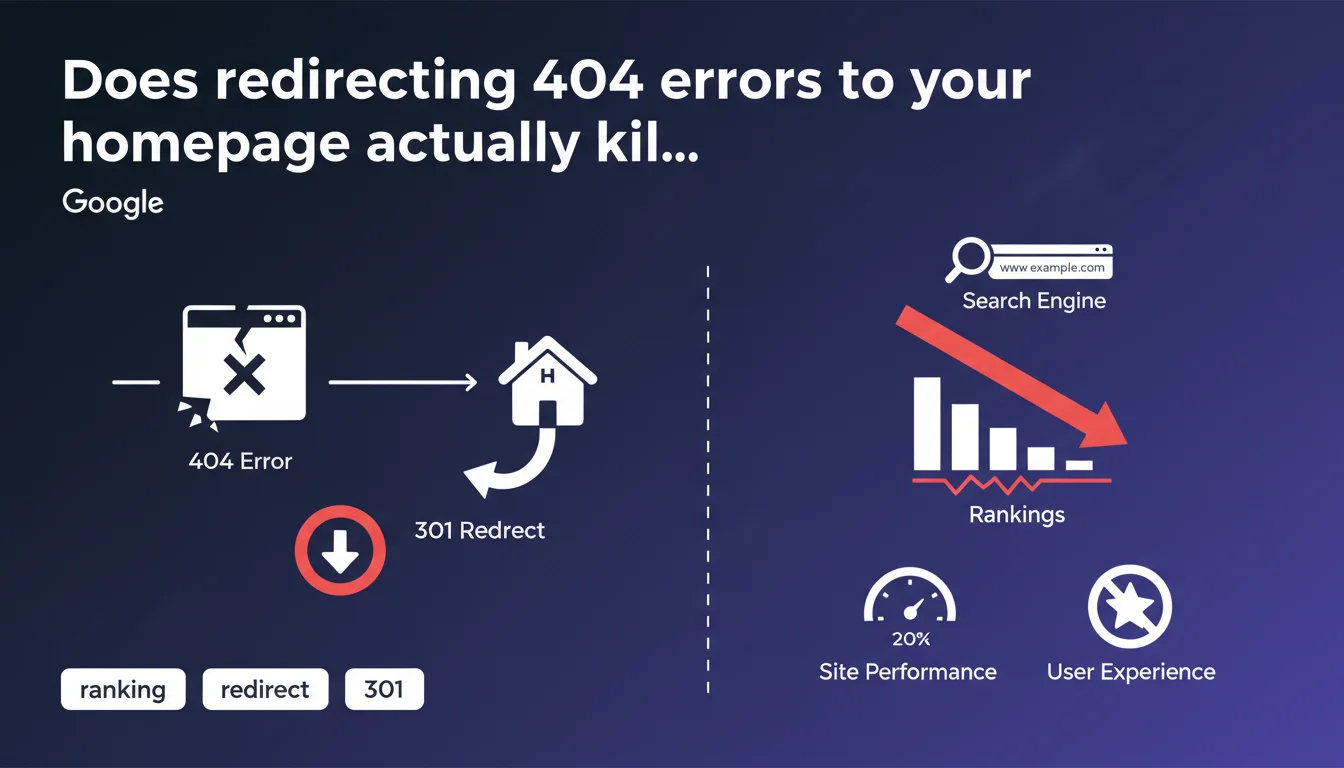
Systematically redirecting all your 404 pages to the homepage via 301 redirects degrades your rankings. Google views this practice as error masking that disrupts the understanding of your site structure and generates confusing signals for the algorithm.
What you need to understand
What makes this practice problematic for Google?
When you massively redirect non-existent pages to your homepage, you create an artificial authority signal. Google receives hundreds of backlinks pointing to dead URLs that all redirect to the same place. The search engine interprets this as an attempt at manipulation or, at minimum, as poor site architecture management.
A 301 redirect explicitly says: "This content has permanently moved to this new address". But a 404 page hasn't moved — it simply doesn't exist or no longer exists. You're technically lying to the search engine, which creates a disconnect between the declared intention and reality.
How does this approach impact your crawl budget?
Google bots follow these redirects. If you have 500 pages returning 404 that all redirect to your homepage, Googlebot will crawl your homepage 500 times thinking it's discovering different content. This is massive crawl budget waste — the limited resource Google allocates to each site.
Even worse: this pollution prevents the bot from focusing on your truly strategic pages. Instead of exploring your new content or deep pages with high added value, it goes in circles following false trails you created yourself.
What is the true purpose of a 404 page according to Google?
A 404 error is a legitimate and useful signal. It indicates that a resource is no longer available, which allows Google to progressively clean its index. It's information, not a failure to hide.
When you systematically mask these errors behind 301s, you prevent Google from doing this natural cleanup. Result: obsolete URLs stay indexed longer, your backlink profile becomes muddled, and the algorithm struggles to evaluate the true quality of your internal linking structure.
- Massive 301 redirect = artificial authority signal on the homepage
- Critical crawl budget waste on worthless URLs
- Prevents natural index cleanup by Google
- A 404 is legitimate information, not an error to hide
- Pollution of backlink and internal linking data
SEO Expert opinion
Does this statement really reflect real-world observations?
Yes, and it's been documented for years in audit cases. Sites that apply this "catch-all redirect" logic often see their crawl rate drop and their strategic pages lose visibility. But — and this is where it gets interesting — the impact varies enormously depending on scale.
On a small site with 10-20 404 pages redirecting to the homepage? The effect is marginal. On a large e-commerce site with thousands of discontinued products? It's a measurable disaster. Google provides no precise threshold, which is frustrating for establishing a clear rule. [To verify]: At what point do 404→homepage redirects become truly penalizing? No official data on that.
In what cases could this practice be justified despite everything?
Let's be honest: sometimes a redirect is better than a hard 404. If a product page disappears but you have a perfectly equivalent category, redirecting to that category (not the homepage) remains coherent. It's a matter of semantic relevance.
The real trap is technical laziness. Redirecting everything to the homepage is easy to implement — a wildcard in .htaccess and you're done. But easy ≠ effective. A granular approach (contextual redirection or properly designed 404 page) requires more work, yes, but it preserves the integrity of your SEO profile.
Is Google consistent in how it treats soft 404s versus hard 404s?
And that's where it gets tricky. Google penalizes massive 301 redirects to the homepage, but it also penalizes soft 404s — pages that return a 200 code while displaying an error message. In both cases, the complaint is the same: you're masking the reality of your structure.
But the nuance is important. A soft 404 actively deceives the bot (200 code = "everything's fine" when it's not). A 301 redirect declares a permanent move — it's technically transparent, but semantically false if the page never existed or has no legitimate successor. Google penalizes the intent to manipulate, not the technical method.
Practical impact and recommendations
What should you concretely do with your existing 404 pages?
First step: audit all your current redirects. Export the list from your configuration file (Apache, Nginx) or redirect plugin. Identify those pointing to the homepage without clear semantic reason.
For each dead URL, ask yourself this question: is there equivalent or similar content? If yes, redirect to that specific page, not the homepage. If no, delete the redirect and let the true 404 display. Yes, it takes longer. Yes, it's worth it.
- List all 301 redirects pointing to the homepage
- Identify URLs with backlinks or organic traffic history
- Create contextual redirects to relevant pages where possible
- Remove unnecessary redirects and allow true 404 responses
- Monitor new 404s via Search Console to address critical cases
How do you create a 404 page that limits SEO damage?
A good 404 page transforms the error into a natural redirection opportunity. Offer links to your main categories, a functional internal search bar, your flagship content. The user stays on your site — and Google sees you're properly managing the experience.
Technically, make sure this page returns a proper 404 HTTP code, not a 200 with an error message. Test with curl or a tool like Screaming Frog. A soft 404 is worse than a redirect to the homepage — at least the redirect is honest on the HTTP level.
What tools should you use to monitor and fix these issues at scale?
Search Console remains your primary ally. The "Coverage" tab lists pages with 404 errors, soft 404s, and redirected pages. Prioritize those still receiving backlinks — that's where you're losing SEO juice.
To automate cleanup on large sites, tools like Screaming Frog or OnCrawl let you extract all redirects and cross-reference them with your Analytics data. You quickly identify absurd patterns (e.g.: 200 discontinued product pages all redirecting to the homepage).
❓ Frequently Asked Questions
Une redirection 302 vers la page d'accueil est-elle moins pénalisante qu'une 301 ?
Combien de temps faut-il laisser une redirection 301 contextuelle en place avant de la supprimer ?
Dois-je rediriger les pages 404 qui reçoivent encore des backlinks de qualité ?
Les soft 404 sont-elles vraiment pires que les vraies 404 ?
Comment détecter si mon site redirige massivement des 404 vers l'accueil sans que je le sache ?
🎥 From the same video 5
Other SEO insights extracted from this same Google Search Central video · published on 05/03/2025
🎥 Watch the full video on YouTube →
💬 Comments (0)
Be the first to comment.