
Official statement
Other statements from this video 5 ▾
- □ Pourquoi rediriger les 404 vers la page d'accueil nuit-il au référencement ?
- □ Pourquoi Google insiste-t-il autant sur le statut 404 pour guider ses crawlers ?
- □ Faut-il vraiment arrêter de rediriger les 404 vers l'accueil ?
- □ Faut-il vraiment éviter les redirections 301 quand le contenu n'existe plus ?
- □ Faut-il vraiment arrêter de rediriger les erreurs 404 vers la page d'accueil ?
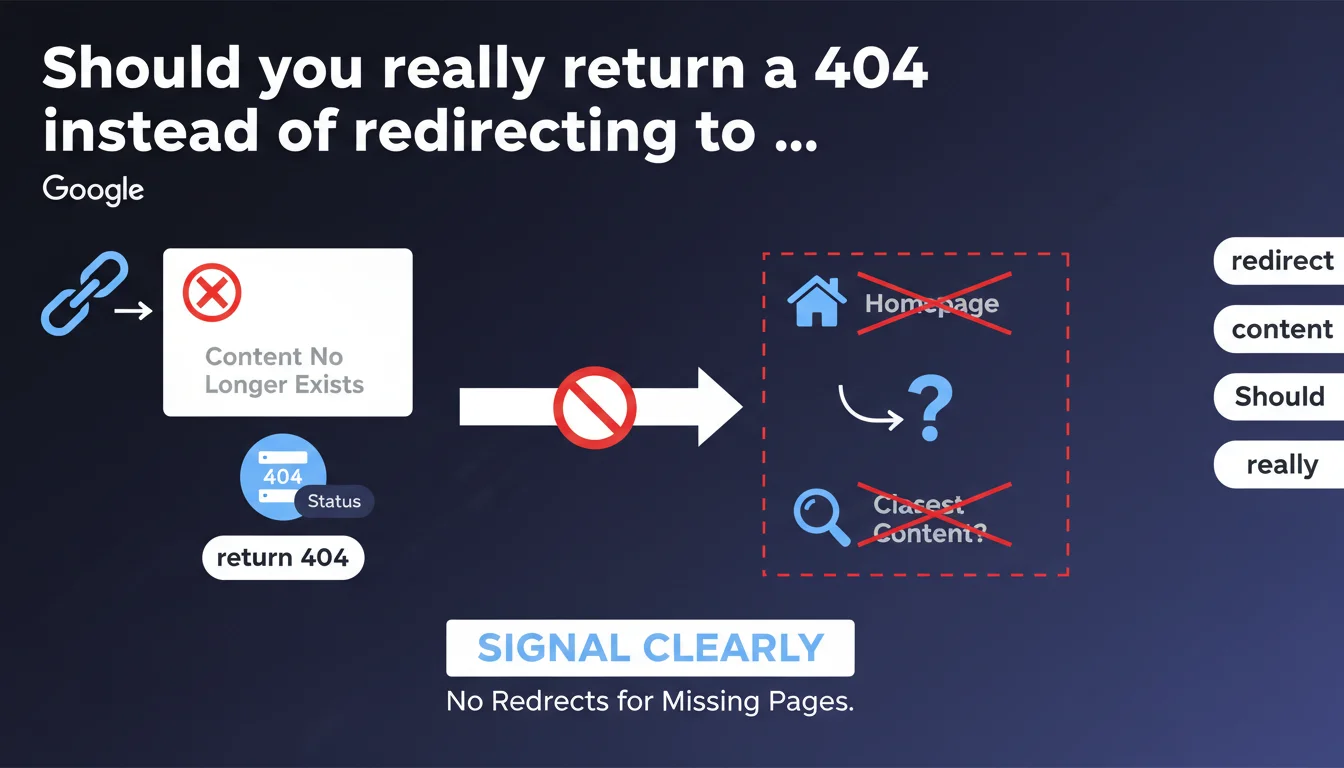
Google is categorical: if content no longer exists, return a 404. Never redirect to the homepage or approximate content « by default ». This position aims to preserve index quality and user experience, but it sometimes clashes head-on with established field practices.
What you need to understand
Why does Google insist so much on the 404?
Google crawls and indexes billions of pages. When content disappears, the search engine must be able to clean up its index efficiently. A 404 is a clear signal: « this content no longer exists, remove it ».
« Fallback » redirects to the homepage or vaguely related content muffle this signal. Google ends up indexing pages that don't match the original URL's intent. Result: index pollution, confusion for the user who lands on a page unrelated to what they were looking for.
What exactly is « approximate content »?
It's any page you redirect to by default without genuine thematic correspondence. The homepage is the typical example, but it can also be a generic category page, a « product not found » page disguised as a 200, or even a randomly chosen « similar » product sheet.
Google considers these redirects as soft 404: technically a 301/302, but pointing to unrelated content. The search engine often ends up interpreting it as a de facto 404, with all the downsides and no benefits.
In which cases is a 404 really the right answer?
Whenever the content has no direct equivalent on your site. Discontinued product without successor, deleted blog article, expired event page. If you can't offer a relevant and legitimate alternative, 404 is the only clean option.
- The 404 cleanly signals the content's disappearance to Google
- Random redirects pollute the index and degrade user experience
- A soft 404 combines the downsides of both 404 (page loss) and redirect (pollution)
- Google prefers a clear signal rather than an attempt to hide reality
SEO Expert opinion
Is Google's position consistent with what we observe in the field?
Yes, but with important nuances. On e-commerce sites, we regularly see 301s to the home generating catastrophic bounce rates. The user looking for a specific product ends up on the homepage and leaves immediately. Google picks up on this negative behavioral signal.
However — and this is where it gets tricky — some large e-commerce sites redirect massively to « close » categories and get away with it very well. [To verify]: Does Google tolerate these practices better on high-authority sites? Or do these sites compensate with other quality signals?
When does this rule not really apply?
Let's be honest: there are cases where a redirect remains the best option. If you have a true replacement content — a successor product, an updated page that addresses exactly the same subject — the 301 redirect is not only acceptable but recommended. Google even acknowledges this in other statements.
The problem is that many SEO professionals interpret « replacement content » very broadly. « Oh, my product X no longer exists, I redirect to category Y, that's close right? » No. It's not close. It's approximate, and that's exactly what Google denounces here.
Is Google oversimplifying business reality?
Clearly. In an ideal SEO world, every obsolete URL would have a legitimate successor or disappear cleanly. In the real world, business decisions (product discontinuation, catalog reorganization, brand mergers) create gray areas where neither 404 nor redirect seems perfect.
Google provides no guidance for these edge cases. What to do with a product sheet that generated 50 quality backlinks, but the product is definitely discontinued with no equivalent? The 404 kills backlink equity. A redirect to what? To nothing relevant. [To verify]: Would a custom « product discontinued » page with smart suggestions be better tolerated than a plain 404?
Practical impact and recommendations
What should you actually do with deleted content?
First and foremost, audit your current redirects. How many 301/302s point to your home or generic categories? These are your potential soft 404s. For each one, ask yourself: « Does this redirect really provide value to the user who clicks? »
If the answer is no, switch to 404. Yes, it hurts at first — you'll see errors in Search Console — but that's the price of a clean index. And it's what Google expects from you.
How to handle discontinued e-commerce products?
This is the classic use case. If the product has a direct successor (new model, updated version), the 301 redirect to that successor is perfectly legitimate. The user finds what they're looking for, Google validates thematic continuity.
If the product is discontinued with no replacement, two options: either a frank and clean 404, or — and this is more subtle — a 410 (Gone) page that explicitly signals the content is permanently deleted. The 410 accelerates deindexation compared to 404. Use it if you're certain the content won't return.
Which mistakes should you absolutely avoid?
Never redirect in bulk to the home. That's the cardinal sin. Google detects these patterns and may derank the entire site for manipulation. If you have 500 obsolete products, assume 500 proper 404s rather than a grouped redirect to the homepage.
Also avoid redirect chains: URL A → URL B → home. Google follows chains, but each link dilutes equity and increases the risk of soft 404 classification. A redirect is one hop maximum, and only to relevant content.
- Audit all existing redirects to identify potential soft 404s
- Switch to 404 or 410 any URL without legitimate replacement content
- Use 301 only to a true thematic successor, not an approximation
- Avoid grouped redirects to the home or generic categories
- Customize 404 pages with relevant suggestions (without returning a 200)
- Monitor Search Console to verify that 404s are properly treated as such
- Document redirect vs 404 decisions to maintain consistency over time
❓ Frequently Asked Questions
Un 404 fait-il perdre définitivement le jus des backlinks pointant vers la page ?
Quelle différence entre un 404 et un 410 dans le traitement par Google ?
Peut-on renvoyer un 404 avec du contenu personnalisé sans que Google le considère comme un soft 404 ?
Combien de temps faut-il à Google pour désindexer une page en 404 ?
Faut-il rediriger les URLs avec paramètres (tracking, filtres) qui génèrent des 404 ?
🎥 From the same video 5
Other SEO insights extracted from this same Google Search Central video · published on 05/03/2025
🎥 Watch the full video on YouTube →
💬 Comments (0)
Be the first to comment.