
Official statement
What you need to understand
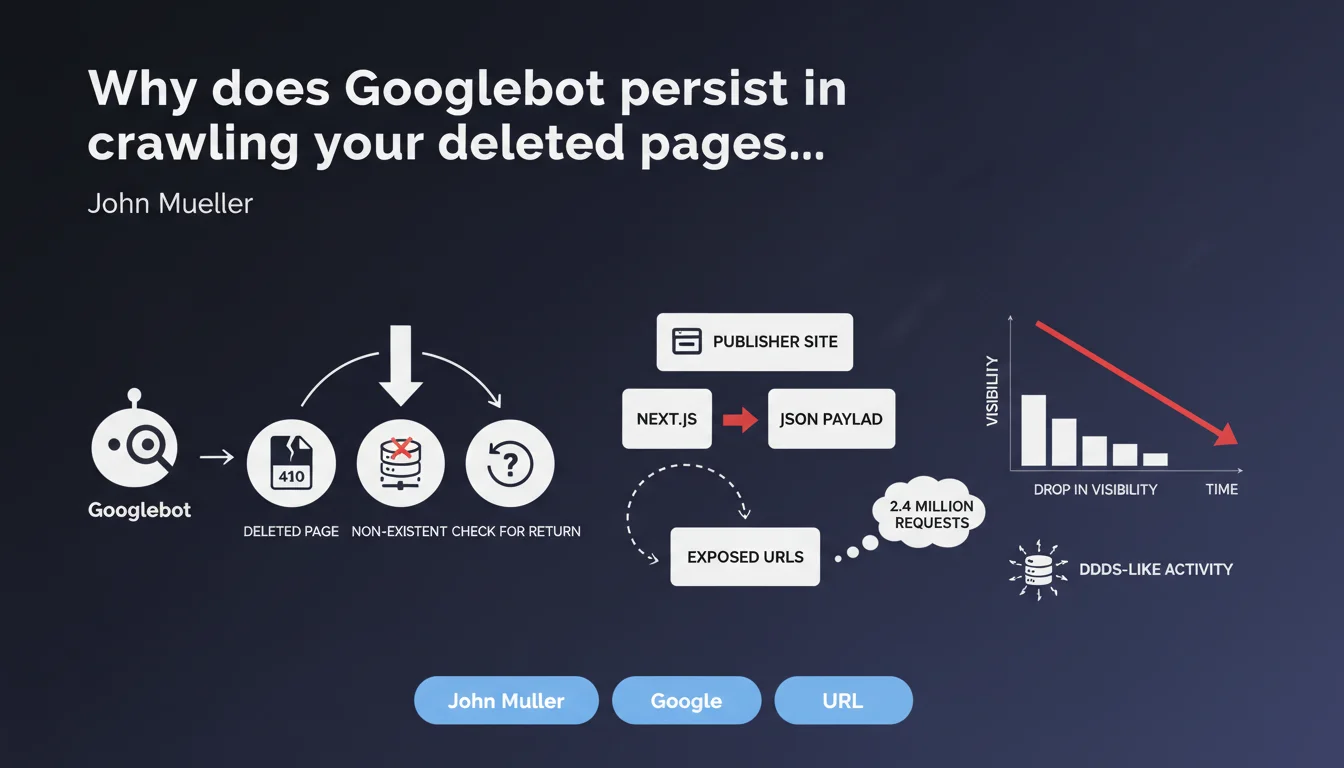
This statement reveals a little-known behavior of Googlebot: pages returning a 410 HTTP status code (Gone) are not permanently ignored by the crawler. Contrary to the common belief that a 410 signals to Google that a page is deleted forever, the bot continues to periodically check these URLs to ensure they don't come back.
The case described illustrates an extreme situation: 2.4 million requests on a single URL, causing a crawl volume close to a DDoS attack. The origin of the problem was accidental exposure of parameterized URLs via a JSON payload automatically generated by Next.js. These URLs, although inaccessible and marked 410, were discovered and indexed by Google, which then attempted to re-crawl them massively.
The instinctive reaction - blocking via robots.txt - carries major risks. Incorrect robots.txt configuration can prevent proper rendering of important pages, particularly in modern JavaScript architectures where certain resources are critical for display.
- The 410 status code does not permanently prevent crawling, contrary to expectations
- Accidental exposure of URLs (JSON, sitemaps, internal links) can trigger massive crawling
- Crawl budget can be wasted on useless pages even with 410 status
- Blocking via robots.txt requires thorough analysis of dependencies
- The correlation between excessive crawling and visibility loss is not automatic
SEO Expert opinion
Mueller's analysis is consistent with what I've observed for years: Google maintains periodic verification even on content marked as permanently deleted. This makes sense from an algorithmic perspective - sites can make mistakes, have configuration errors, or reactivate content. The search engine prefers to check rather than permanently lose track of potentially relevant content.
However, Mueller's point needs to be nuanced on one crucial aspect: he invites us not to stop at a superficial explanation. This is fundamental. In 90% of the cases I've analyzed where a publisher attributes a traffic drop to Googlebot's behavior, the real cause lies elsewhere: loss of links, content cannibalization, algorithmic update, quality issues. Excessive crawling is often a symptom, not the disease.
Practical impact and recommendations
- Audit the origin of exposure: Search your JSON payloads, built JavaScript files, XML/HTML sitemaps, and internal links for references to these problematic URLs
- Clean up exposure sources: Configure Next.js/Nuxt to exclude these patterns from builds, remove URLs from sitemaps, eliminate orphaned internal links
- Do NOT immediately block via robots.txt: First test the impact on rendering with the URL Inspection tool in Search Console for each pattern you're considering blocking
- Use the crawl-delay parameter: In Search Console, adjust crawl speed if the volume poses a real infrastructure problem (availability varies by account)
- Analyze the real cause of traffic loss: Compare in Google Analytics the pages that lost traffic vs those being over-crawled. Look for temporal correlations with algorithmic updates (Core Updates, Helpful Content)
- Post-cleanup monitoring: After removing exposure sources, crawling should naturally decrease over 15-30 days. If not, then consider targeted blocking
- Parameterized URL pattern: If your 410s come from parameters (?feature=, ?id=), configure parameter handling in Search Console to tell Google which ones to ignore
- Implement noindex before 410: For future mass deletions, first go through a noindex phase (a few weeks) before switching to 410, this reduces Google's interest in these pages
💬 Comments (0)
Be the first to comment.