
Official statement
What you need to understand
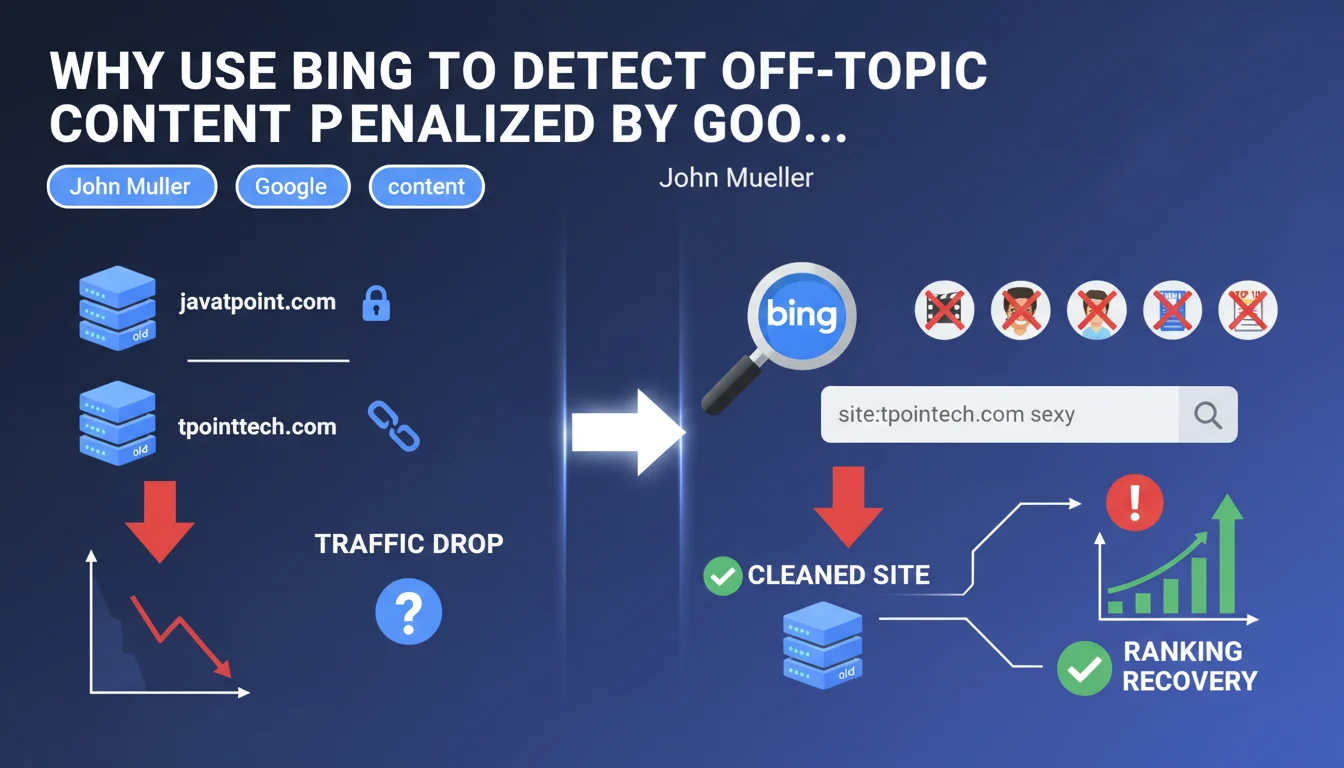
This statement reveals a counter-intuitive SEO diagnostic technique: using a competing search engine to identify content issues causing penalties on Google. In the case mentioned, an educational site suffered a drastic traffic drop after a domain migration, and the cause wasn't technical but editorial.
The problem lay in off-topic content inherited from the old domain: celebrity articles, "watch online" content, and other publications unrelated to the main educational theme. Google detected this thematic dilution and partially de-indexed the site, considering that topical authority was compromised.
The suggestion to use Bing with a query like site:example.com suspicious-keyword is based on a simple principle: Bing sometimes indexes more quickly or retains certain content longer than Google, allowing you to discover problematic pages that no longer surface easily in Google results.
- Off-topic content dilutes a site's thematic authority in Google's eyes
- Domain migrations can transfer content problems from the old to the new site
- Bing can serve as a diagnostic tool to identify indexed but problematic content
- Thematic consistency is an increasingly important ranking factor
- A post-migration traffic drop isn't always technical; it can be editorial
SEO Expert opinion
This recommendation is perfectly consistent with the evolution of Google's algorithms toward more sophisticated evaluation of thematic relevance. Since the updates focused on helpful content and E-E-A-T, Google clearly favors specialized sites demonstrating focused expertise. An educational site suddenly publishing celebrity lists sends contradictory signals that erode algorithmic trust.
Using Bing as a diagnostic tool is a pragmatic trick I've personally used in several audits. Bing often has a different crawl budget and distinct indexing priorities, which effectively allows discovery of orphaned pages, duplicate content, or problematic sections that Google has already "neutralized" in its index. However, this technique has limitations: Bing may also not have indexed certain pages, and the absence of results doesn't guarantee the absence of problems.
Practical impact and recommendations
- Conduct a complete thematic audit of your site with
site:yourdomain.comqueries combined with suspicious or off-topic terms on Bing and Google - Identify and remove (or noindex) all off-topic content that doesn't contribute value to your primary thematic authority
- Before any domain migration, analyze the complete history of the target domain via Wayback Machine, Bing, Ahrefs/Semrush to detect potential problematic prior content
- Use Search Console to cross-reference data: check which pages receive impressions for completely off-topic queries
- When taking over an existing domain, conduct an exhaustive inventory of indexed content across all search engines, not just Google
- Implement a clear "topic clustering" strategy where each site section addresses a coherent and interconnected theme
- In case of post-migration traffic drop, don't focus solely on technical aspects (redirects, speed) but investigate content quality and consistency
- Create an editorial monitoring process to ensure all newly published content aligns with the site's thematic positioning
- Absolutely avoid the temptation to publish "viral" or trending content if it falls outside your site's thematic scope
💬 Comments (0)
Be the first to comment.