
Official statement
Other statements from this video 5 ▾
- □ Does redirecting 404 errors to your homepage actually kill your search rankings?
- □ Does Google really rely on 404 status codes to guide its crawlers effectively?
- □ Is redirecting 404 errors to your homepage really killing your SEO?
- □ Should you really avoid 301 redirects when content no longer exists?
- □ Should you really return a 404 instead of redirecting to similar content?
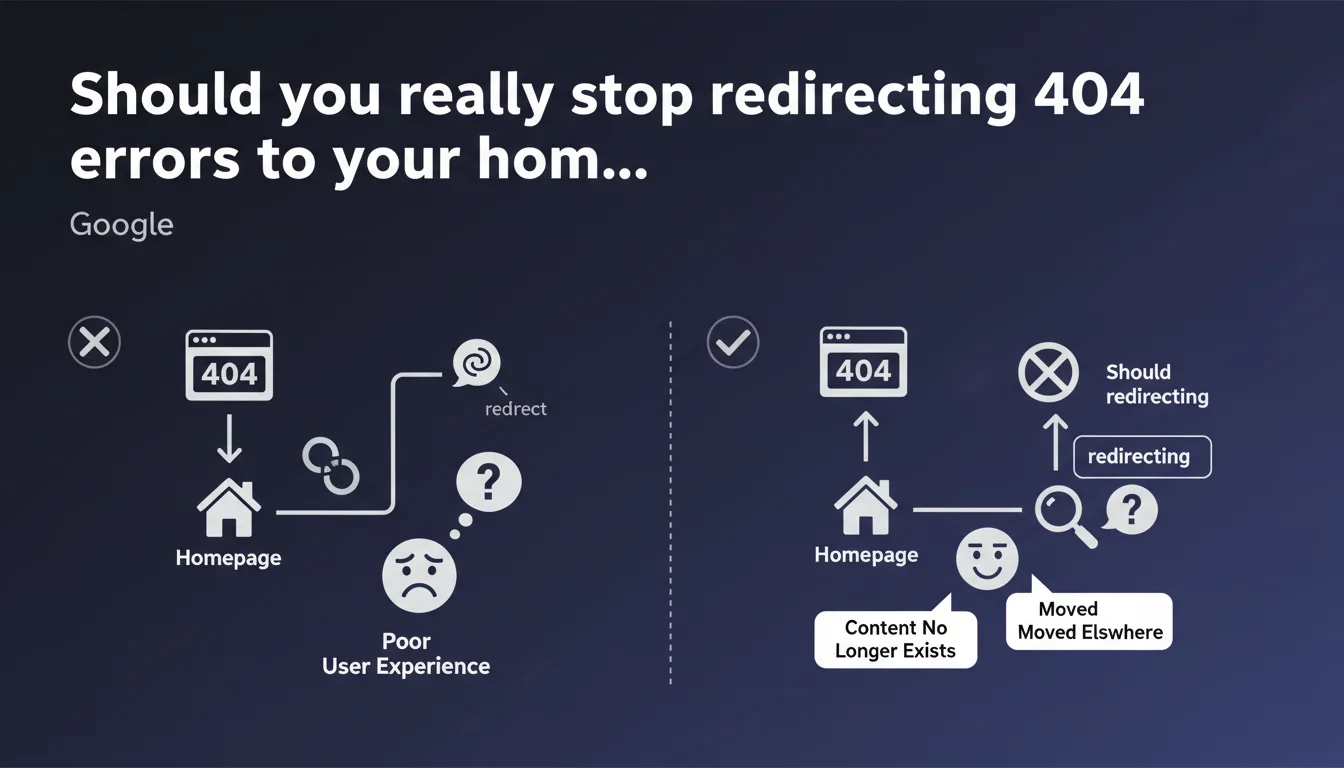
Google explicitly condemns the practice of redirecting 404 pages to your homepage. This technique harms user experience by obscuring essential information: the content users are looking for no longer exists. Users must be able to immediately understand what happened and find a relevant alternative.
What you need to understand
Why is Google making this statement now?
The systematic redirection of 404 errors to the homepage remains a common practice, often justified by a desire to "retain" the user on the site. The reasoning: rather than a frustrating error page, why not send them back to the homepage where they can navigate around.
Google has been fighting this reflex for years. The position is crystal clear: masking a 404 error by redirecting to the root of your site creates confusion. Users don't understand why they've landed on the homepage when they were looking for specific content. Worse, they don't know whether the page has moved, still exists elsewhere, or has simply disappeared.
What does a "poor user experience" concretely mean in this context?
Let's take a classic scenario: a user clicks an outdated link from the SERPs or an external backlink. They land on your homepage via a 301 redirect. No error message. No explanation. They have to guess that the content no longer exists and figure out how to find an alternative.
This friction immediately generates pogo-sticking: the user returns to the search results looking for a better source. For Google, this is a clear signal that your page didn't match their search intent. Engagement metrics plummet, and so does your credibility.
What are the SEO risks of such a practice?
Beyond user experience, mass redirects to the homepage dilute the thematic relevance of that homepage. If hundreds of disappeared pages all redirect to the root, Google receives contradictory signals about your site's main subject.
Additionally, a 301 redirect theoretically transfers PageRank — but to what? To a generic page unrelated to the original content. It's a waste of link equity, especially if the obsolete URLs had quality backlinks pointing to them.
- Transparency above all: users must know when a page no longer exists
- Degraded UX signal: pogo-sticking tells Google that your answer didn't match user expectations
- Semantic dilution: redirecting everything to the homepage confuses Google about your site's main topic
- Loss of link equity: generic redirects waste link juice from backlinks pointing to obsolete URLs
SEO Expert opinion
Does this recommendation truly reflect practices observed in the field?
Absolutely. Sites that implement 404 → homepage redirects systematically encounter high bounce rates and low session duration on their homepage. Analytics show it unambiguously: these visits are dead ends.
Now, let's be honest: many sites continue this practice because they lack a real obsolete content management strategy. It's technically simpler to redirect everything to the root than to intelligently map each dead URL to relevant replacement content.
Are there cases where redirecting to the homepage is still justified?
Very rarely. The only defensible scenario: a site that completely changes its positioning, abandons an entire editorial line, and has no equivalent content to offer. Even then, a 410 Gone page would be more honest than a redirect.
The real problem is that Google's statement remains vague on one point: what alternative should you prioritize when no relevant redirect exists? [To verify] Google doesn't explicitly say whether it prefers a custom 404 with suggestions, a 410, or a well-managed soft 404. Field observations suggest that a custom 404 with contextual navigation performs better — but Google never officially confirms this.
Does the volume of affected pages matter?
Yes, and it's critical. Redirecting 5 dead pages to the homepage on a 500-URL site likely won't cause major issues. However, on an e-commerce site with thousands of permanently out-of-stock products, redirecting everything to the homepage becomes both an UX and SEO catastrophe.
In this second case, it's better to create category pages or thematic landing pages as logical destinations. If a specific product no longer exists, redirecting to the parent category maintains semantic coherence. And if truly nothing matches — accept the 404 with intelligent suggestions.
Practical impact and recommendations
How can you properly manage obsolete content without harming UX?
The first rule: map before removing. Before deactivating a page, analyze its organic traffic, its backlinks, and identify whether equivalent or superior content exists elsewhere on your site. If yes, set up a 301 redirect to that relevant alternative.
If no alternative exists, create a custom 404 page that clearly explains the situation and offers logical navigation paths: internal search bar, links to main categories, popular content in the same theme. The goal: transform failure into a discovery opportunity.
For e-commerce sites with rapid product rotation, consider keeping product pages online with an "permanently out of stock" status and suggestions for similar products. This preserves backlinks, maintains semantic consistency, and provides real value to users.
What critical errors must you absolutely avoid?
Never redirect en masse to the homepage without individual analysis. It's the worst possible approach. Each obsolete URL deserves a customized decision based on its traffic history and backlinks.
Also avoid redirect chains: if A redirects to B which redirects to C, Google may stop following after 3-4 jumps. Always simplify by redirecting directly to the final destination.
Last common pitfall: sending an HTTP 200 code on a custom 404 page. That's a soft 404 that Google hates. Your server must absolutely return a real 404 or 410 code, even if the HTML content is custom and aesthetically pleasing.
How can you efficiently audit and fix existing issues?
Start by exporting all 404 errors detected from Google Search Console. Cross-reference this list with your analytics to identify URLs that still generate traffic despite the error — these are your priorities.
Use a crawler like Screaming Frog to map all 301 redirects to your homepage. Analyze each one: is there a better destination? Equivalent content elsewhere? If not, would it be better to leave it as a 404 with an enriched error page?
- Audit all redirects pointing to the homepage and evaluate their relevance
- Create a custom 404 page that returns a real HTTP 404 code
- Map each obsolete piece of content to a relevant alternative when one exists
- Use 301s only toward thematically coherent content
- Implement contextual suggestions on error pages
- Monitor Google Search Console to spot unintentional soft 404s
- Prefer 410 Gone codes for permanently deleted content with no alternative
- Keep out-of-stock product pages with replacement suggestions rather than deleting them
❓ Frequently Asked Questions
Une redirection 301 vers la homepage est-elle toujours considérée comme une mauvaise pratique ?
Quelle différence entre un code 404 et un code 410 pour les contenus supprimés ?
Comment éviter qu'une page 404 personnalisée soit traitée comme un soft 404 ?
Faut-il conserver les backlinks pointant vers des pages 404 ou demander leur suppression ?
Les redirections vers la homepage nuisent-elles vraiment au référencement si le taux de rebond reste acceptable ?
🎥 From the same video 5
Other SEO insights extracted from this same Google Search Central video · published on 05/03/2025
🎥 Watch the full video on YouTube →
💬 Comments (0)
Be the first to comment.