
Official statement
Other statements from this video 7 ▾
- □ Does Google really treat internal links as a UX signal for Googlebot?
- □ Does Googlebot really discover your pages through internal links?
- □ Why is the HTML <a> element with an href attribute absolutely essential for Google's crawling?
- □ Why does Google insist that links should remain real HTML links?
- □ Is your internal linking strategy hurting your SEO more than it helps?
- □ How do you strike the right balance with internal linking without overdoing it?
- □ Why does Google keep emphasizing internal links as the backbone of site crawlability and content discovery?
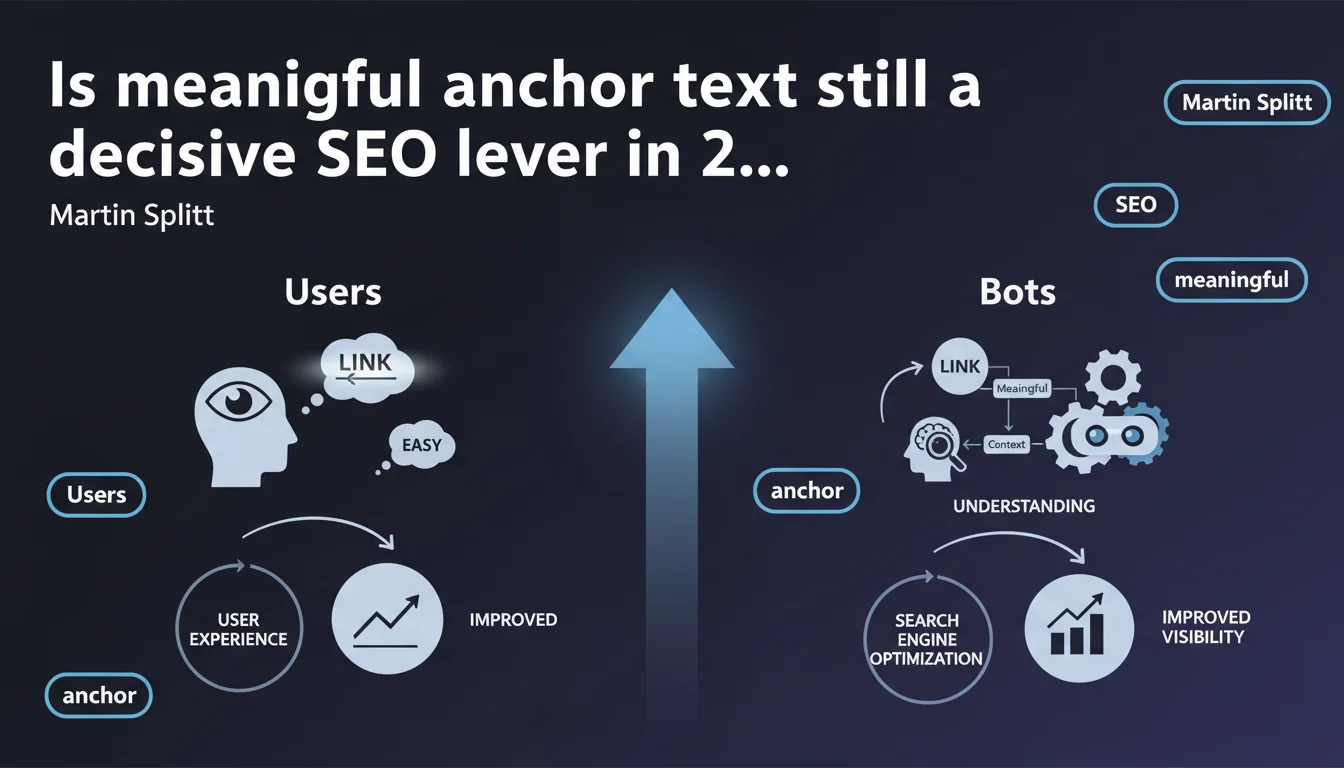
Google confirms that anchor text must be explicit and descriptive to optimize user experience and search rankings. Links with vague anchors like "click here" harm contextual understanding for both bots and visitors. This directive targets both UX and semantic signal transmission.
What you need to understand
Why is Google still emphasizing this point in 2024?
This statement reminds us of a fundamental SEO principle often overlooked: anchor text remains an essential information vector for algorithms. Martin Splitt emphasizes that bots analyze the semantic context of links to understand a site's thematic structure and the relevance of linked pages.
It's not a revelation — it's a wake-up call. Too many sites still use generic anchors that dilute the signal. Google is refocusing the debate: good anchoring benefits both audiences, human and machine.
What does "meaningful anchor text" concretely mean?
Meaningful anchor text precisely describes the link destination without being keyword-stuffed. The goal: enable the user to know where they're going before clicking, and help bots understand the semantic link between pages.
Google implicitly contrasts this practice with hollow anchors ("learn more", "here", "this link") that provide no contextual value. The text must be self-contained and explicit, even taken out of context.
What's the difference between internal linking and backlinks on this topic?
The recommendation applies to all types of links, but the impact differs. In internal linking, good anchor text guides crawl and strengthens thematic structure. For backlinks, it directly influences topical authority transmission.
Let's be honest: you control your internal anchors, rarely those of incoming links. The priority remains internal linking, where you control 100% of the signal.
- Anchor text serves as a semantic tag for Google's algorithms
- Generic anchors dilute contextual signal and harm user experience
- This directive applies to both internal linking and backlinks
- Good anchor text must be understandable out of context
SEO Expert opinion
Is this statement consistent with observed practices?
Yes, but with one major caveat: over-optimization is still penalized. Google doesn't say "stuff your anchors with exact-match keywords". Field tests show that natural variety and contextualization take priority over mechanical repetition of a target phrase.
Top-performing sites use anchors that are descriptive AND diversified. Those hammering the same exact-match anchor across 50 internal links take an over-optimization risk, even though Google never explicitly states this in this type of communication.
What limitations should be placed on this recommendation?
First point: Google remains intentionally vague on the acceptability threshold. How many times can you use the same anchor? What proportion of exact-match anchors is "natural"? [To verify] — no numerical data is provided.
Second limitation: certain UX contexts impose generic anchors (action buttons, call-to-action, mobile navigation). In these cases, visual context and semantic markup compensate for the lack of anchor text richness.
Should you rewrite all existing links?
No. Prioritize strategic pages and links pointing to your high-potential content. A linking audit often reveals that a handful of pages receive 80% of internal links — start there.
Rewriting 10,000 generic anchors at once creates a visible manipulation signal in logs. Proceed in waves, integrating these changes into a natural editorial refresh cycle.
Practical impact and recommendations
What should you audit first on your site?
Start by extracting all internal links and their anchors via a crawl (Screaming Frog, Oncrawl, Botify). Identify the most frequent generic anchors: "click here", "read more", "learn more", "here".
Cross-reference this list with your site's priority pages (conversions, organic traffic, top 3-10 positions). If these pages receive mostly links with vague anchors, you're losing signal.
How to rewrite an anchor without over-optimizing?
Ask yourself two questions: "If I read this link out of context, would I know where it leads?" and "Is this how I'd phrase it in conversation?" If the answer is no to either, rewrite it.
Favor natural phrasing that includes the target page's subject without forcing an exact keyword. Example: instead of "technical SEO", prefer "improve your site's technical structure". The signal stays clear, the anchor breathes.
What errors should you absolutely avoid?
Don't fall into the title-anchor trap (systematically copying the target page's H1 word for word). It's mechanical, repetitive, and screams automation. Vary your phrasing.
Another pitfall: overly long anchors (more than 8-10 words). They dilute the signal and harm readability. An effective anchor fits in one phrase, not a full sentence.
- Crawl the site and extract all internal link anchors
- Identify generic anchors ("click here", "learn more", "read more")
- Prioritize corrections on strategic pages (conversions, SEO traffic)
- Rewrite anchors with natural, descriptive phrasing
- Vary wording to avoid mechanical repetition of an exact keyword
- Keep anchor length to 5-8 words maximum
- Integrate changes progressively to avoid a manipulation signal
- Verify each anchor remains understandable out of context
❓ Frequently Asked Questions
Combien de fois peut-on utiliser la même ancre exacte sans risquer une pénalité ?
Faut-il modifier les ancres des backlinks reçus si elles sont trop génériques ?
Les boutons CTA avec "En savoir plus" sont-ils pénalisants pour le SEO ?
Un lien image sans texte d'ancre transmet-il du signal SEO ?
Peut-on utiliser des ancres en marque (nom du site ou de l'entreprise) sans perdre en SEO ?
🎥 From the same video 7
Other SEO insights extracted from this same Google Search Central video · published on 23/07/2024
🎥 Watch the full video on YouTube →
💬 Comments (0)
Be the first to comment.