
Official statement
What you need to understand
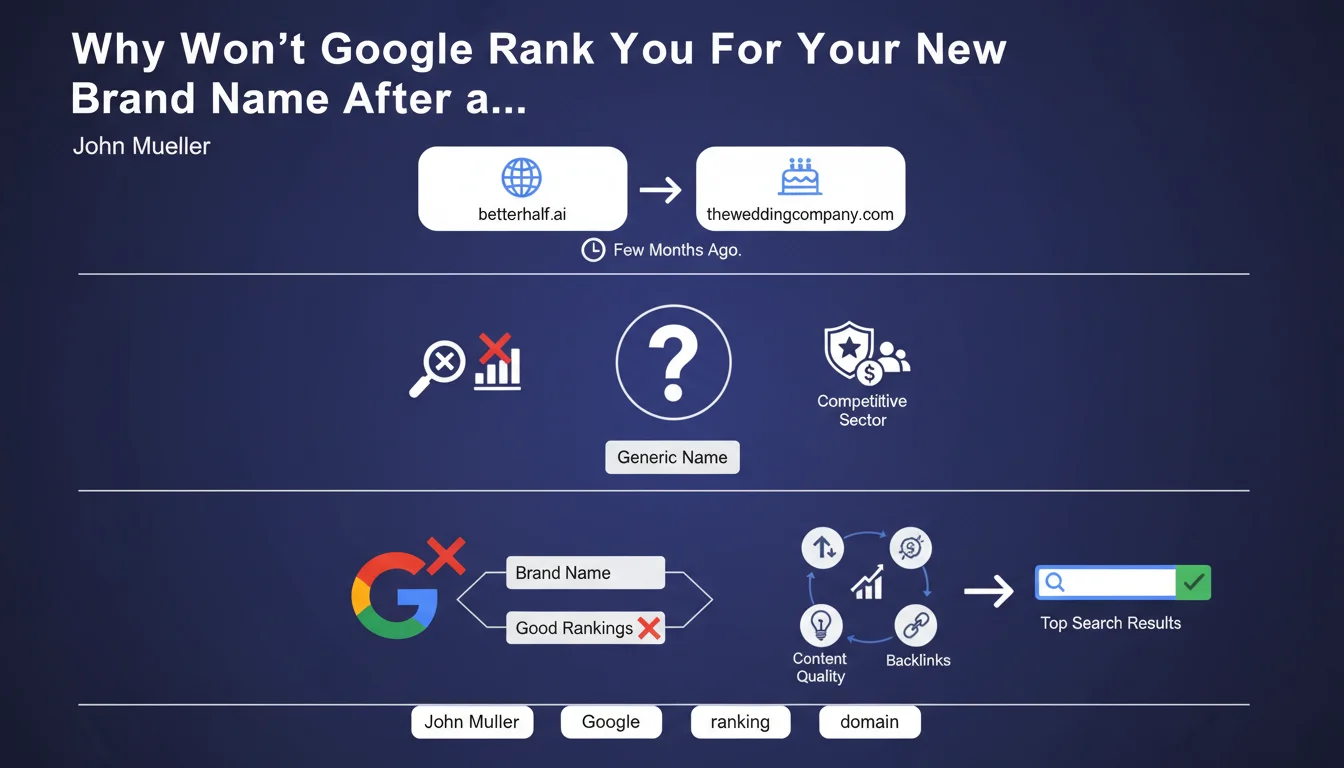
John Mueller provided an important clarification regarding a common misconception: owning a domain name does not automatically grant the right to rank for corresponding queries. In this specific case, a company that migrated from "betterhalf.ai" to "theweddingcompany.com" was surprised not to appear immediately in the top position for their new brand.
The central issue lies in the generic nature of the new brand name. "The Wedding Company" is not a distinctive term, but a combination of common keywords in a highly competitive sector. Google cannot guess that this is a specific brand rather than simply an informational search about wedding companies.
This situation illustrates a fundamental SEO principle: Google evaluates relevance and authority, not domain name ownership. A recent site, even with an exact match domain name, must prove its legitimacy before ranking.
- A domain change requires time for Google to transfer authority and reevaluate the site
- Generic names face increased competition compared to distinctive brand names
- History, brand signals, and backlinks are essential to establish yourself for a competitive term
- Simple name/domain matching does not create ranking rights
SEO Expert opinion
This statement from Mueller is perfectly consistent with what we observe daily in our SEO audits. Domain migrations, even when technically well-executed (301 redirects, Search Console updates), require several months before regaining their full potential. When you add a change to a generic name, the difficulty multiplies.
There are nevertheless important nuances to consider. If the company had built strong brand awareness before the migration (media mentions, advertising campaigns, social media presence with the new name), Google could have identified the brand signal more quickly. Similarly, a highly distinctive brand like "Betterhalf" would have had an easier time ranking than a generic term.
Practical impact and recommendations
- Before any domain change: evaluate the distinctiveness of your new brand name and the existing SEO competition for that term
- Favor unique and distinctive brand names rather than generic keyword combinations, even if they seem attractive for SEO
- Build strong brand signals: media mentions, press releases, social presence, advertisements mentioning the new name several months before migration
- Prepare a complete rebranding campaign including updating all your important backlinks, social profiles, and online citations
- Implement technical aspects perfectly: 301 redirects for 100% of URLs, Search Console and Analytics updates, Schema.org Organization markup
- Communicate extensively about the change to your customers, partners, and influencers to generate natural mentions of the new name
- Monitor ranking evolution for your new brand name and related terms for at least 12 months post-migration
- Strengthen your branded content: create dedicated pages explaining who you are, your story, your values to establish brand identity
- Avoid panicking in the first 3 months: fluctuations are normal and authority transfer takes time
These migration operations and brand signal building require sharp technical expertise and long-term strategic vision. The stakes are considerable, especially for sites generating significant revenue. Many companies find that support from a specialized SEO agency allows them to secure this critical transition, anticipate problems, and implement an optimal rebranding strategy that minimizes traffic losses while maximizing opportunities from the new positioning.
💬 Comments (0)
Be the first to comment.