
Official statement
Other statements from this video 20 ▾
- □ Do internal links in the header or footer really have less SEO value?
- □ Do you really need technical perfection to rank well on Google?
- □ Does Google really crawl your site less when it perceives low quality?
- □ Is the 'Crawled, Currently Not Indexed' status really just a sign of poor website quality?
- □ Can invalid structured data penalize your SEO performance?
- □ Should you worry when the number of indexed pages drops?
- □ Crawled vs Discovered: Are these two non-indexed statuses really the same thing?
- □ Can you really control which images Google displays in your search snippets?
- □ Is your franchise network losing visibility because of duplicate content across multiple domains?
- □ CCTLD, subdomain or subdirectory: which structure for international geotargeting?
- □ Does the 503 status code really protect your pages from deindexing during an outage?
- □ Will accidental dofollow links in your PR coverage actually hurt your rankings?
- □ Can you really use the address change tool to merge or split websites?
- □ Why are your structured data disappearing on your localized pages?
- □ Do structured data really improve rankings, or just how results are displayed?
- □ Will Google ever display Core Web Vitals badges directly in search results?
- □ Why Does Google Cause Position Fluctuations for Two Months After URL Restructuring?
- □ Does internal linking really outperform URL structure for SEO?
- □ Should you really spend time calculating internal PageRank to optimize your website?
- □ Can Google Really Identify the Main Language of a Multilingual Page Without Hurting Your SEO?
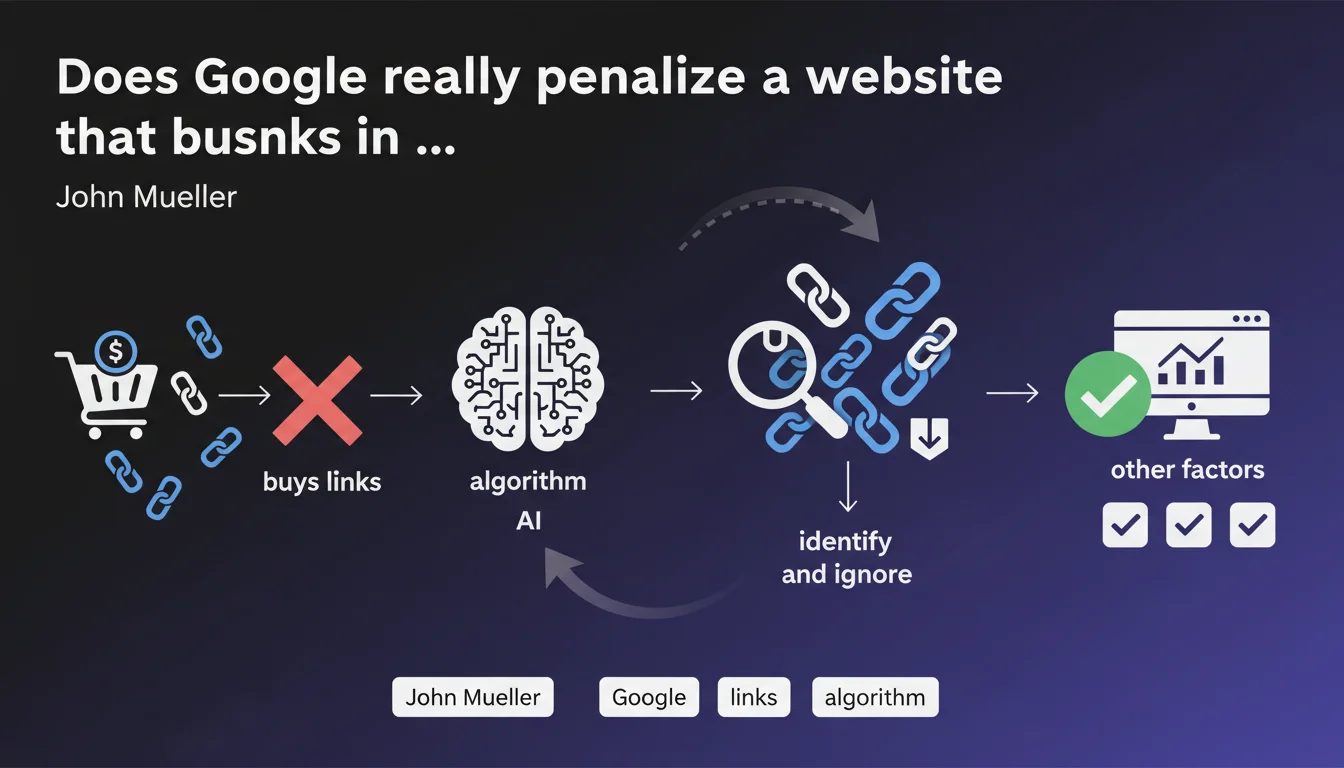
Google does not systematically apply manual penalties against sites that purchase links. Algorithms simply identify and ignore or devalue these artificial backlinks. A site can therefore perform well despite a questionable link profile, provided that its other relevance signals are sufficiently strong.
What you need to understand
What happens to a website that buys links according to Google?
Contrary to popular belief, Google does not automatically deindex a site detected purchasing backlinks. John Mueller's official position is clear: algorithms identify these artificial links and neutralize them by removing all ranking value from them.
In practice, this means the site simply does not benefit from the expected boost through these paid links. They are treated as if they don't exist — or almost. The risk of manual action still exists, but only in the most flagrant and repeated cases.
How does Google detect paid link schemes?
Algorithms analyze patterns of suspicious links: sudden growth in the number of backlinks, identical over-optimized anchors, sources from low-quality or thematically unrelated sites, revealing technical footprints.
Google also cross-references these signals with other metrics: user behavior, content quality, E-E-A-T signals. A site with solid foundations can therefore partially compensate for an artificial link profile.
Why this approach rather than systematic penalties?
Penalizing broadly would create too many false positives. Sites can involuntarily receive paid backlinks (negative SEO, links inherited from old campaigns). Google therefore prefers to neutralize algorithmically rather than penalize manually.
This logic also allows Google to manage scale: processing billions of links through algorithms is more efficient than deploying human teams to evaluate each suspicious case.
- No automatic deindexing for mass link purchasing
- Paid links are ignored or devalued algorithmically
- Manual action possible but reserved for flagrant and repeated abuse
- A quality site can perform well despite artificial backlinks if other signals compensate
- Pragmatic approach to avoid false positives at scale
SEO Expert opinion
Does this statement really reflect what happens in the field?
Yes and no. Fundamentally, Mueller's statement is consistent with observations: we regularly see sites with clearly artificial link profiles maintain their SERP positions. They simply don't benefit from the expected boost.
But this statement understates the risk of manual action. Manual actions for "unnatural link schemes" do exist, and still affect sites every month. Saying Google "will not remove a site from results" is technically correct — but a manual penalty can cause a drastic drop, which amounts to nearly the same thing.
What nuances should be added to this official position?
Mueller's statement works in an ideal context: a solid site that committed a few missteps. In this case, yes, algorithms will neutralize bad links without destroying the site.
But what about a site where 90% of the profile is artificial? If paid links are the only reason for its ranking, their neutralization equates to a sharp drop. Technically not a penalty — algorithmically, it's indistinguishable. [To verify]: Google maintains this ambiguity intentionally to discourage aggressive tactics without having to manually penalize.
Another sensitive point: Mueller speaks of algorithms capable of identifying and ignoring bad links. Let's be honest — these algorithms are not infallible. Sophisticated PBN networks still slip under the radar for months. Detection heavily depends on footprints and execution quality.
In what cases does this rule not protect?
If the site multiplies manipulation signals (link buying + spun content + cloaking + spam), algorithmic tolerance reaches its limits. At this point, manual action becomes likely.
Finally, some ultra-competitive sectors (finance, health, gambling) receive stricter examination. YMYL criteria amplify the risk that an artificial link profile triggers manual review, even if algorithms alone would have tolerated it.
Practical impact and recommendations
What should I do if my site has purchased links in the past?
First step: audit the backlink profile with tools like Ahrefs, Semrush, or Majestic. Identify suspicious links: over-optimized anchors, low-authority domains, thematically unrelated sites, PBN footprints.
Next, assess the ratio of natural to artificial links. If organic links dominate significantly and the site performs well in other dimensions (content, UX, E-E-A-T), the urgency is moderate. If the profile is mostly artificial, risk is higher.
Two options: disavow via Google Search Console (disavow file) or attempt to manually have the most toxic links removed. Disavowal remains the most scalable solution, but doesn't guarantee Google will account for all listed links.
What mistakes should you absolutely avoid in this situation?
Don't panic and disavow everything at once. Some tools flag perfectly legitimate backlinks as "toxic." An overly aggressive disavowal can destroy valid ranking signals.
Also avoid abruptly stopping all link acquisition. If the site receives no new backlinks, it creates an abnormal pattern that can trigger algorithmic re-evaluation. Better to diversify toward white-hat tactics (digital PR, linkable assets, editorial partnerships).
Finally, don't ignore the other SEO pillars believing that cleaning up links is enough. If content is poor, UX is terrible, or Core Web Vitals are in the red, the site will stagnate even with a perfect link profile.
How to build a sustainable backlink strategy after this episode?
Focus on publicly defensible tactics: creation of reference content (studies, free tools, infographics), digital press relations, guest blogging on quality media, transparent editorial partnerships.
Regularly monitor the profile via automated alerts. If a competitor launches a negative SEO campaign (toxic backlink spam), you need to react quickly with a disavow file.
- Audit the backlink profile with professional tools
- Identify suspicious links: anchors, domains, technical footprints
- Assess the ratio of natural to artificial links
- Use the disavow file for the most toxic links
- Don't disavow massively without detailed analysis
- Diversify toward white-hat tactics (PR, linkable assets)
- Monitor the profile regularly to detect negative SEO
- Strengthen other pillars: content, UX, E-E-A-T, technical performance
Mueller's statement is reassuring on paper, but shouldn't lead to inaction. An artificial link profile remains a technical SEO debt that weakens the site against future algorithmic changes.
Progressively cleaning up toxic backlinks, diversifying traffic sources, and strengthening site foundations (content, authority, UX) help reduce dependence on paid links. These optimizations can be complex to orchestrate alone, especially in competitive sectors. Working with a specialized SEO agency often allows you to benefit from precise diagnostics, professional tools, and a repositioning strategy tailored to your specific context.
❓ Frequently Asked Questions
Google peut-il détecter tous les liens achetés ?
Faut-il désavouer tous les liens marqués comme toxiques par les outils SEO ?
Un concurrent peut-il nuire à mon site en m'envoyant des liens spam ?
Les liens payants ont-ils encore une valeur en SEO aujourd'hui ?
Combien de temps faut-il pour qu'un fichier disavow soit pris en compte ?
🎥 From the same video 20
Other SEO insights extracted from this same Google Search Central video · published on 21/01/2022
🎥 Watch the full video on YouTube →
💬 Comments (0)
Be the first to comment.