
Official statement
What you need to understand
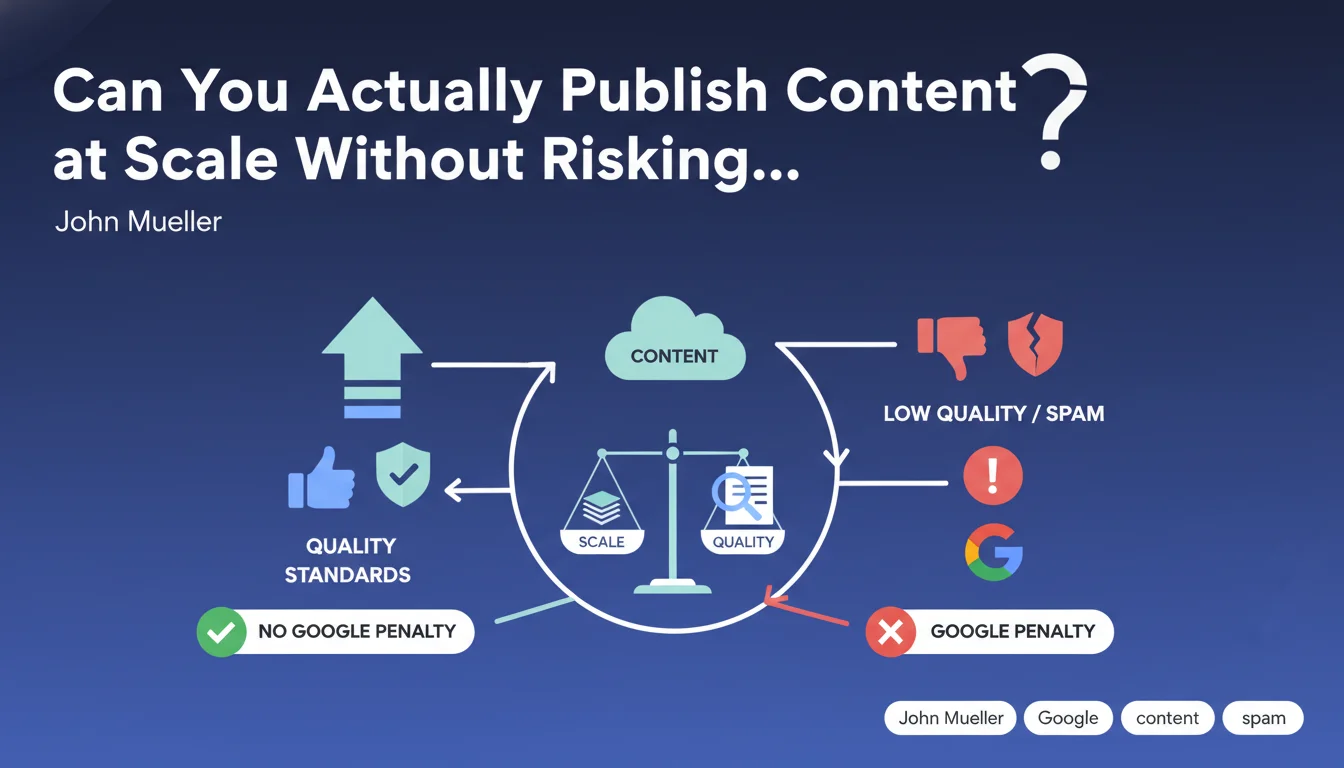
Google has recently clarified its position regarding high-volume content publication. Contrary to what many SEO practitioners might fear, publishing massively is not automatically considered spam.
The determining factor remains the quality of the content produced. Google clearly distinguishes between an ambitious editorial strategy that generates many quality pages, and a spam approach aimed solely at saturating the index with poor content.
This position represents a notable evolution compared to the 2010s, when mass publication was more perceived as a warning signal. Today, with legitimate sites naturally producing thousands of pages (e-commerce, news portals, marketplaces), Google has adapted its criteria.
- Volume is not a penalizing criterion in itself if quality is present
- Google can process thousands of new pages simultaneously without technical issues
- The definition of "quality" remains central: useful, relevant content that addresses a search intent
- This clarification does not validate content farms or automatically generated content without added value
SEO Expert opinion
This statement is consistent with field observations from recent years. Many e-commerce sites regularly add hundreds of product pages without suffering penalties, while others with just a few dozen low-quality pages are sanctioned.
The critical nuance lies in the definition of "quality". Google does not provide a precise checklist, but user behavioral signals (reading time, bounce rate, satisfaction) play a major role. Content published at scale that fails to engage visitors will be progressively demoted.
There is also a risk of topical dilution. Publishing massively without a siloing strategy and semantic coherence can weaken the site's topical authority rather than strengthen it.
Practical impact and recommendations
- Validate quality before volume: Establish strict editorial criteria and a validation process before any mass publication
- Prioritize user intent: Each page must address a real user search, not just target a keyword
- Structure your architecture: Organize content into coherent thematic silos to maintain topical authority
- Monitor engagement metrics: Implement monitoring of behavioral signals (session time, page views, interactions)
- Avoid disguised duplication: Mass pages with only minor variations remain problematic
- Plan indexation: Use crawl budget intelligently with a prioritized sitemap and controlled publication pace
- Document your editorial process: In case of quality review, demonstrate that there is a real methodology behind the production
In summary: High-volume content publication becomes a viable strategy, but it requires a solid editorial infrastructure and sharp expertise to maintain high quality standards at scale.
Implementing such a strategy often requires rethinking the entire editorial organization: validation workflows, quality assessment grids, update processes, advanced performance monitoring. To effectively structure this approach and avoid technical or editorial pitfalls, support from a specialized SEO agency can prove relevant, particularly for defining processes, training teams, and implementing management tools adapted to your specific context.
💬 Comments (0)
Be the first to comment.