
Official statement
What you need to understand
Content geolocation is a common practice for adapting the user experience according to the country of visit. Some sites display different information, products, or sidebars depending on the user's geographic location.
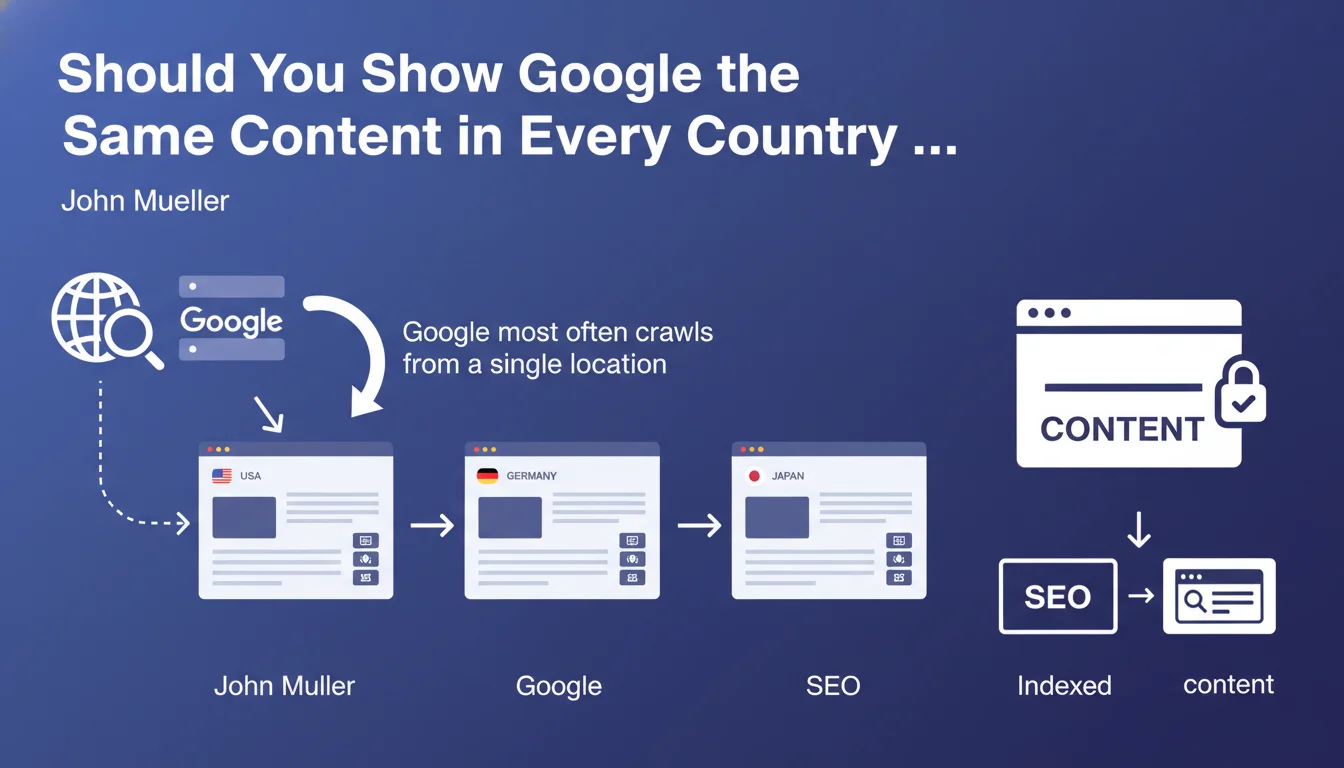
Google has clarified its position: the search engine primarily crawls from a single location, generally the United States. This means that Googlebot only sees the version of the content that is served to American visitors.
If you reserve exclusive content for certain countries without making it accessible to American robots, that content risks never being indexed. Google cannot reference what it doesn't see during its crawl.
- Crawling is done predominantly from the United States, with an American IP address
- Geolocated content invisible to the USA will probably not be indexed
- This limitation applies to main content as well as peripheral elements
- There is no penalty for geolocation, only a risk of invisibility
SEO Expert opinion
This statement is perfectly consistent with field observations. Many international sites have found that their region-specific content never appeared in search results, precisely for this reason.
However, there are important nuances to consider. Google offers localized versions of its bot (Googlebot-FR, Googlebot-DE, etc.) that can crawl from other countries, but their crawl frequency is much lower. For sites with multiple language versions and truly distinct content by country, it is crucial to structure the architecture with distinct URLs (subdomains or subdirectories) rather than serving dynamic content based solely on IP.
Practical impact and recommendations
- Audit your geolocated content: identify all elements that vary depending on the user's country
- Ensure that the main content is always visible for an American IP, even if you adapt secondary elements
- Use distinct URLs for versions that are truly different by country (example.com/fr/, example.com/de/) rather than serving dynamic content on a single URL
- Test your site with an American VPN or tools that simulate US geolocation to see what Google actually sees
- Properly implement hreflang tags if you have multiple language or regional versions with distinct content
- Never block indexable content based solely on IP geolocation without an accessible alternative
- Document your international content strategy to avoid unintentional indexation losses
In summary: Google primarily sees your site as an American visitor would see it. All essential content must be accessible in this configuration.
Implementing an optimal international architecture requires specialized expertise in technical SEO, hreflang tag management, and multilingual content strategy. These issues can quickly become complex, particularly for large-scale sites with multiple regional variations. Enlisting a specialized SEO agency can prove wise for properly structuring your international presence and guaranteeing optimal indexation in all your target markets, while avoiding common technical pitfalls.
💬 Comments (0)
Be the first to comment.