
Official statement
What you need to understand
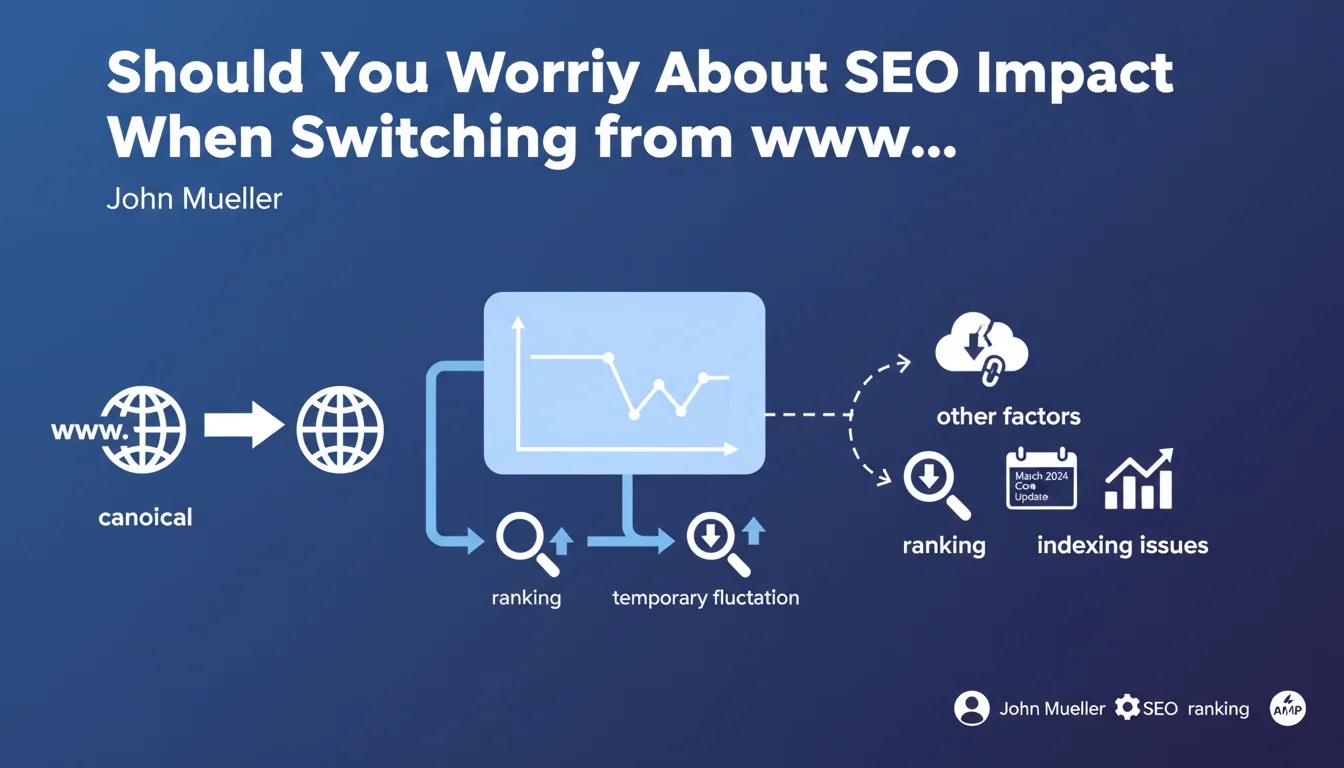
John Mueller recently provided clarifications on a topic that regularly concerns SEO professionals: switching from a www version to a non-www version of a site (or vice versa). According to him, this type of technical modification does not have a significant impact on ranking in search results.
However, he acknowledges that a temporary fluctuation in positions may occur during the transition phase. This phenomenon is normal and rankings generally stabilize quickly once Google has reprocessed all of the site's signals.
Mueller emphasizes a crucial point: if lasting traffic drops or indexing problems appear after such a change, they are probably not caused by the www/non-www modification itself, but by other concomitant factors such as an algorithmic update or technical errors.
- The choice between www and non-www is primarily a matter of technical consistency, not SEO performance
- A slight temporary fluctuation in positions is possible but should not be a concern
- Lasting traffic drops generally have other causes that need to be investigated
- Proper technical implementation (301 redirects, Search Console updates) remains essential
SEO Expert opinion
This statement from Mueller is generally consistent with what is observed in the field, but it deserves some important nuances. In most cases, a well-executed www/non-www change indeed only generates minor and temporary fluctuations.
However, experience shows that the quality of technical implementation makes all the difference. A poorly executed change can generate redirect chains, mixed canonicalization issues, or Search Console errors that will have a real impact. The devil is in the details: internal links not updated, obsolete XML sitemaps, or 302 redirects instead of 301s.
It is also true that some SEOs report problems after such changes. But in the majority of observed cases, thorough investigation reveals implementation errors or pre-existing technical issues that simply become more visible after the migration.
Practical impact and recommendations
In summary: A www/non-www change is not inherently risky for SEO, but it should be considered as a mini-technical migration requiring rigor and method.
- Before the change: Choose your preferred version and document the current architecture of your canonicalizations
- Redirect implementation: Set up permanent 301 redirects from all old URLs to the new ones (server-side, not JavaScript)
- Search Console update: Add the new version of the site and set it as the main property
- Internal consistency: Update all internal links to point directly to the new canonical version
- XML sitemaps: Generate and submit new sitemaps containing only URLs from the new version
- Technical files: Check and update robots.txt, hreflang (if applicable), and canonical tags
- Post-migration monitoring: Monitor key metrics (crawl, indexing, positions) daily for at least 4 weeks
- Backlink management: Contact important partner sites to update links pointing to your site
- If problems arise: Don't automatically blame the www/non-www change, but investigate technical errors and external factors
This type of technical migration, although presented as simple, involves numerous points of vigilance that can impact SEO if poorly managed. Coordination between different teams (development, infrastructure, marketing) and meticulous verification of each step are essential.
For medium to large sites, or when internal technical resources are limited, support from a specialized SEO agency can prove valuable. Expert guidance helps anticipate common pitfalls, implement a robust migration plan, and effectively monitor the transition to intervene quickly in case of anomalies.
💬 Comments (0)
Be the first to comment.