
Official statement
What you need to understand
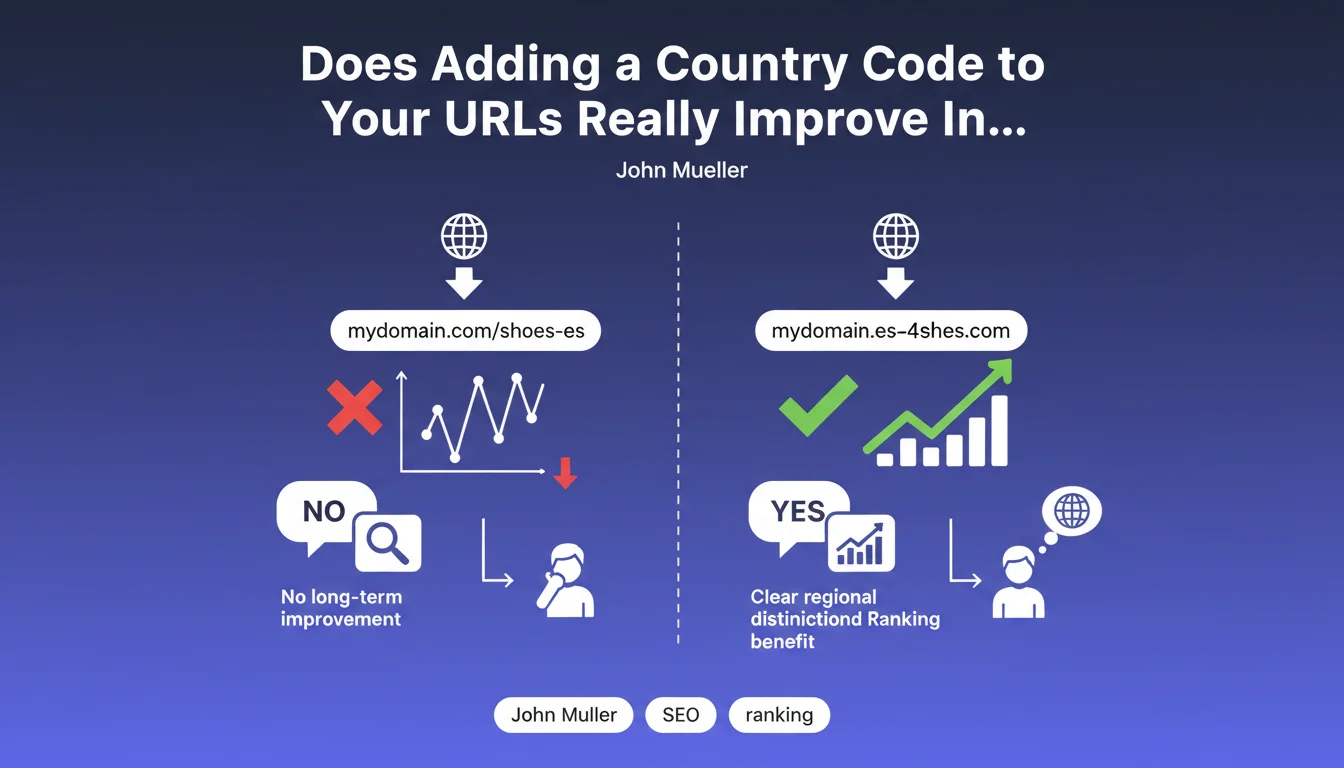
Google has just clarified a common practice in international SEO: adding a country code to the URL (such as /shoes-es, /shoes-fr) provides no tangible benefit for regional search rankings. This approach, often used to signal a linguistic or geographic version, is in reality ineffective from an algorithmic standpoint.
Worse still, modifying an existing URL structure to include these country codes can trigger temporary fluctuations in rankings. These variations are typically the result of the time Google needs to recrawl and reindex the new URLs, with no gains observed once stabilization occurs.
Google instead recommends using country-code top-level domains (ccTLDs) such as .fr, .es, .de to create a clear distinction between regional versions. This method sends a strong and unambiguous geographic signal to search engines.
- Country codes in URLs (e.g., /fr/, /es/) do not influence geographic targeting
- A URL restructuring to add these codes can cause temporary disruptions with no benefit
- ccTLDs (.fr, .es, .de) remain the most effective solution for international SEO
- This optimization is not critical for the majority of websites
SEO Expert opinion
This statement confirms what empirical testing has demonstrated for several years: Google primarily relies on hreflang tags, ccTLDs, and Google Search Console settings to determine geographic targeting. The URL structure itself is merely a cosmetic element from an algorithmic perspective.
However, there is an important nuance: even if the URL doesn't matter to Google, it can have an indirect impact on click-through rate. A French user might view a URL containing /fr/ more favorably than a generic URL. This UX and psychological aspect should not be completely overlooked, even if it doesn't directly affect the algorithm.
For multilingual sites without strict geographic targeting (for example, Spanish spoken in Spain, Latin America, United States), language-based subdirectories (/es/, /en/) remain a viable solution, provided they are combined with properly implemented hreflang tags.
Practical impact and recommendations
- Don't add country codes to your URLs if your site doesn't already contain them: it won't improve your international SEO
- Don't modify an existing URL structure solely to include country codes: the risk of fluctuations far outweighs the nonexistent benefits
- Favor ccTLDs (.fr, .es, .de) if you have the resources to manage multiple domains and geographic targeting is crucial for your business
- Use hreflang tags correctly: they are the true lever for indicating to Google the relationships between your linguistic and regional versions
- Configure geographic targeting in Google Search Console if you use generic subdomains or subdirectories
- Focus your efforts on the quality of localized content rather than on marginal structural optimizations
- If you're launching a new international site, prioritize the simplicity and consistency of your architecture rather than multiplying geographic signals
In summary: A site's international architecture requires comprehensive strategic thinking that goes well beyond simple URL structure. Between choosing ccTLDs, subdomains, or subdirectories, the technical implementation of hreflang, managing multilingual duplicate content, and configuring Search Console, the decisions to be made are numerous and interdependent.
These international SEO issues can quickly become complex, particularly when anticipating the impacts of a migration or avoiding costly mistakes in terms of time and rankings. For large-scale projects or delicate technical situations, support from an SEO agency specialized in international search optimization provides proven expertise and helps avoid common pitfalls while optimizing the allocation of your internal resources.
💬 Comments (0)
Be the first to comment.