
Official statement
What you need to understand
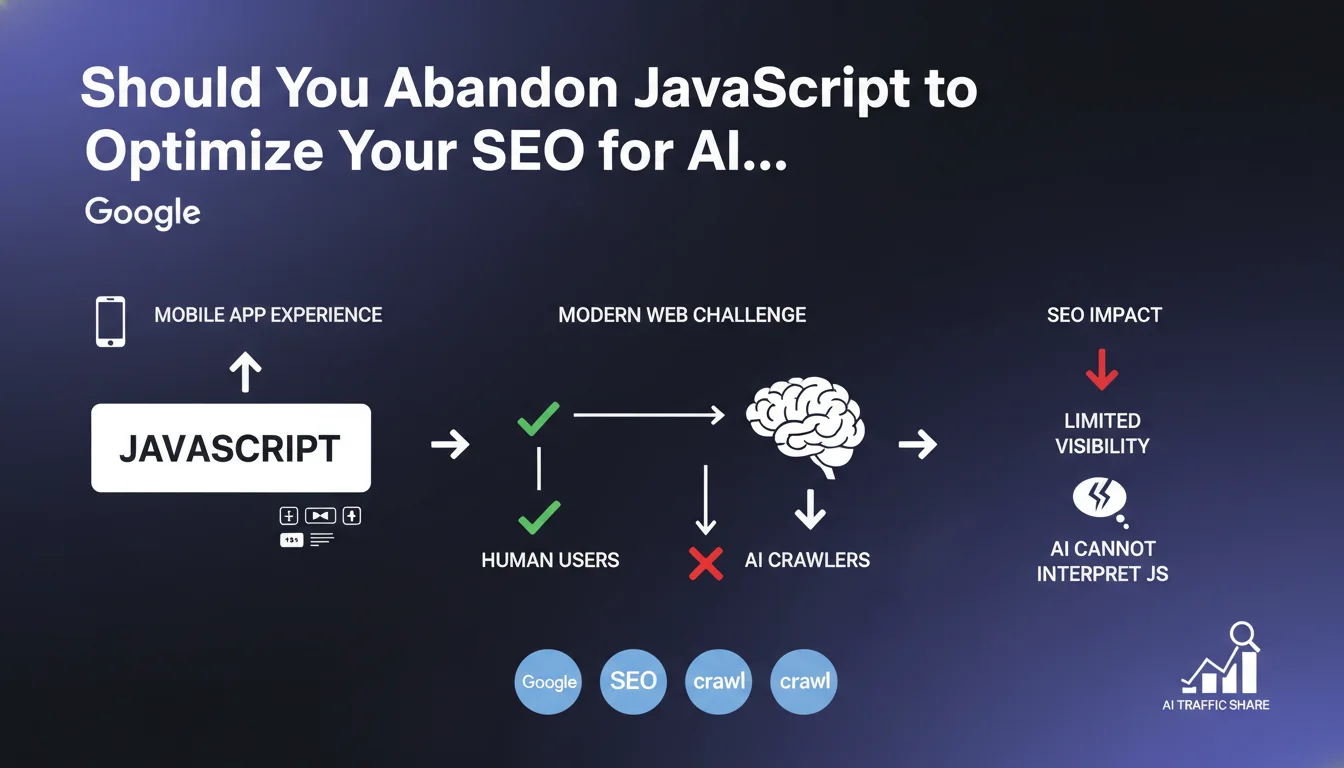
Google is warning about a major shift in the SEO ecosystem: the emergence of artificial intelligence-based crawlers that represent a growing share of web traffic.
The identified problem is that these new AI indexing bots cannot interpret JavaScript, unlike the traditional Googlebot which has evolved to support it. This technical limitation creates a gap between modern websites that rely heavily on JavaScript and the crawling capabilities of this new generation of crawlers.
This statement marks a turning point in web architecture strategy for SEO. For years, the industry has adapted to JavaScript rendering by Google, but the arrival of multiple AI search engines (ChatGPT Search, Perplexity, etc.) is changing the game.
- AI crawlers don't have the JavaScript rendering capabilities of Googlebot
- Excessive use of JavaScript can hide your content from these new players
- Static HTML is once again becoming a competitive advantage for visibility
- This evolution affects all sites, particularly single-page applications (SPAs)
SEO Expert opinion
This statement is consistent with the observable market evolution. AI crawlers indeed prioritize crawling speed and massively consume raw HTML content. Their business model doesn't justify investment in complex JavaScript rendering engines.
Important nuance: this doesn't mean you should abandon JavaScript, but rather adopt a smart hybrid approach. Server-side rendering (SSR) or static site generation (SSG) allow you to reconcile modern user experience with compatibility across all crawlers.
E-commerce sites and media outlets that depend on client-side rendering exclusively are most at risk. On the other hand, sites already optimized with SSR or using frameworks like Next.js or Nuxt are better positioned.
Practical impact and recommendations
- Test your site with JavaScript disabled to identify content invisible to AI crawlers
- Prioritize server-side rendering (SSR) or static site generation (SSG) for your critical content
- Gradually migrate Single Page Applications (SPAs) to hybrid architectures
- Implement pre-rendering for key pages if a complete overhaul isn't feasible
- Avoid JavaScript lazy-loading for the main text content of your pages
- Ensure your SEO metadata (title, meta description, structured data) is available in the initial HTML
- Use modern frameworks (Next.js, Nuxt, Astro) that natively handle SSR/SSG
- Monitor crawl logs to identify new user-agents from AI crawlers visiting your site
These technical optimizations require deep expertise in web architecture and can significantly impact your technology stack. Migrating an SPA to an SSR/SSG solution requires rigorous planning and in-depth knowledge of modern SEO issues. To guarantee a transition without loss of visibility and maximize your compatibility with all crawlers, support from an SEO agency specialized in technical challenges can prove decisive in orchestrating this strategic evolution.
💬 Comments (0)
Be the first to comment.