
Official statement
Other statements from this video 20 ▾
- □ Les liens internes dans le header ou le footer ont-ils moins de valeur SEO ?
- □ Google pénalise-t-il vraiment un site qui achète des liens en masse ?
- □ Faut-il vraiment viser la perfection technique pour bien ranker sur Google ?
- □ Pourquoi Google crawle-t-il moins votre site s'il le trouve de mauvaise qualité ?
- □ Le statut « Crawlée, actuellement non indexée » est-il vraiment un signal de qualité insuffisante ?
- □ Les données structurées invalides peuvent-elles pénaliser votre référencement ?
- □ Faut-il s'inquiéter d'une baisse du nombre de pages indexées ?
- □ Crawlée non indexée vs Découverte non indexée : vraiment équivalent ?
- □ Peut-on vraiment contrôler les images affichées dans les snippets Google ?
- □ Pourquoi Google pénalise-t-il le contenu dupliqué entre sites de franchises ?
- □ CCTLD, sous-domaine ou sous-répertoire : quelle structure pour le géociblage international ?
- □ Le code 503 protège-t-il vraiment vos pages de la désindexation en cas de panne ?
- □ Les liens dofollow accidentels dans vos RP vont-ils vous pénaliser ?
- □ Peut-on vraiment utiliser l'outil de changement d'adresse pour fusionner ou diviser des sites ?
- □ Pourquoi vos données structurées disparaissent-elles sur vos pages localisées ?
- □ Google va-t-il un jour afficher les Core Web Vitals directement dans les résultats de recherche ?
- □ Restructuration d'URL : pourquoi Google provoque-t-il des fluctuations pendant deux mois ?
- □ Le linking interne surpasse-t-il vraiment la structure d'URL pour le SEO ?
- □ Faut-il vraiment calculer le PageRank interne pour optimiser son site ?
- □ Google peut-il vraiment identifier la langue principale d'une page multilingue sans pénaliser votre SEO ?
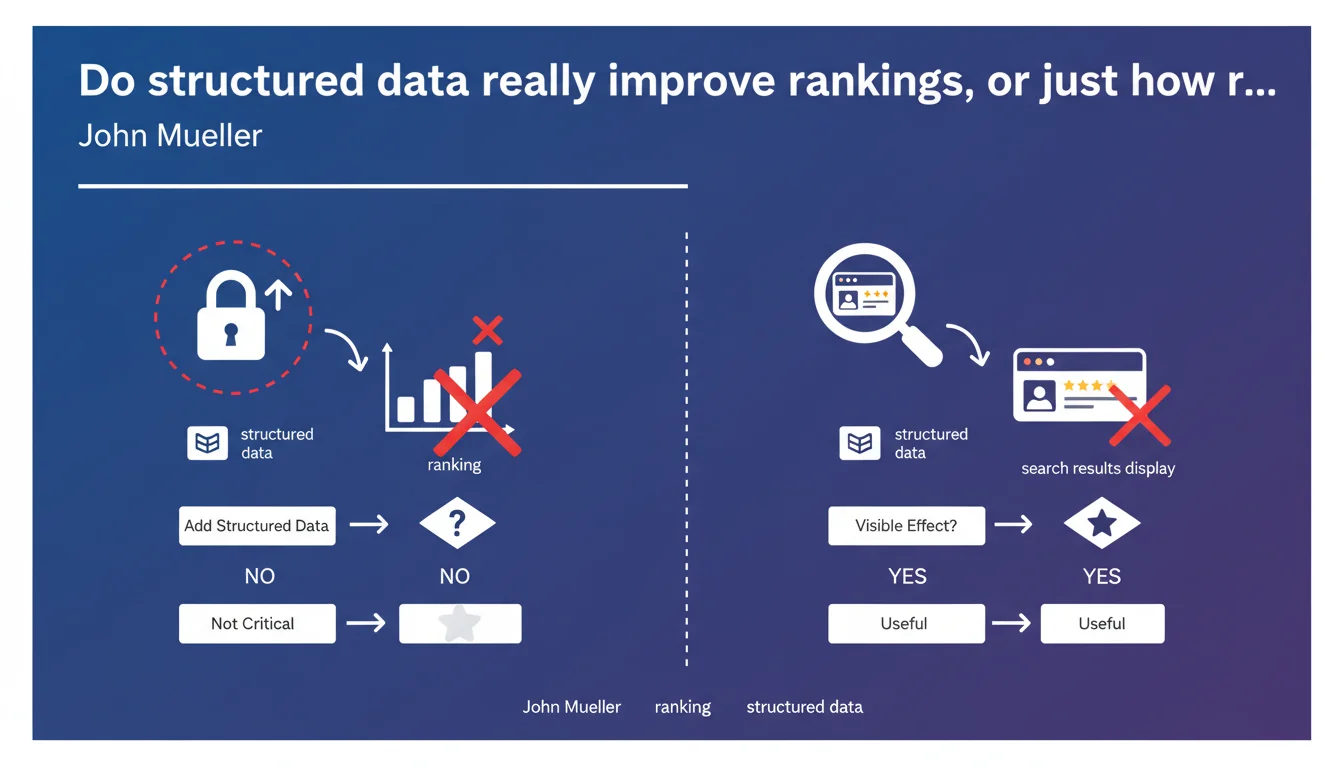
Google claims that structured data does not influence page ranking. Their utility is limited to visual effects in search results (rich snippets, stars, FAQs). If they generate no specific display, their implementation is not a priority according to Mueller.
What you need to understand
What is the real function of structured data for Google?
Google presents structured data as a visual enrichment tool for search results, not as a ranking lever. Their role is limited to facilitating the display of rich snippets — rating stars, prices, availability, expandable FAQs, enriched breadcrumbs.
This position contrasts with the ground-level perception of many SEO professionals who observe an indirect correlation: a page with rich snippets often generates more clicks, which can influence CTR and potentially ranking through user engagement signals. But Google denies any direct algorithmic impact.
Why does Mueller insist on the absence of ranking impact?
This statement aims to manage expectations and prevent webmasters from seeing structured data as a magic solution for climbing SERPs. Google wants to clarify that marking up content without it appearing in results (because it's ineligible, poorly implemented, or not relevant) serves no purpose.
It's also a way to remind that visual enrichment depends on strict criteria — well-formed schema.org, relevant content, compliance with guidelines. Adding JSON-LD randomly will trigger no special display if Google judges the markup inadequate or misleading.
In what cases do structured data produce a visible effect?
- Schema Product: display of price, availability, rating stars on e-commerce product listings
- Schema Recipe: preparation time, calories, user ratings for recipes
- Schema FAQ/HowTo: expandable blocks directly in results, capturing attention
- Schema Organization/LocalBusiness: enriched knowledge panel, logo, contact details
- Schema Event: dates, locations, practical information displayed in enriched cards
- Schema Article: news carousel, publication dates visible
SEO Expert opinion
Is this statement consistent with field observations?
Partially. On paper, Google separates ranking and display — this is technically defensible. But SEO professionals observe that a performing rich snippet mechanically boosts CTR, and a high CTR can strengthen a page's position on competitive queries.
So saying that structured data « don't change ranking » is legally accurate, but strategically reductive. A well-designed rich snippet captures more clicks than a standard result, which indirectly influences ranking through engagement metrics. Google plays here on a semantic distinction between « direct algorithmic impact » and « indirect impact through user behavior ».
What nuances should be added to this claim?
Mueller says « if they are not displayed, their addition is not critical ». This is true for generic schema.org that triggers nothing. But certain types of structured data remain useful even without visible display — for example, Schema Breadcrumb can influence the breadcrumb trail displayed by Google, or Schema SiteNavigationElement can help the engine better understand site architecture.
Moreover, Google does not systematically communicate about all the signals it exploits. [To verify]: field tests suggest that certain schemas (Organization, WebSite with sitelinks searchbox) can influence the display of specific features in SERPs or knowledge panels, even if the effect is not immediately visible as a classic rich snippet.
In what cases does this rule not really apply?
For e-commerce sites, ignoring Product structured data on the pretense that they « don't change ranking » would be a major strategic mistake. Without them, it's impossible to obtain stars and prices in Google Shopping results or organic results — essentially a competitive handicap against competitors who display them.
Same for recipe sites, events, or FAQs: rich snippets generate a significantly higher click-through rate, which translates to more traffic. Saying it's « not critical » amounts to ignoring real business impact.
Practical impact and recommendations
What should you concretely do with structured data?
First, identify eligible schemas for enriched display in your industry. Google provides comprehensive documentation on supported rich result types — consult the gallery of rich results to see what applies to your content.
Next, implement these schemas in JSON-LD (format recommended by Google) on relevant pages. Use the rich results test tool to verify that the markup is valid and eligible. If errors appear, correct them before production deployment.
Finally, monitor actual display in SERPs via Google Search Console (« Enhancements » report). If a schema is correctly implemented but never appears, it's either because Google doesn't find it relevant, or the page doesn't rank high enough to trigger display (some rich snippets only appear in top 3-5 results).
What errors should you avoid during implementation?
- Don't mark up invisible content for users — Google penalizes misleading markup
- Avoid multiplying schemas without coherence — better 2-3 well-done types than 10 poorly done
- Don't neglect validation — malformed JSON-LD will trigger no display and may generate Search Console errors
- Don't expect magical ranking effect — structured data serves display, not raw positioning
- Don't ignore specific guidelines for each schema type (e.g., Product requires a valid price, Recipe needs an image, etc.)
How do you verify that your markup produces the expected effect?
Use Google's rich results test tool to technically validate the markup. This tool indicates whether the schema is eligible for specific display and lists errors or warnings to fix.
Next, monitor the « Enhancements » report in Google Search Console: it shows which types of rich snippets are detected, how many pages are eligible, and if there are issues. Compare impressions and CTR of pages with/without rich snippets to measure actual traffic impact.
❓ Frequently Asked Questions
Les données structurées influencent-elles le classement Google ?
Faut-il ajouter des structured data même si elles ne s'affichent pas ?
Quels types de données structurées génèrent le plus d'impact visuel ?
Peut-on être pénalisé pour un mauvais balisage de données structurées ?
Comment savoir si mes données structurées fonctionnent correctement ?
🎥 From the same video 20
Other SEO insights extracted from this same Google Search Central video · published on 21/01/2022
🎥 Watch the full video on YouTube →
💬 Comments (0)
Be the first to comment.