
Official statement
Other statements from this video 20 ▾
- □ Do internal links in the header or footer really have less SEO value?
- □ Does Google really penalize a website that buys links in bulk?
- □ Do you really need technical perfection to rank well on Google?
- □ Does Google really crawl your site less when it perceives low quality?
- □ Is the 'Crawled, Currently Not Indexed' status really just a sign of poor website quality?
- □ Can invalid structured data penalize your SEO performance?
- □ Should you worry when the number of indexed pages drops?
- □ Crawled vs Discovered: Are these two non-indexed statuses really the same thing?
- □ Can you really control which images Google displays in your search snippets?
- □ Is your franchise network losing visibility because of duplicate content across multiple domains?
- □ CCTLD, subdomain or subdirectory: which structure for international geotargeting?
- □ Does the 503 status code really protect your pages from deindexing during an outage?
- □ Will accidental dofollow links in your PR coverage actually hurt your rankings?
- □ Can you really use the address change tool to merge or split websites?
- □ Why are your structured data disappearing on your localized pages?
- □ Do structured data really improve rankings, or just how results are displayed?
- □ Why Does Google Cause Position Fluctuations for Two Months After URL Restructuring?
- □ Does internal linking really outperform URL structure for SEO?
- □ Should you really spend time calculating internal PageRank to optimize your website?
- □ Can Google Really Identify the Main Language of a Multilingual Page Without Hurting Your SEO?
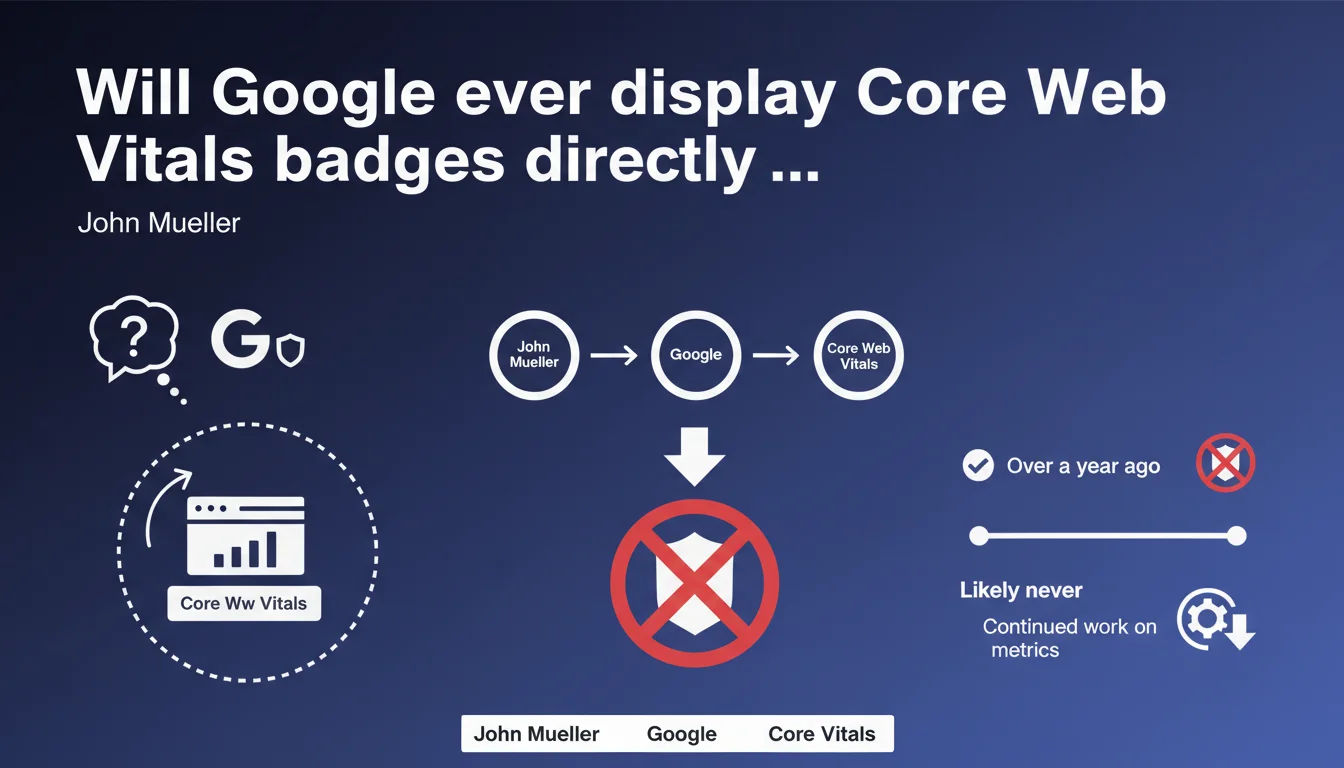
Google will likely never display a Core Web Vitals or Page Experience badge in the SERPs, despite tests conducted over a year ago. The company continues to improve these metrics internally, but has no intention of making them a visual signal for users. Core Web Vitals remain a ranking criterion, but Google prefers not to make it explicit in the search interface.
What you need to understand
Why did Google abandon the idea of a visible badge in search results?
The announcement by John Mueller closes a debate that had been dragging on since experiments from the previous year. At that time, Google had tested displaying visual indicators signaling sites offering a good Page Experience.
The problem? These badges created confusion between ranking criterion and quality guarantee. Displaying a badge for "fast" or "good experience" could have led people to believe it was the only important criterion — which is far from the case in Google's algorithm.
Are Core Web Vitals still a ranking factor?
Yes, and that hasn't changed. The Core Web Vitals (LCP, FID, CLS) remain integrated into Google's ranking system, just like mobile compatibility or the HTTPS protocol.
What Google refuses is to transform them into a visible signal for the user. The algorithm uses them, but without making them a label in the interface. It's consistent with Google's philosophy: not to reveal its criteria too explicitly to avoid manipulation.
What does "Google continues to work on these metrics" mean?
Mueller clarifies that Google isn't abandoning Core Web Vitals, quite the opposite. The company is continuously refining how this data is collected, measured, and weighted in the algorithm.
Concretely, this means that thresholds can evolve, new metrics can appear (like INP, which replaces FID), and the relative importance of these signals can fluctuate. But all of this remains in the engine, not in the user interface.
- No visible badge in the SERPs, even if tests existed
- Core Web Vitals remain an active ranking criterion
- Google continuously refines these metrics without exposing them publicly
- Page Experience will never be a label displayed like "news" or "video"
- This avoids transforming one criterion among many into an absolute quality signal
SEO Expert opinion
Is this statement consistent with practices observed in the field?
Absolutely. Since the rollout of the Page Experience Update, no SEO professional has observed a sharp correlation between a good CWV score and a jump in rankings. Gains exist, but they are marginal and often lost among other signals.
Google has always been vague about the real impact of Core Web Vitals. Saying "it's a criterion" without ever specifying its weight is convenient to prevent everyone from rushing into it while neglecting content or backlinks. [To verify]: the real impact according to niches — some sectors seem more sensitive than others.
Why is this decision strategically logical for Google?
Displaying a badge would have created a perverse effect: sites would have optimized their technical metrics to earn the badge, at the expense of actual experience. A site can have excellent Lighthouse scores and still be unpleasant to use.
Google prefers to keep the algorithm opaque. This allows it to adjust the dials without causing panic or over-optimization. And it avoids public debates like "my competitor has the badge, why don't I?" — a nightmare in terms of support and communication.
Should we conclude that Core Web Vitals are secondary?
No. But we need to stop treating them as a miracle criterion. Let's be honest: if your site has mediocre content, few backlinks, and poor search intent match, fixing your CLS won't change anything.
However, in a context where content is equal, between two similar sites, the one offering better technical experience will have a slight advantage. It's a tie-breaker, not a game-changer. And that's what Google has always said — without ever saying it quite so clearly.
Practical impact and recommendations
Should we continue optimizing Core Web Vitals without a visible badge?
Yes, absolutely. The absence of a badge doesn't mean these metrics are useless. They remain integrated in the ranking algorithm and, more importantly, they directly influence user behavior.
A slow or visually unstable site generates more bounces, less engagement, and these behavioral signals are captured by Google. So even without a badge, a good CWV score contributes to better SEO indirectly.
What mistakes should you avoid when optimizing Core Web Vitals?
The first mistake: optimizing only for tools (Lighthouse, PageSpeed Insights) without testing the real experience. Labs give scores, but it's the field data (CrUX data) that matters to Google.
Second mistake: sacrificing essential features to gain a few points. If your site needs a carousel or a header video to convert, keep them — but optimize them. Don't kill your conversion rate for a perfect score.
What should you implement concretely to stay performant?
Focus on projects that have double impact: SEO technique and user experience. Prioritize optimizations that improve both your metrics and your conversion rate.
- Monitor your field data via Google Search Console (Core Web Vitals report), not just lab tests
- Optimize LCP as a priority: fast server, optimized images (WebP, lazy loading), CDN if necessary
- Reduce CLS by fixing image dimensions and avoiding late dynamic insertions
- Prepare for the shift from FID to INP: optimize overall responsiveness, not just the first click
- Don't overlook other criteria: quality content, backlinks, and search intent match remain priorities
- Regularly test the real experience on mobile, where performance issues are most visible
❓ Frequently Asked Questions
Google va-t-il réintroduire un badge Core Web Vitals dans le futur ?
Les Core Web Vitals sont-ils encore un critère de classement officiel ?
Pourquoi Google refuse-t-il d'afficher un badge de performance dans les résultats ?
Faut-il privilégier les scores Lighthouse ou les données terrain (CrUX) ?
L'optimisation des Core Web Vitals a-t-elle un impact mesurable sur le trafic ?
🎥 From the same video 20
Other SEO insights extracted from this same Google Search Central video · published on 21/01/2022
🎥 Watch the full video on YouTube →
💬 Comments (0)
Be the first to comment.