
Official statement
Other statements from this video 20 ▾
- □ Do internal links in the header or footer really have less SEO value?
- □ Does Google really penalize a website that buys links in bulk?
- □ Do you really need technical perfection to rank well on Google?
- □ Does Google really crawl your site less when it perceives low quality?
- □ Is the 'Crawled, Currently Not Indexed' status really just a sign of poor website quality?
- □ Can invalid structured data penalize your SEO performance?
- □ Should you worry when the number of indexed pages drops?
- □ Crawled vs Discovered: Are these two non-indexed statuses really the same thing?
- □ Can you really control which images Google displays in your search snippets?
- □ Is your franchise network losing visibility because of duplicate content across multiple domains?
- □ CCTLD, subdomain or subdirectory: which structure for international geotargeting?
- □ Does the 503 status code really protect your pages from deindexing during an outage?
- □ Will accidental dofollow links in your PR coverage actually hurt your rankings?
- □ Can you really use the address change tool to merge or split websites?
- □ Why are your structured data disappearing on your localized pages?
- □ Do structured data really improve rankings, or just how results are displayed?
- □ Will Google ever display Core Web Vitals badges directly in search results?
- □ Does internal linking really outperform URL structure for SEO?
- □ Should you really spend time calculating internal PageRank to optimize your website?
- □ Can Google Really Identify the Main Language of a Multilingual Page Without Hurting Your SEO?
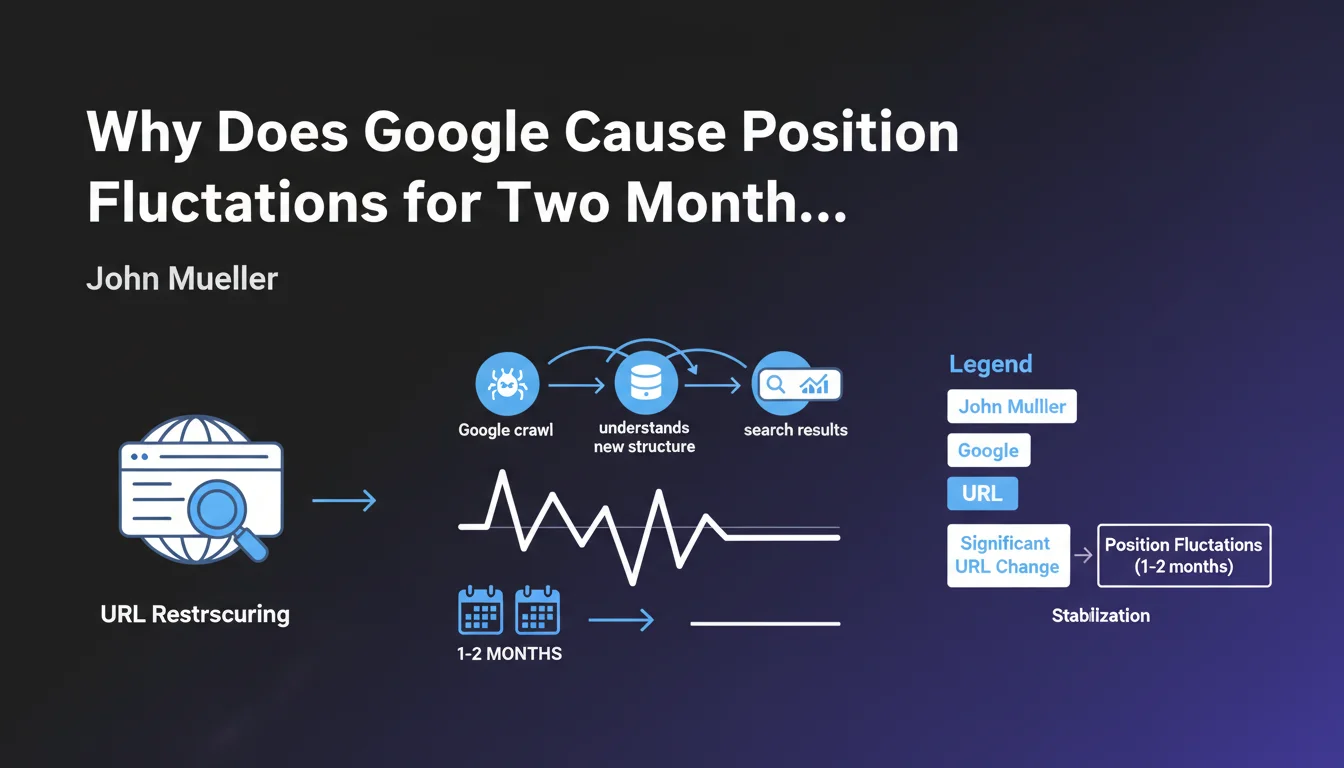
Any major URL architecture overhaul triggers ranking fluctuations while Google recrawls and reinterprets the new structure. These variations can last one to two months before complete stabilization. This is a normal process, not a cause for alarm.
What you need to understand
Why Are These Fluctuations Inevitable?
When you make massive changes to your URLs, Google must reevaluate your entire architecture. Every page changes address, relevance signals get redistributed, redirects must be interpreted. The search engine doesn't instantly switch from one index to another — it progressively crawls, tests new URLs, and transfers signals.
This process takes time because Google must understand that these new URLs replace the old ones, not that they coexist. Fluctuations result from this transition phase where the old and new indexes partially overlap.
How Long Does This Instability Period Actually Last?
Mueller mentions one to two months. In reality? Most sites see stabilization between 4 and 8 weeks, but some complex projects can stretch to 12 weeks. Duration depends on page volume, crawl frequency, and redirect quality.
A 500-page site with proper redirects stabilizes faster than a 50,000-product e-commerce catalog with sloppy redirects. Crawl budget matters too: if Google crawls infrequently, the process stretches out.
What Do These "Fluctuations" Mean in Practice?
You'll observe position variations, sometimes dramatic: a page oscillating between 5th and 7th place can drop to page 2, then bounce back to top 3. Some URLs might temporarily disappear from the index, others appear with inconsistent snippets.
This signals that Google is still hesitating between the old and new version, testing different signal combinations. As long as redirects are clean and content remains consistent, these fluctuations eventually subside.
- Transition period: 4 to 8 weeks on average, up to 12 for large sites
- Symptoms: position variations, temporary disappearances, unstable snippets
- Cause: Google progressively recrawls and redistributes relevance signals
- Crawl budget: critical factor in stabilization speed
SEO Expert opinion
Is This Statement Consistent with Real-World Observations?
Yes, and actually quite conservative. The one to two-month window matches what we see on well-executed projects — clean 301 redirects, logical structure, no redirect chains. However, when migration is poorly executed (redirects to 404 pages, rough mapping, simultaneous content changes), fluctuations can last far longer.
What Mueller doesn't say: some pages may never recover their original position, especially if the new structure dilutes PageRank or breaks internal linking. Fluctuations eventually stabilize, true, but not always at the hoped-for level.
What Nuances Should Be Added to This Statement?
The stated duration assumes that Google quickly accepts new URLs as legitimate replacements. If your redirects are ambiguous (temporary 301s that become permanent, cross-redirects), the engine may take longer to decide. [To verify]: Mueller doesn't clarify whether these two months include the time to recover initial traffic or only to stabilize positions.
Another missing point: the impact of Core Web Vitals and user experience post-migration. If your new structure is slower or less ergonomic, fluctuations can mask structural degradation, not just technical delay.
In Which Cases Does This Rule Not Apply?
For minor changes (a few dozen URLs), fluctuations are often negligible and subside in one to two weeks. The two-month rule applies to significant restructuring — not cosmetic changes to three category URLs.
Practical impact and recommendations
What Should You Concretely Do Before and During Migration?
Before: establish precise old/new URL mapping, verify every old URL redirects to a semantically equivalent page, test redirects in pre-production. During: monitor Search Console daily (4xx/5xx errors, index coverage), force recrawl of strategic pages via the inspection tool, keep your XML sitemap updated.
Change nothing else during this period: no simultaneous design overhaul, no massive content rewrite, no HTML structure changes. Isolate the "URLs" variable so you can diagnose properly.
What Mistakes Must You Avoid at All Costs?
First mistake: redirecting all old URLs to the homepage. Google detects this practice and may ignore the redirects, leaving old pages in limbo. Second mistake: chaining redirects (A → B → C). Each link dilutes PageRank and slows crawling.
Third mistake: panicking at the first fluctuation and reverting everything. Variations are normal — as long as your redirects are clean, let Google do its work.
How Do You Verify That Stabilization Is Progressing?
Track the evolution of indexed pages count in Search Console. If new URLs progressively replace old ones, that's a good sign. Monitor crawl rate too: a temporary increase indicates Google is actively digesting the new structure.
Analyze your rankings on a panel of strategic keywords: if fluctuation amplitude decreases week after week, you're on the right track. A stable plateau, even slightly below initial levels, beats persistent roller-coasters.
- Map each old URL to a new URL that's semantically equivalent
- Implement clean 301 redirects with no chains
- Update XML sitemap immediately after migration
- Force recrawl of strategic pages via Search Console
- Leave everything else untouched (design, content, structure) during transition
- Monitor 4xx/5xx errors and index coverage daily
- Analyze crawl rate and indexed page count evolution
- Wait 8 to 12 weeks before concluding the migration failed
❓ Frequently Asked Questions
Peut-on accélérer la stabilisation en augmentant le budget de crawl ?
Les redirections 302 provoquent-elles des fluctuations plus longues que les 301 ?
Faut-il conserver les anciennes URLs en redirection indéfiniment ?
Si mes positions baissent pendant les fluctuations, vont-elles forcément revenir au niveau initial ?
Dois-je attendre la fin des fluctuations avant d'optimiser mes nouvelles URLs ?
🎥 From the same video 20
Other SEO insights extracted from this same Google Search Central video · published on 21/01/2022
🎥 Watch the full video on YouTube →
💬 Comments (0)
Be the first to comment.