
Official statement
Other statements from this video 20 ▾
- □ Does Google really penalize a website that buys links in bulk?
- □ Do you really need technical perfection to rank well on Google?
- □ Does Google really crawl your site less when it perceives low quality?
- □ Is the 'Crawled, Currently Not Indexed' status really just a sign of poor website quality?
- □ Can invalid structured data penalize your SEO performance?
- □ Should you worry when the number of indexed pages drops?
- □ Crawled vs Discovered: Are these two non-indexed statuses really the same thing?
- □ Can you really control which images Google displays in your search snippets?
- □ Is your franchise network losing visibility because of duplicate content across multiple domains?
- □ CCTLD, subdomain or subdirectory: which structure for international geotargeting?
- □ Does the 503 status code really protect your pages from deindexing during an outage?
- □ Will accidental dofollow links in your PR coverage actually hurt your rankings?
- □ Can you really use the address change tool to merge or split websites?
- □ Why are your structured data disappearing on your localized pages?
- □ Do structured data really improve rankings, or just how results are displayed?
- □ Will Google ever display Core Web Vitals badges directly in search results?
- □ Why Does Google Cause Position Fluctuations for Two Months After URL Restructuring?
- □ Does internal linking really outperform URL structure for SEO?
- □ Should you really spend time calculating internal PageRank to optimize your website?
- □ Can Google Really Identify the Main Language of a Multilingual Page Without Hurting Your SEO?
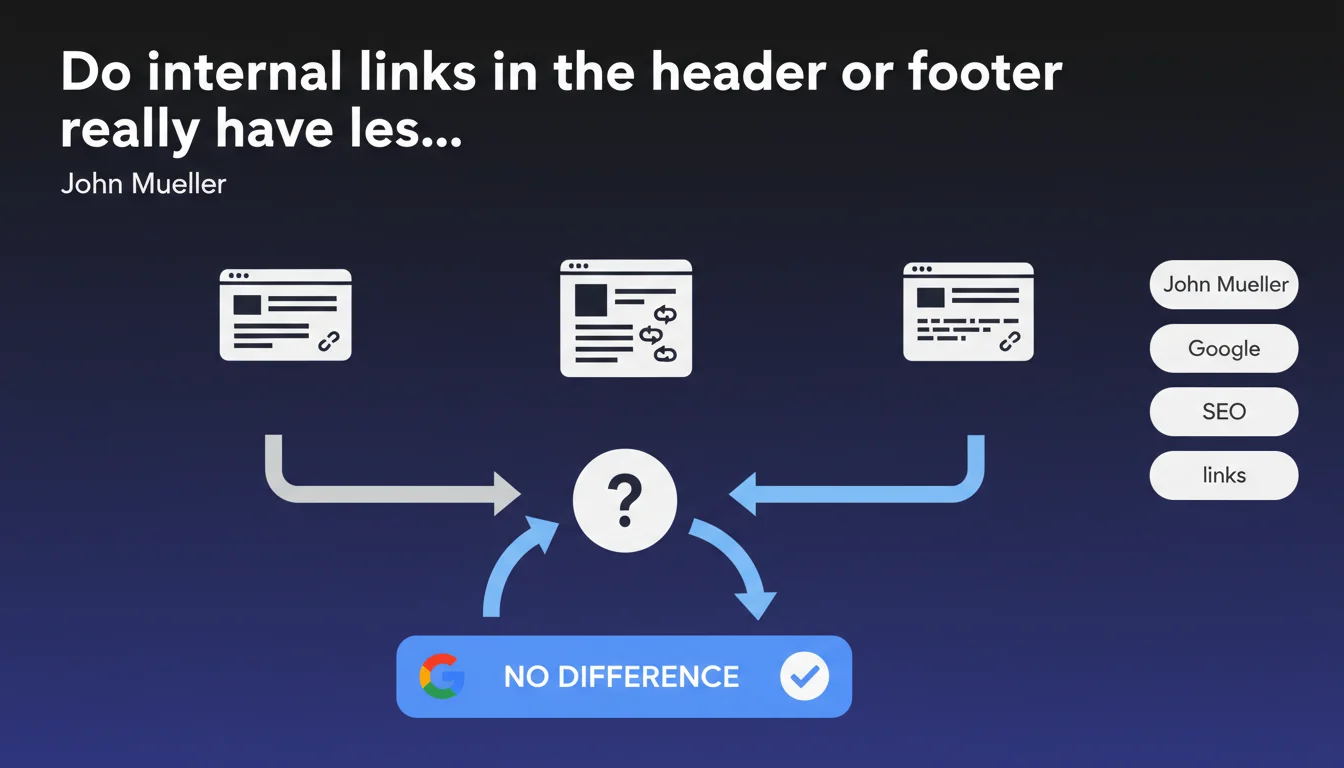
Google claims to make no distinction in value between internal links based on their position on the page. Whether they are in the header, footer, or main content, all internal links would be treated equivalently. This statement challenges certain SEO practices that have been established for years.
What you need to understand
Why does this statement challenge our established beliefs?
For years, SEO practitioners have assumed that a link placed in the main content carries more weight than a link buried in the footer with 50 others. This logic is based on the idea that Google values editorial context and contextual relevance.
Mueller claims here that there is no quantifiable difference between these placements. Technically, the engine would treat all internal links the same way, without assigning a value coefficient based on the page zone.
What does "no quantifiable difference" really mean?
This formulation leaves significant room for interpretation. Google is not saying that all links have exactly the same impact — only that there is no systematic distinction based on physical location in the HTML code.
The term "quantifiable" suggests there is no fixed coefficient (for example: link in content = 1.0, footer link = 0.3). But this does not exclude the possibility that other factors — such as semantic context or anchor text relevance — influence the weight transmitted.
So how does Google evaluate the value of an internal link?
If location is not a criterion in itself, other dimensions probably come into play: topical relevance between the source and target page, anchor text, frequency of link repetition, or proximity to other semantically rich elements.
A footer link to a contact page will not have the same contextual impact as a link within a detailed thematic paragraph. Even if technically Google treats them identically at the indexing level, their contribution to rankings can differ.
- No position coefficient: Google does not apply differentiated scoring based on the HTML location of the link.
- Context and relevance matter: even if location is not a criterion, semantic context remains decisive.
- All links are crawled: header, footer, sidebar — Google follows all detected links without location hierarchy.
- Beware of over-optimization: multiplying links in the footer probably adds nothing if context is absent.
SEO Expert opinion
Is this statement consistent with real-world observations?
Let's be honest: this claim contradicts many tests and empirical observations. SEO practitioners have observed for years that contextual links within article bodies perform better than generic footer links.
The nuance may lie in the distinction between technical value and actual impact. Google may treat all links equally at the crawl and indexing level, while weighting their contribution to ranking differently based on context. [To verify] — Mueller does not specify whether this equality of treatment applies only to crawling or also to internal PageRank calculation.
What nuances should we consider?
First point: a link in the content generally benefits from a rich semantic environment — keywords, entities, co-occurrences — that strengthens its relevance. A footer link is often isolated, without editorial context.
Second point: repeated links across all pages (via menu or footer) create a signal dilution. Google can technically process them, but their individual weight decreases mechanically through their ubiquity. Bottom line? It is not the placement itself that matters, but the uniqueness and contextual relevance.
In what cases does this rule not apply?
If you stuff your footer with 100 links to orphaned pages hoping to rank them, you are wasting your time. Google can crawl them, certainly, but without editorial context, their contribution to rankings remains null.
On the other hand, a strategic link in an article — surrounded by relevant content, with optimized anchor text — benefits from an amplifying effect. The link inherits the semantic strength of the surrounding paragraph. That is where the difference lies, not in the raw HTML position.
Practical impact and recommendations
What should you do concretely?
Do not remove your navigation or footer links under the assumption they would be "useless". They remain essential for user experience and crawling. But do not rely on them to push a strategic page into the SERPs.
Focus your efforts on contextual internal linking: links placed in paragraphs rich in keywords, with varied and relevant anchor text, pointing to pages you genuinely want to boost. It is the combination of context plus link that makes the difference.
What mistakes should you avoid?
Mistake #1: believing that adding 50 links to your footer will boost your crawl budget or distribute PageRank. It does not work that way. Google will crawl them, but their individual impact will be diluted to the extreme.
Mistake #2: neglecting editorial internal linking by thinking "all links are equal". No. A link well-placed in a 2,000-word article on a related topic will have far greater impact than an orphaned link in a sidebar.
How do you audit and optimize your internal linking?
Start by mapping your strategic pages: those generating traffic, revenue, or that you want to rank. Then identify existing content that could naturally link to them — thematically close, with relevant editorial context.
Use tools like Screaming Frog, Oncrawl, or Botify to analyze the distribution of internal PageRank. Identify orphaned pages, poorly connected silos, missed linking opportunities. Build a coherent linking plan based on semantic logic, not blind repetition.
- Prioritize contextual links within article bodies over generic footer links
- Vary anchor text and avoid over-optimization on a single keyword
- Limit the number of links in repeated zones (header, footer, sidebar) to avoid dilution
- Regularly audit your internal linking with a crawl tool to identify opportunities
- Create interconnected content hubs around your main topics
- Avoid orphaned pages: each strategic page should receive at least 3-5 contextual internal links
❓ Frequently Asked Questions
Un lien dans le footer a-t-il exactement la même valeur qu'un lien dans le contenu ?
Dois-je supprimer les liens de mon footer pour éviter la dilution ?
Comment savoir si mon maillage interne est efficace ?
Faut-il privilégier la quantité ou la qualité des liens internes ?
Google pénalise-t-il les sites avec trop de liens dans le footer ?
🎥 From the same video 20
Other SEO insights extracted from this same Google Search Central video · published on 21/01/2022
🎥 Watch the full video on YouTube →
💬 Comments (0)
Be the first to comment.