
Official statement
Other statements from this video 20 ▾
- □ Do internal links in the header or footer really have less SEO value?
- □ Does Google really penalize a website that buys links in bulk?
- □ Do you really need technical perfection to rank well on Google?
- □ Does Google really crawl your site less when it perceives low quality?
- □ Is the 'Crawled, Currently Not Indexed' status really just a sign of poor website quality?
- □ Can invalid structured data penalize your SEO performance?
- □ Should you worry when the number of indexed pages drops?
- □ Crawled vs Discovered: Are these two non-indexed statuses really the same thing?
- □ Can you really control which images Google displays in your search snippets?
- □ Is your franchise network losing visibility because of duplicate content across multiple domains?
- □ CCTLD, subdomain or subdirectory: which structure for international geotargeting?
- □ Does the 503 status code really protect your pages from deindexing during an outage?
- □ Will accidental dofollow links in your PR coverage actually hurt your rankings?
- □ Can you really use the address change tool to merge or split websites?
- □ Why are your structured data disappearing on your localized pages?
- □ Do structured data really improve rankings, or just how results are displayed?
- □ Will Google ever display Core Web Vitals badges directly in search results?
- □ Why Does Google Cause Position Fluctuations for Two Months After URL Restructuring?
- □ Should you really spend time calculating internal PageRank to optimize your website?
- □ Can Google Really Identify the Main Language of a Multilingual Page Without Hurting Your SEO?
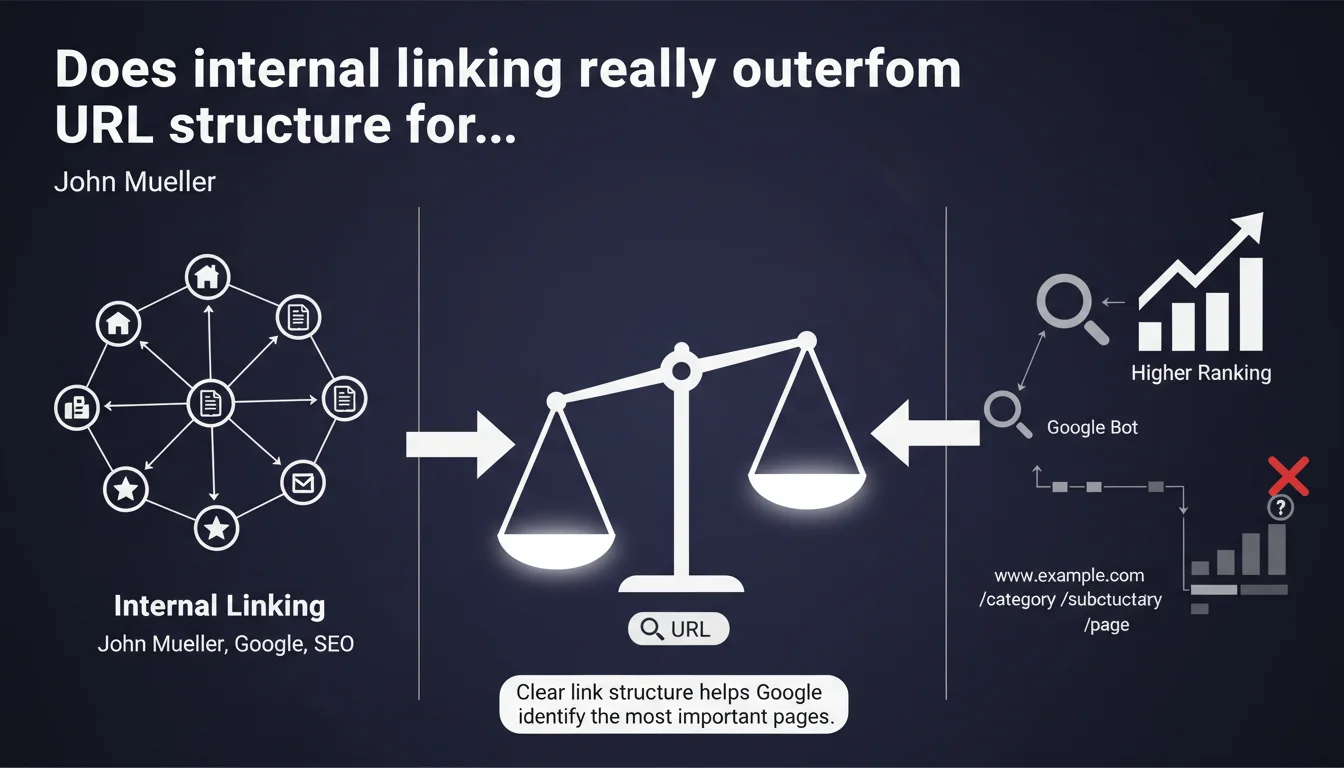
Google states that internal linking matters more than URL architecture for understanding a website. The link structure better reveals the hierarchy and relative importance of pages than any URL naming convention. In practice: good linking can compensate for a poor URL, but not the reverse.
What you need to understand
Why does Google downplay the role of structured URLs?
URLs have long been considered a major hierarchical signal. It was believed that a structure like /category/subcategory/product would help Google understand site organization.
But Google has evolved. The algorithm now relies more heavily on the internal link graph to map out structure. A flat URL like /product-123 can work perfectly fine if the linking is clean and coherent.
What does internal linking really reveal to Google?
Internal linking acts as a voting system. Each link passes juice, but more importantly, it indicates a relationship of thematic proximity and importance.
Google observes how frequently links point to a page, their position in the site architecture, and the anchor text used. A page receiving 50 internal links is perceived as more important than an isolated page — regardless of its URL.
Do URLs retain any residual SEO function?
Yes, but limited. URLs remain visible in SERPs, they inform the user (thus impacting CTR), and a logical structure facilitates crawling and maintenance.
But Google no longer uses them as the primary signal for hierarchy. The era when a deeply nested URL was automatically perceived as less important is over.
- Internal linking is the dominant signal for mapping site structure
- Structured URLs are no longer a priority hierarchical factor
- A site with flat URLs can perform well if linking is solid
- Google evaluates page importance through density and quality of internal links
- URLs remain relevant for UX and CTR, not for structural understanding
SEO Expert opinion
Is this statement consistent with field observations?
Yes, broadly speaking. Tests conducted on flat-URL sites (like e-commerce with SKUs) show that intelligent linking more than compensates for the absence of URL structure.
However — and this is where it gets tricky — many CMS and e-commerce platforms automatically generate both structured URLs and coherent linking. It's difficult to isolate the determining factor under these conditions.
What nuances should be added to this claim?
Mueller doesn't say that URLs have no importance; he says they're secondary to linking. A critical distinction.
A descriptive URL improves CTR, facilitates sharing, aids memorability. It remains a weak signal of thematic relevance through keywords it contains. But it no longer structures the index as it once did.
[To verify]: Google doesn't specify how it arbitrates when there's a contradiction between structured URL and chaotic linking. If your URL suggests one category but your internal links suggest something else, which really takes precedence?
In what cases doesn't this rule fully apply?
On massive sites (millions of pages), URL structure remains a practical tool for segmenting crawl and facilitating technical management. Google Discover and Google News also rely on URL patterns.
And let's be honest: a site with poor URLs AND poor linking will always be in trouble. One doesn't save the other if both are broken.
Practical impact and recommendations
What should you do concretely on internal linking?
Start by auditing your link graph. Use Screaming Frog or Oncrawl to identify orphaned pages, bottlenecks, and unnecessarily over-linked pages.
Then define a thematic siloing logic: each content hub should point to its child pages and receive links from related pages. Important pages should be at most 2-3 clicks from the homepage.
Optimize anchor text. Varied, descriptive, natural — but above all consistent with the target page's intent.
Should you abandon structured URLs then?
No. Keep a clean and readable URL structure, but stop stressing about depth or perfect hierarchy at all costs.
If your CMS imposes flat URLs, it's no longer a disaster. Compensate with solid linking. If you already have structured URLs, keep them — but invest your energy on linking rather than on cosmetic URL restructuring.
How do you verify your site complies with this logic?
- Crawl your site and identify orphaned pages (0 inbound internal links)
- Analyze internal PageRank distribution: do strategic pages receive enough juice?
- Verify that your important pages are accessible in 3 clicks maximum from the homepage
- Check the consistency of internal link anchor text (avoid over-optimization with exact keywords)
- Ensure each thematic hub links to its child pages and receives contextual links
- Use breadcrumbs and menus to reinforce navigation structure
- Avoid internal nofollow links except in justified cases (login, filters, etc.)
❓ Frequently Asked Questions
Dois-je restructurer mes URL si elles sont déjà en place ?
Une URL plate (/produit-123) peut-elle vraiment bien ranker ?
Le fil d'Ariane (breadcrumb) compte-t-il comme linking interne ?
Combien de liens internes maximum par page ?
Les ancres de liens internes doivent-elles être optimisées keyword ?
🎥 From the same video 20
Other SEO insights extracted from this same Google Search Central video · published on 21/01/2022
🎥 Watch the full video on YouTube →
💬 Comments (0)
Be the first to comment.