
Official statement
Other statements from this video 21 ▾
- □ Should you update the same page or create a new URL every day for frequently refreshed content?
- □ Should you stop using the manual submission tool in Google Search Console?
- □ Do H2 tags in your footer actually hurt your SEO rankings?
- □ Do HTML5 <header> and <footer> tags really boost your SEO rankings?
- □ Should you really rely on the schema.org validator to optimize your structured data?
- □ Does improving page speed really boost your rankings as fast as everyone claims?
- □ Does Google really crawl all your sitemaps at the same pace?
- □ Does Google really keep crawling a sitemap after you remove it from Search Console?
- □ Is Google really refusing to index your pages even though they're crawled regularly and have no technical issues?
- □ Can you safely use bidirectional canonicals between two site versions without any risk?
- □ Can structured data really replace traditional internal linking strategy?
- □ Why is one x-default enough for your entire multi-domain hreflang configuration?
- □ Should you really avoid product structured data on category pages?
- □ Why is Google completely ignoring your desktop version once mobile-first indexing kicks in?
- □ Can commodity content really survive in Google search results?
- □ Should you isolate your FAQs on separate pages to rank better?
- □ Is Google really cutting back on FAQ rich snippets in search results, and what does that mean for your SEO strategy?
- □ Is Google really ignoring 95% of your submitted URLs—and what does that say about your content?
- □ Can you host your XML sitemap on a different domain than your main website?
- □ Does the shift from 'Bad' to 'Medium' on Core Web Vitals really transform your Google rankings?
- □ Does server speed really impact the crawl budget of large websites?
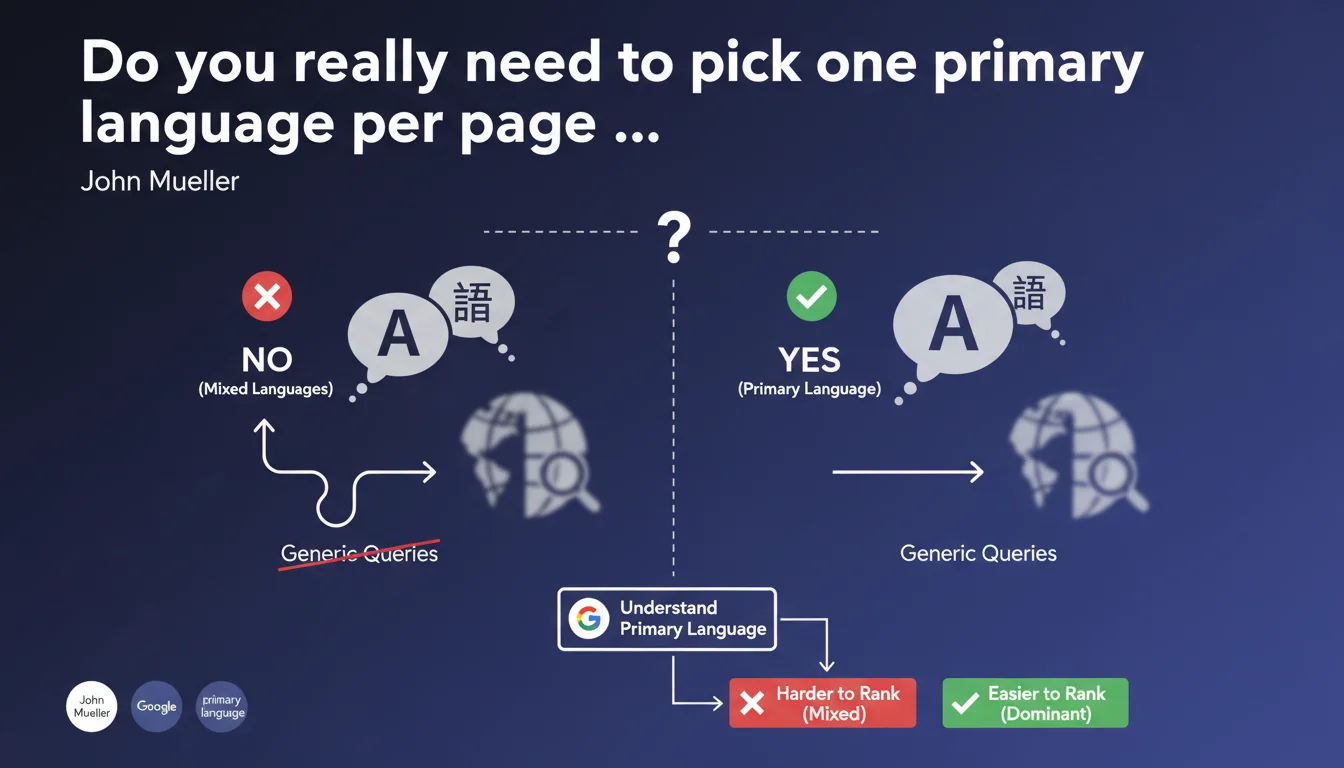
Google can only properly rank a page if it clearly identifies its primary language. Pages intentionally mixing multiple languages confuse the algorithm and limit visibility on generic search queries. A dominant language per page remains the rule, even if some secondary elements in another language slip through.
What you need to understand
Why does Google insist so much on having one primary language per page?
Google's algorithm works through linguistic matching between the user's search query and indexed content. When a page mixes multiple languages equally, the search engine can't determine which language index to prioritize it in.
The result? The page ends up stuck in an algorithmic no man's land. It doesn't appear in French search results, nor in English ones, because Google can't decide. This positional ambiguity directly impacts your ranking potential.
What separates a problematic multilingual page from acceptable content?
The difference lies in proportion and intent. A French page with a few English quotes or a block of customer testimonials in another language poses no problem — the dominant language remains identifiable.
On the other hand, a page that systematically alternates paragraphs between two languages, or presents two complete versions side by side, muddies the signals. Google looks for structural linguistic consistency, not a mosaic.
Do brand searches really escape this constraint?
Mueller clarifies that the impact primarily affects generic search queries. On brand searches (company name, specific product), Google has other signals to identify the relevant page — backlinks, mentions, recognized entity.
But once you leave brand territory, the linguistic criterion becomes decisive again. A multilingual page targeting "agence marketing digital" + "digital marketing agency" will get crushed by more focused monolingual pages.
- A clear primary language per page conditions proper ranking on generic queries
- Intentional multilingual pages complicate indexation and reduce visibility
- A few secondary elements in another language remain tolerated if the dominant language is clear
- Brand search queries partially compensate for this handicap through other signals
- The hreflang architecture remains the standard solution for properly managing multiple languages
SEO Expert opinion
Does this rule apply uniformly across all site types?
In practice, multilingual e-commerce sites that tried the "all-in-one" approach to limit content duplication quickly became disillusioned. Field observations show a collapse in rankings on generic keywords as soon as two languages share space equally.
Where it gets sticky: niche B2B sites targeting naturally bilingual audiences (Switzerland, Belgium, Luxembourg). They get caught between Google's rule and user reality. [To verify]: is there a precise tolerance threshold in terms of acceptable secondary content percentage?
How consistent is this statement with multilingual SERP practices?
Let's be honest — we regularly see partially multilingual pages ranking correctly. But in 90% of cases, it's on ultra-specialized queries or brand terms where pure monolingual competition simply doesn't exist.
As soon as you enter a competitive sector with players following proper hreflang implementation, the multilingual page plummets. The problem is Google never specifies the critical threshold that tips a page from "acceptable" to "problematic" status.
In what cases does this recommendation become counterproductive?
For sites documenting international technical vocabulary (IT, medicine, law), forcing systematic term translation can harm semantic relevance. An article on GDPR that systematically translates "data protection officer" to "délégué à la protection des données" loses precision.
Practical impact and recommendations
What should you do concretely if your site mixes multiple languages?
First step: audit your current pages to identify those presenting ambiguous language ratios. Tools like Screaming Frog with language detection, or simply manual analysis of strategic pages.
Then decide. Either you create distinct versions per language with hreflang implementation (standard solution), or you commit to one primary language and relegate the other to purely decorative or functional elements (buttons, labels).
What mistakes should you absolutely avoid during multilingual redesigns?
Don't try the "60% French, 40% English, that should work" gambit. Google doesn't operate with negotiable percentages. The primary language must be obvious from the title, meta description, H1-H2 and text body.
Also avoid the trap of content duplicated 80% across the same URL with JavaScript language switching. Google crawls one version, indexes another, and you end up with contradictory signals that sabotage both languages' ranking potential.
How do you verify your language architecture is compliant?
Test your target pages on generic search queries in both languages via VPN or private browsing with language settings adjusted. If your page doesn't appear on either SERP, you have your answer.
Also validate your hreflang tags through Google Search Console (International Targeting section). Implementation errors are common and silently sabotage your efforts.
- Identify all pages presenting ambiguous language mixing
- Create distinct versions per language with dedicated URLs
- Implement hreflang tags correctly (bidirectional and consistent)
- Define a clear primary language in title, meta, H1 and body text
- Limit secondary language elements to less than 10% of content
- Verify the proper indexation of each language version in Search Console
- Test ranking on generic search queries to validate effectiveness
❓ Frequently Asked Questions
Peut-on garder des éléments de navigation (menu, footer) dans une autre langue que le contenu principal ?
Les pages produits e-commerce avec descriptions multilingues sont-elles concernées ?
Un site canadien ciblant français et anglais doit-il obligatoirement dupliquer tout son contenu ?
Les citations ou extraits dans une autre langue posent-ils problème ?
Le hreflang suffit-il ou faut-il aussi des URLs distinctes par langue ?
🎥 From the same video 21
Other SEO insights extracted from this same Google Search Central video · published on 05/03/2022
🎥 Watch the full video on YouTube →
💬 Comments (0)
Be the first to comment.