
Official statement
Other statements from this video 4 ▾
- □ Can you really mix multiple languages on the same page without SEO penalties?
- □ Do you really need a meta tag to declare your site's language to Google?
- □ Is the HTML lang attribute really useless for SEO?
- □ How should you structure a language learning website to maximize SEO performance and avoid Google's ranking confusion?
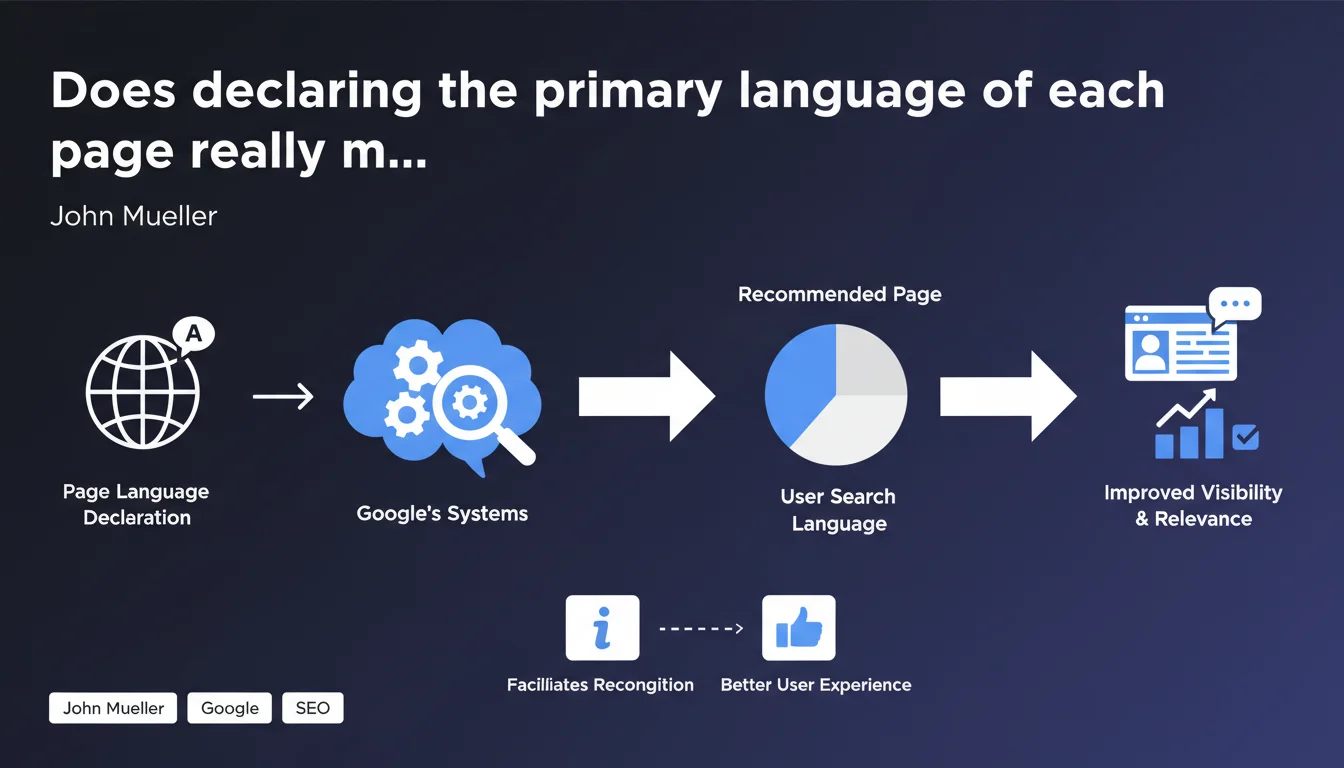
Google recommends clearly identifying the primary language of each page to facilitate matching with users searching in that language. This statement confirms the importance of the language signal in geographic and linguistic ranking. The nuance lies in the term "ideal" — it's not a blocking criterion, but a targeting facilitator.
What you need to understand
Why does Google insist on language recognition?
Google processes billions of queries in dozens of languages every day. To display relevant results, its systems must quickly identify the language of content and match it with the user's linguistic intent.
When a page doesn't give a clear signal about its primary language, Google has to guess. It often works, but not always — particularly on multilingual or technical content where vocabulary can seem neutral.
What actually changes for SEO?
This statement reinforces what we already know: hreflang and lang attributes are not merely decorative tags. They actively participate in geographic and linguistic targeting in the SERPs.
For a multilingual site, the absence of these signals can cause cross-language cannibalization: the English version appears on google.fr, the French version pollutes google.com, and so on. This is particularly problematic on e-commerce sites with translated catalogs.
What distinction should be made between language and geolocation?
Google differentiates content language and geographic targeting. A French-language site can target Belgium, Canada, or France — these are three distinct markets even though the language is the same.
Language helps Google understand what language the page is written in. Geographic targeting (via Search Console, ccTLD, or hreflang) indicates which market it addresses. Both mechanisms complement each other; they don't substitute for one another.
- Identifiable primary language = better matching with queries in that language
- HTML lang attribute and hreflang tags are the privileged technical signals
- Language/geo distinction: content in French can target multiple French-speaking countries
- The absence of a clear signal forces Google to guess, with risk of targeting error
- The term "ideal" suggests this is not a hard ranking factor, but a relevance facilitator
SEO Expert opinion
Is this recommendation consistent with real-world observations?
Absolutely. We regularly observe multilingual language targeting issues on multilingual sites that neglect language signals. English pages ranking on .fr, French content polluting .com SERPs, and so on.
What's interesting is that Mueller uses the word "ideal" rather than "mandatory." Google can recognize language without these signals — through content analysis, inbound links, domain — but it remains less reliable. [To verify]: what is the exact margin of error when language signals are absent? Google doesn't publish figures.
In what cases does this rule become critical?
Three contexts where the absence of clear language signal creates problems. First: multilingual sites with parallel versions (en/fr/de/es). Without hreflang and lang, Google might serve the wrong version or create cross-language duplicate content.
Second: markets with multiple official languages (Belgium, Canada, Switzerland). If your site targets Belgian francophones, Google must understand it's French AND that it targets .be. Otherwise, cannibalization with the .fr version.
Third: technical or mixed content. A French-language page with many English terms (tech, SaaS, dev) can confuse Google. The lang signal becomes essential to resolve ambiguity.
What nuance should be added about the true weight of this signal?
Google has never stated that the lang attribute or hreflang is a direct ranking factor. It's a targeting signal. It doesn't improve your ranking; it improves your relevance for a given linguistic audience.
Concretely: if your French content is weak, adding lang="fr" won't make it rise. But if your content is good and Google hesitates between your FR version and your EN version for a French user, the language signal will tip the scale. Important nuance.
Practical impact and recommendations
What exactly should you do on a monolingual site?
On a site entirely in French targeting a single market (for example: .fr for France), implementation is straightforward. Add the lang="fr" attribute in the <html> tag on each page. This is a standard best practice that takes 30 seconds.
Also verify that geographic targeting is consistent in Google Search Console (if generic domain) or via domain extension (.fr, .be, .ca). This reinforces signal coherence for Google.
How do you manage a multilingual site without creating problems?
First rule: each language version must have its own distinct URL. Forget client-side language detectors that display dynamic content on the same URL — Google can't crawl multiple languages on a single endpoint.
Second rule: implement hreflang correctly. Each version points to all other alternative versions AND to itself. A frequent error: forgetting the self-reference. If page-fr.html has hreflang pointing to page-en.html, page-en.html must also point to page-fr.html AND to itself.
Third rule: consistency between lang and hreflang. If your html tag says lang="fr-CA" (Canadian French), your hreflang should reflect fr-CA too, not just fr. Google is particular about regional granularity.
What mistakes should you absolutely avoid?
Classic mistake: deploying hreflang on a site with existing technical issues. If your canonical URLs are misconfigured, if you have duplicate content or chaotic redirects, hreflang will amplify the mess instead of fixing it.
Another pitfall: hreflang in conflict with automatic geographic redirects. If you automatically redirect French visitors to /fr/, but your hreflang points to /en/ as default, Google will get confused. Choose: either hreflang or auto-redirects — rarely both.
- Add the
langattribute in the<html>tag on each page - Use correct ISO 639-1 codes (fr, en, de, es…) with regional variants if relevant (fr-CA, en-GB)
- Implement hreflang on multilingual sites with parallel versions
- Verify that each hreflang version points to all alternatives AND to itself
- Test the implementation with an hreflang validator before production deployment
- Avoid automatic geographic redirects if hreflang is in place
- Monitor Search Console to detect hreflang errors (missing tags, loops, conflicts)
❓ Frequently Asked Questions
L'attribut lang dans la balise HTML est-il suffisant pour le SEO multilingue ?
Peut-on utiliser hreflang sans attribut lang dans le HTML ?
Faut-il différencier français de France et français du Canada dans hreflang ?
Que se passe-t-il si Google ne reconnaît pas la langue d'une page ?
Les erreurs hreflang dans Search Console sont-elles bloquantes ?
🎥 From the same video 4
Other SEO insights extracted from this same Google Search Central video · published on 06/09/2022
🎥 Watch the full video on YouTube →
💬 Comments (0)
Be the first to comment.