
Official statement
Other statements from this video 4 ▾
- □ Faut-il vraiment indiquer la langue principale de chaque page pour le SEO ?
- □ Faut-il vraiment une balise meta pour indiquer la langue de votre site ?
- □ L'attribut HTML lang est-il vraiment inutile pour le référencement ?
- □ Comment structurer un site d'apprentissage de langues pour optimiser son référencement ?
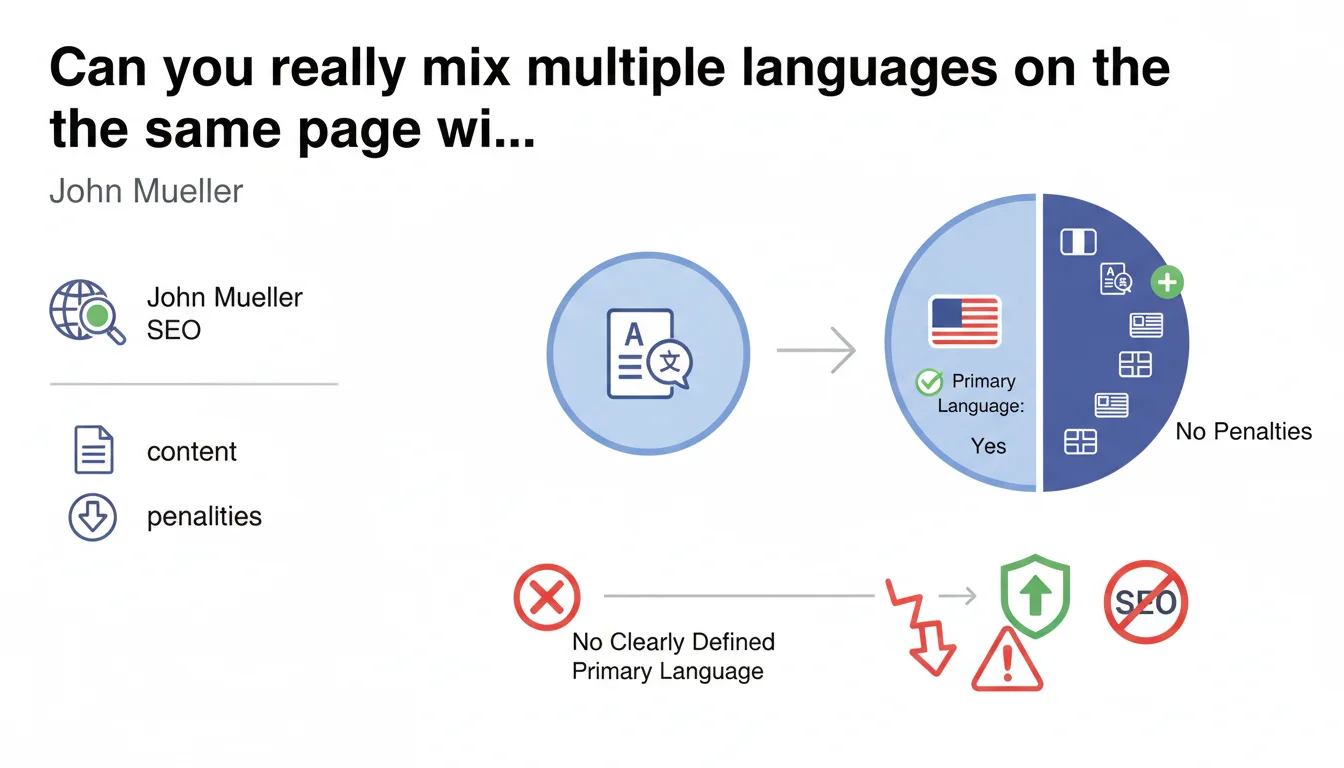
Google tolerates the presence of multilingual content on the same page, but insists on the need to clearly identify a primary language. This official position opens the door to certain common practices (quotes, testimonials, multilingual examples) while maintaining a requirement for clarity for language processing algorithms.
What you need to understand
Why does Google take a stance on multilingualism within the same page?
Search engines rely on natural language processing models that must identify the dominant language to categorize, index, and rank content. A page without a clearly identified language complicates this analysis and can create interpretation ambiguities.
The lang signal in HTML tags, automatic content detection, and language metadata work better when there is a clear hierarchy between the primary language and secondary elements. Google takes a stance to prevent practices where multilingualism becomes an obstacle to semantic understanding.
What does Google mean by "clearly identified primary language"?
This means having a critical mass of content in a single language, the one that structures the overall purpose of the page. Elements in other languages should remain secondary and contextualized — quotes, customer testimonials, technical excerpts, proper nouns.
Concretely, if 80% of your content is in French with a few clearly separated English paragraphs, Google considers the page as French. If you systematically alternate French and English paragraphs without a dominant structure, you create algorithmic confusion.
What technical risks do poorly managed multilingual content pose?
Unclear language identification can lead to incorrect geographic ranking — your French page could be proposed in English SERPs, or vice versa. Rich snippets may display fragments in the wrong language.
Quality algorithms that evaluate semantic coherence and reading fluidity may penalize content perceived as disjointed. And if you work with hreflang to manage multiple language versions, a fuzzy multilingual page further complicates things.
- Google tolerates multilingualism but requires a dominant primary language
- Secondary elements (quotes, testimonials) in other languages are acceptable if they remain minority and contextualized
- Lack of language clarity disrupts indexing, geographic ranking, and rich snippets
- Using
langandhreflangtags correctly becomes critical in this context
SEO Expert opinion
Is this statement consistent with practices observed in the field?
Yes, but with significant gray areas. In reality, many international e-commerce sites mix product descriptions in local language with technical specifications in English — and rank correctly. Blogs citing academic sources in foreign languages do not suffer visible penalties.
Where it gets tricky: Google does not specify the acceptable ratio. 10% of secondary content? 30%? The "strongly recommended" leaves enormous room for interpretation. [To verify]: no official data quantifies this tolerance threshold.
In what cases does this rule become truly constraining?
Sites that are actually penalized are those that systematically alternate languages without clear editorial logic — typically poorly implemented machine-translated content, or pages seeking to rank simultaneously on multiple linguistic markets.
Also watch out for multilingual user interfaces where menus, filters, and navigation elements represent a significant portion of crawlable content. If your template injects English text everywhere on a French page, you dilute the primary language signal.
What practical nuances should be applied to this directive?
Let's be honest: editorial context matters enormously. A legal website citing English case law in a French article is nothing like a lifestyle blog mixing languages for convenience. Google evaluates content coherence as a whole.
The real criterion — the one Google doesn't explicitly state — is added value. If multilingualism serves the reader (untranslated technical examples, authentic testimonials), no problem. If it reflects an opportunistic SEO strategy or editorial laziness, quality algorithms will react negatively.
Practical impact and recommendations
How do you properly structure a page with multilingual content?
Declare a clear primary language via the lang attribute on the <html> tag. For each section in a secondary language, use a local lang on a container element (<blockquote lang="en">, <div lang="de">).
Visually, differentiate these sections — indentation for quotes, boxes for testimonials. This helps users AND signals to Google that these blocks have a particular status, not erratic language alternation.
Make sure primary content represents at least 70-80% of the page's crawlable text. If your multilingual elements exceed this threshold, you step outside the "acceptable" framework mentioned by Mueller.
What critical errors should you absolutely avoid?
Never deploy unreviewed machine translations that let source and target languages coexist on the same URL. Some WordPress or Shopify plugins generate this type of hybrid content — this is exactly what Google penalizes.
Avoid multilingual navigation menus that inject text in multiple languages on every page. If your header contains 200 words in English on a French site, you dangerously dilute the primary language signal.
Watch out for dynamically generated content (comments, customer reviews, forums) that can introduce uncontrolled multilingualism. Implement filters or automatic lang attributes if necessary.
- Verify that the
langattribute on<html>matches the dominant language of your content - Encapsulate each secondary section with an appropriate
lang - Measure the ratio of primary language / secondary languages (target: 70-80% minimum)
- Audit navigation elements and templates to detect parasitic multilingual content
- Test rich snippet display in Google Search Console — correct language displayed?
- Verify consistency between hreflang tags and automatically detected language
- Control that user-generated content doesn't introduce language pollution
lang tagging, template management, content ratio audits — requires pointed expertise and regular monitoring. For international or technical sites where multilingualism is structural, this issue can quickly become complex. Working with an SEO agency specialized in multilingual architecture helps avoid pitfalls and ensures each technical signal remains coherent with your editorial strategy.❓ Frequently Asked Questions
Puis-je laisser des citations en anglais dans un article français sans risque SEO ?
Faut-il traduire les spécifications techniques produits souvent rédigées en anglais ?
Un site multilingue doit-il absolument utiliser des URLs séparées pour chaque langue ?
Comment gérer les avis clients rédigés dans différentes langues ?
Les balises alt d'images peuvent-elles être dans une langue différente du contenu principal ?
🎥 From the same video 4
Other SEO insights extracted from this same Google Search Central video · published on 06/09/2022
🎥 Watch the full video on YouTube →
💬 Comments (0)
Be the first to comment.