
Official statement
Other statements from this video 4 ▾
- □ Faut-il vraiment indiquer la langue principale de chaque page pour le SEO ?
- □ Peut-on vraiment mélanger plusieurs langues sur une même page sans pénalité SEO ?
- □ L'attribut HTML lang est-il vraiment inutile pour le référencement ?
- □ Comment structurer un site d'apprentissage de langues pour optimiser son référencement ?
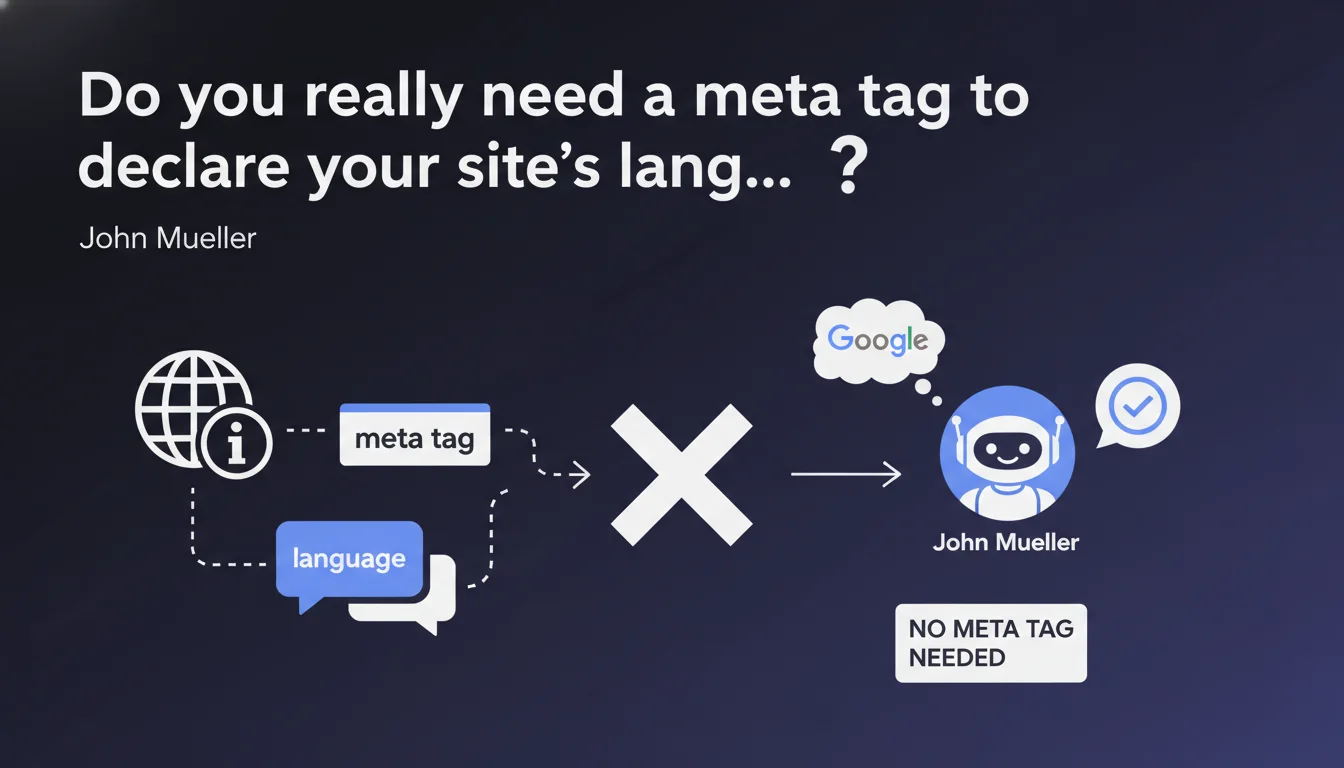
Google confirms that no meta tag is mandatory to declare a page's language. The search engine detects language automatically through content and other signals. That said, certain tags remain useful for removing ambiguities and optimizing multilingual user experience.
What you need to understand
Why does Google insist that no meta tag is mandatory?
Google has sufficiently powerful automatic language detection algorithms to identify a page's language without requiring an explicit declaration. The engine analyzes text content, linguistic structure, and other contextual signals to determine the primary language.
Mueller's statement aims to reassure webmasters who don't have specific meta tags — their content will still be correctly understood and indexed in the right language. No penalty is applied for the absence of these tags.
What tags do SEO professionals typically use for language management?
Two types of tags are commonly implemented for multilingual management. First, the lang attribute in the HTML tag (<html lang="en">) which indicates the document's primary language. Second, hreflang tags that allow you to declare a page's alternative versions in different languages or regions.
The confusion often arises because some believe a meta tag in the <head> is necessary, when in fact it simply doesn't exist in Google's recommended standards for declaring language.
Does Google sometimes make mistakes in automatic detection?
Yes, in certain specific cases. Pages with little text content, mixed multilingual content, or words identical across multiple languages can create ambiguity. Product pages with short descriptions, technical pages with lots of code, or bilingual sites with mixed content sometimes pose problems.
It's precisely in these situations that explicit signals like the lang attribute and hreflang tags become valuable — not because Google "must have" them, but to eliminate any potential confusion.
- Google detects language automatically without a mandatory meta tag
- The lang attribute in the HTML tag remains a best practice
- The hreflang tags are essential for multilingual sites with alternative versions
- Automatic detection can fail on thin or mixed content
- No penalty for the absence of explicit language declaration
SEO Expert opinion
Is this statement consistent with real-world observations?
Yes, overall. Tests show that Google correctly indexes pages without any explicit language tag, provided the text content is sufficiently rich and unambiguous. Monolingual sites with substantial content indeed have no language detection issues.
However — and this is where Mueller oversimplifies somewhat — multilingual and multiregional sites absolutely cannot do without hreflang tags to properly manage geographic targeting. Saying that "no tag is mandatory" is technically true for language detection, but misleading for overall international strategy.
What nuances should be added to this statement?
The distinction between "mandatory for indexing" and "recommended for optimization" is crucial. Google doesn't need a meta tag to index your content in the right language. But you need explicit signals to precisely control which language version displays for which user.
The lang attribute in the HTML tag is an accessibility best practice and web standard, independent of SEO. Screen readers, browsers, and translation tools use it. Neglecting this attribute on the grounds that "Google doesn't need it" would be a misguided holistic web approach.
[Worth verifying]: Some observe that in highly competitive markets with similar content in multiple languages, sites with proper lang and hreflang implementation tend to perform better in geographic targeting, even though Google claims to detect automatically. Correlation or causation? Hard to prove formally.
In what cases is this rule insufficient?
For any site operating in multiple countries or languages, the absence of hreflang creates chaos in search results. French users land on the English version, Francophone Canadians on the France version, etc. Google "detects" the language, but doesn't know which version to prioritize for which market.
Sites with dynamic content generated client-side (heavy JavaScript) can also encounter problems if the initial rendered content is insufficient for reliable detection. Again, explicit signals make Google's job easier.
Practical impact and recommendations
What should you concretely do for language management?
For a monolingual site, simply ensure the lang attribute is present in your HTML tag (<html lang="en"> for English, lang="fr" for French, etc.). It's quick, clean, and beneficial beyond SEO.
For a multilingual or multiregional site, implementing hreflang tags becomes non-negotiable. Each language version must point to its alternatives with appropriate syntax. Test your implementation with Google Search Console tools to detect configuration errors.
What mistakes must you absolutely avoid?
Don't create a <meta name="language" content="en"> tag thinking that's what Google expects — this tag isn't standardized and serves no SEO purpose. You're wasting your time.
Also avoid mixing multiple languages on the same page without clear structure (primary content in English, sidebar in French, footer in Spanish). Google may navigate it, but user experience suffers and signals become confused.
Last classic trap: implementing hreflang only in the XML sitemap without duplicating it in HTTP headers or <link> tags for dynamically generated pages. Redundancy improves detection reliability.
How do you verify your configuration is optimal?
Use Search Console to check for hreflang errors detected by Google. The "International Targeting" tool tells you if your annotations are correctly understood. Supplement with manual testing: search for your content from different countries (via VPN or Geolocation Search) to verify which version appears.
Regularly audit your tags with crawlers like Screaming Frog or Oncrawl to detect orphaned pages without hreflang, broken links between language versions, or inconsistencies in lang attributes.
- Add the
langattribute to all your<html>tags - Implement hreflang tags for any multilingual or multiregional site
- Don't create useless non-standardized "language" meta tags
- Test your implementation in Google Search Console
- Verify language version display from different geolocations
- Regularly audit the consistency of your multilingual annotations
- Avoid unstructured mixed multilingual content on the same page
❓ Frequently Asked Questions
Dois-je supprimer mes balises meta language existantes ?
L'attribut lang dans la balise HTML a-t-il un impact SEO direct ?
Hreflang et lang, c'est la même chose ?
Mon site monolingue français doit-il implémenter hreflang ?
Google peut-il confondre le français et l'espagnol sur une page courte ?
🎥 From the same video 4
Other SEO insights extracted from this same Google Search Central video · published on 06/09/2022
🎥 Watch the full video on YouTube →
💬 Comments (0)
Be the first to comment.