
Official statement
Other statements from this video 12 ▾
- □ Can you really succeed in SEO without experts or specialized tools?
- □ Why does Google refuse to endorse or recommend specific SEO tools?
- □ Why is knowing Google's guidelines non-negotiable before hiring an SEO specialist?
- □ Should you really trust the recommendations from SEO tools?
- □ Is Google really saying what SEO professionals claim it does?
- □ Can you really guarantee results in SEO?
- □ Is your SEO tool recommending tactics that could trigger a Google penalty?
- □ Should you really ignore third-party domain metrics to optimize your SEO strategy?
- □ Should you adapt your content specifically for LLMs and generative AI?
- □ Should you stop optimizing for Google's ranking algorithms?
- □ Should you really stop obsessing over technical SEO details?
- □ Should small businesses really abandon SEO technical optimization?
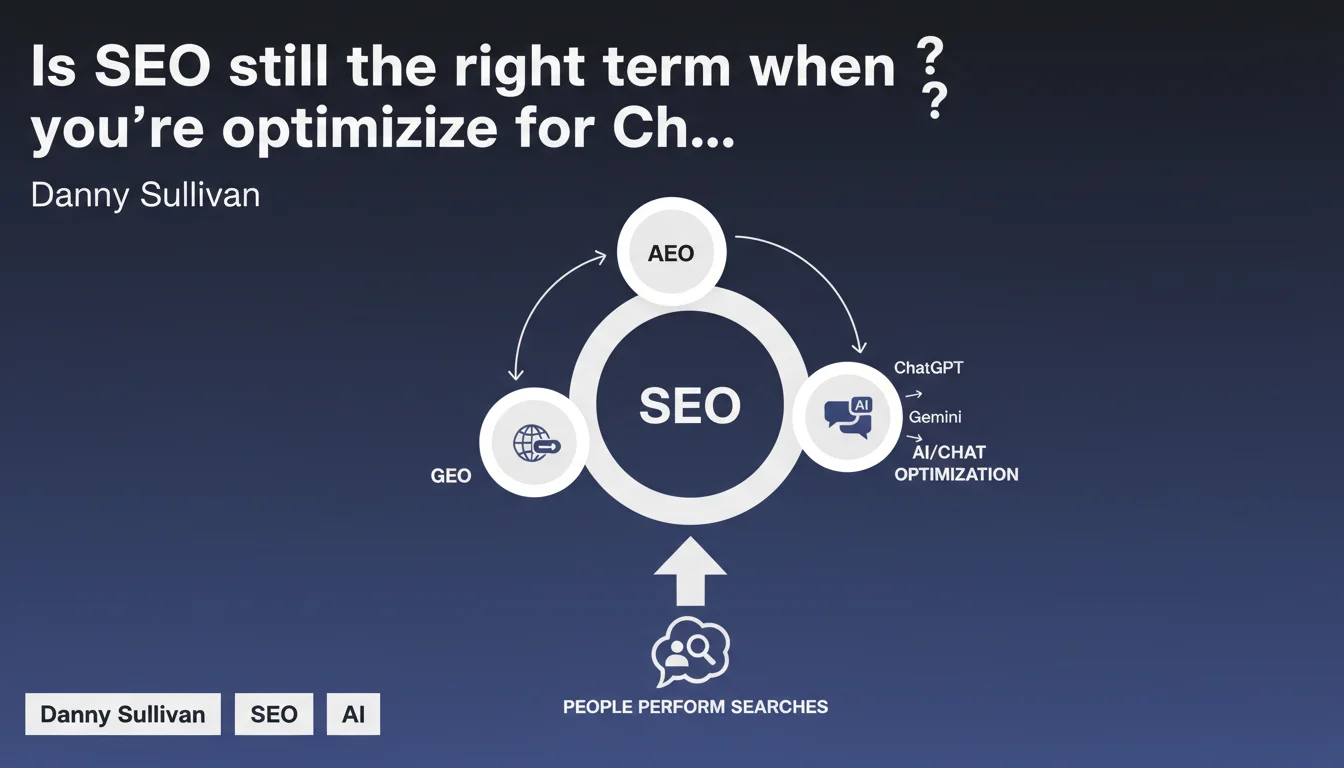
Google clarifies the terminology: AEO, GEO, and other trendy acronyms remain subcategories of SEO. Whether the user queries a traditional search engine or an AI chatbot, optimizing for visibility in search results falls within the same domain. SEO encompasses all content discovery optimization practices, regardless of the response format.
What you need to understand
Why does Google insist on refining the terminology around SEO?
The industry loves inventing new acronyms. AEO (Answer Engine Optimization), GEO (Generative Engine Optimization), LLM Optimization — all these terms emerged with the rise of conversational interfaces and AI Overviews.
Google reminds us of an obvious truth often lost in media noise: these practices don't revolutionize the field. They fit within the continuity of traditional SEO, because they all aim at the same objective — making content visible where users search for information.
What does this actually change for a practitioner?
Nothing fundamentally, but a lot perception-wise. This clarification prevents artificial fragmentation of skills. A consultant optimizing for featured snippets is already doing AEO without realizing it.
The emergence of new search interfaces (ChatGPT, Perplexity, Google SGE) doesn't create new professions — it extends the scope of classic SEO. The fundamentals remain: semantic relevance, authority, information structure.
Do generative answer engines really work like Google Search?
Not exactly. Generative engines like ChatGPT or Perplexity don't use the same ranking signals as a traditionally crawled index. Some rely on third-party engine APIs, others on pre-trained corpora.
But from the user's perspective, there's no difference. They ask a question, they expect an answer. From a business standpoint, optimizing visibility in these interfaces follows the same logic: understand intent, structure content, maximize the probability of being cited as a source.
- SEO remains the generic term for any optimization aimed at content discovery through search
- AEO, GEO, LLM optimization are tactical subsets, not separate disciplines
- Fundamental SEO skills (semantics, architecture, authority) apply to these new formats
- The user is looking for information — the technical channel matters little in defining the profession
SEO Expert opinion
Is this statement consistent with what we observe in the field?
Yes and no. Google is right in principle — the optimization intent remains identical. But concretely, the tactical levers sometimes differ radically between classic Search and generative interfaces.
An example: optimizing for a featured snippet relies on documented ranking signals (Hn structure, lists, top 10 position). Optimizing to be cited by ChatGPT? We're still navigating murky waters — [To verify] what precise criteria influence source selection in generated responses.
Why does the industry constantly invent new acronyms?
Let's be honest: innovation marketing. Rebranding an existing practice allows you to sell training courses, specialized audits, and position yourself as a pioneer.
The problem? This terminological inflation creates confusion among clients and artificially fragments budgets. A marketing director finds themselves arbitrating between "SEO", "AEO" and "GEO" when it's fundamentally about maximizing organic visibility, period.
What limits should we place on this generalization?
Google is oversimplifying a bit. Some emerging search channels (decentralized engines, proprietary voice assistants, in-app search within closed ecosystems) partly escape classic SEO levers.
And there's a political angle: by claiming "everything is SEO", Google maintains its position as the conceptual reference in an ecosystem where other players (OpenAI, Perplexity) are starting to grab search query share.
Practical impact and recommendations
Should you abandon the terms AEO or GEO in your communications?
Not necessarily. These terms remain useful for segmenting specific tactics within an overall SEO strategy. But let's stop presenting them as autonomous disciplines.
Internally or with a client, it's better to speak of "SEO for generative interfaces" or "optimization for AI Overviews" rather than create a separate budget line for "GEO". This avoids confusion and strengthens strategic coherence.
What should you actually do for these new search formats?
Fundamentals first: well-structured content, semantically rich, technically accessible remains the foundation. Then, a few tactical adjustments depending on the targeted channel.
For Google's AI Overviews: prioritize concise yet complete answers, structure in short paragraphs, use verifiable factual data. For ChatGPT or Perplexity: focus on editorial authority, external citations, content freshness — even if exact criteria remain opaque [To verify].
What mistakes should you avoid in this transition?
First mistake: neglecting fundamentals in favor of exotic tactics. Before optimizing for an AI chatbot, ensure your site is crawlable, fast, and mobile-friendly.
Second mistake: believing there's a "magic GEO recipe". Generative interfaces evolve quickly, as do their selection criteria. A editorial quality + authority + structure approach remains more durable than gaming techniques.
- Continue investing in SEO fundamentals (technical, content, authority)
- Structure content to facilitate extraction of concise answers (featured snippets, short paragraphs)
- Strengthen authority and credibility signals (external mentions, citations, demonstrated expertise)
- Monitor visibility in new interfaces (AI Overviews, Perplexity, ChatGPT Search) without obsession
- Avoid budget fragmentation — integrate these tactics into a unified SEO strategy
- Test and measure the impact of adjustments specific to generative formats
❓ Frequently Asked Questions
AEO et GEO sont-ils vraiment différents du SEO traditionnel ?
Faut-il créer des contenus spécifiques pour ChatGPT ou Perplexity ?
Comment mesurer l'impact SEO sur les moteurs de réponse génératifs ?
Google favorise-t-il ses propres formats (AI Overviews) par rapport aux résultats organiques classiques ?
Les backlinks restent-ils importants pour l'optimisation des moteurs génératifs ?
🎥 From the same video 12
Other SEO insights extracted from this same Google Search Central video · published on 08/01/2026
🎥 Watch the full video on YouTube →
💬 Comments (0)
Be the first to comment.