
Official statement
Other statements from this video 12 ▾
- □ Faut-il encore parler de SEO quand on optimise pour ChatGPT ou Gemini ?
- □ Peut-on vraiment réussir en SEO sans experts ni outils spécialisés ?
- □ Pourquoi Google refuse-t-il de recommander des outils SEO spécifiques ?
- □ Pourquoi connaître les guidelines Google est-il indispensable avant de recruter un prestataire SEO ?
- □ Faut-il vraiment faire confiance aux recommandations des outils SEO ?
- □ Google dit-il vraiment ce qu'on lui fait dire en SEO ?
- □ Peut-on vraiment garantir des résultats en SEO ?
- □ Faut-il ignorer les métriques de domaine tierces pour optimiser son SEO ?
- □ Faut-il adapter son contenu spécifiquement pour les LLM et l'IA générative ?
- □ Faut-il arrêter d'optimiser pour les algorithmes de Google ?
- □ Faut-il vraiment arrêter de s'obséder sur les détails techniques en SEO ?
- □ Faut-il vraiment abandonner la technique SEO quand on est une petite entreprise ?
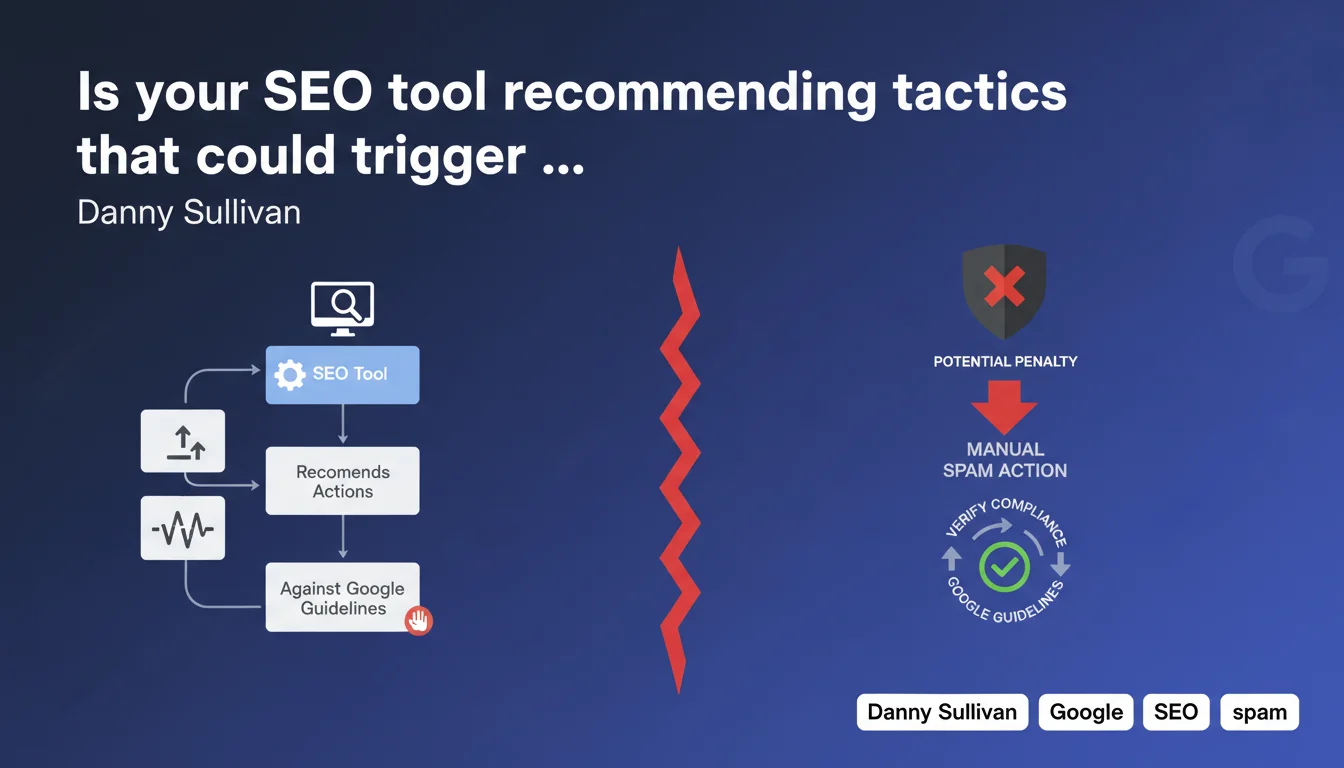
Danny Sullivan warns: many SEO tools and agencies recommend tactics that contradict Google's official guidelines. Blindly following these recommendations can trigger manual spam action. Compliance with guidelines remains the only reliable safeguard before any implementation.
What you need to understand
Danny Sullivan is here raising the alarm on a recurring problem in the SEO industry: the proliferation of automated recommendations that ignore — or deliberately circumvent — Google's official guidelines.
This statement comes at a time when SEO audit tools are multiplying. Some offer standardized suggestions without contextual analysis.
Why is Google communicating about this now?
The multiplication of SEO analysis tools has democratized access to technical recommendations. But this democratization has a perverse side effect: it trivializes edge-case practices, even dangerous ones.
Google is likely observing a rise in penalized sites following mechanical application of automated advice. Sullivan reminds us that compliance with guidelines takes priority over any optimization, however tempting it may be.
What types of recommendations are targeted by this warning?
Google doesn't provide an exhaustive list — and that's intentional. But we can identify several recurring categories: artificial backlink strategies, technical cloaking, automated content spinning, or certain forms of automated internal linking.
Some tools suggest, for example, creating satellite site networks, buying links from third-party platforms, or using hidden text techniques. All practices explicitly prohibited.
How can you distinguish legitimate advice from risky recommendations?
The fundamental rule remains simple: any recommendation must be verifiable in Google's Search Essentials. If a tool suggests an action that appears nowhere in the official documentation, or that seems to circumvent a technical limitation, caution is warranted.
Sound advice improves user experience AND respects guidelines. Toxic advice optimizes solely for search engines, without consideration for the end user.
- Systematically verify each technical recommendation against the official Search Essentials
- Beware of promises of quick results without substantial effort
- Favor tools that cite their sources and justify their recommendations
- Understand that some practices once tolerated are today explicitly sanctioned
- Never automate an SEO action without prior manual validation
SEO Expert opinion
Is this Google alert consistent with on-the-ground observations?
Let's be honest: yes, and that's even an understatement. The SEO tools market is experiencing considerable qualitative fragmentation. Some serious publishers invest in R&D and compliance; others recycle obsolete tactics in modern interfaces.
I regularly observe penalized sites after faithfully applying recommendations from tools that are nonetheless popular. The problem? These platforms optimize for metrics disconnected from true ranking criteria. They generate impressive reports that reassure the client, but sometimes suggest counterproductive actions.
Should all SEO tools be rejected then?
No — and that would be an extremist reading of Sullivan's statement. Tools remain essential for auditing at scale, detecting technical problems, or tracking rankings. The danger lies in blind application of their suggestions.
Here's the nuance that Google doesn't explicitly state: a high-performing SEO tool identifies opportunities and risks. It's then up to the practitioner to filter, contextualize, and arbitrate. No algorithm will ever replace this layer of critical analysis.
[To verify] Google deliberately remains vague about the exact definition of "practices that violate guidelines." This ambiguity maintains a gray zone where certain techniques — defensive negative SEO, certain types of PBN, intensive JavaScript usage — oscillate between tacit tolerance and latent risk.
What are the real consequences of manual spam action?
Concretely? A brutal visibility drop, sometimes exceeding 90% on certain strategic queries. Recovery takes between 3 and 6 months in the best case, provided you thoroughly clean up the incriminated practices and submit a convincing reconsideration request.
What Google never publicly specifies: some manual penalties leave lasting algorithmic scars. Even after the sanction is lifted, some domains struggle to regain their initial trust level. The true cost of a strategic error can be measured in years, not months.
Practical impact and recommendations
How can you audit your current tools' recommendations?
First step: extract the complete list of active suggestions from your various tools (technical audit, backlinks, content). Compile them in a spreadsheet with three columns: recommendation, source, implementation status.
Second step: for each recommendation, search for explicit validation in the Search Essentials. If you find nothing, mark as orange. If you find a prohibition, mark as red immediately.
What corrective actions should be put in place immediately?
Suspend any automation of backlink creation — whether directory submissions, automated comments, or triangular exchanges. These practices generate a toxic link profile detectable by algorithmic filters.
Verify that your content isn't generated or rewritten by unsupervised AI systems. Google is increasingly better at detecting patterns of synthetic text with low added value.
Control your internal linking: some plugins create automated contextual links based on over-optimized anchors. That's exactly the type of signal Google interprets as manipulation.
How can you build a sustainable and compliant SEO strategy?
Prioritize an approach where every optimization serves the user first. If a technical modification improves page load speed AND respects Web Vitals, it's doubly legitimate. If it exists only to manipulate crawl behavior, it's suspect.
Train your team — or yourself — in the fundamentals documented by Google. The Search Essentials, Quality Rater Guidelines, and official interventions from Sullivan or Gary Illyes constitute your primary knowledge base. Every tool must align with these references, never the other way around.
- Establish a validation process for any automated recommendation before implementation
- Consult manual actions in Search Console monthly, even without notifications
- Document every structural SEO decision with its guideline justification
- Disable automatic features of tools that generate content or links without supervision
- Perform a compliance audit quarterly comparing your practices to recent guideline updates
- Train internal teams or partners on warning signals: unrealistic promises, overly short timelines, opaque methods
- Maintain active monitoring of official Google communications (Search Central blog, Sullivan and Illyes Twitter accounts)
Sullivan's statement reminds us of an uncomfortable truth: SEO automation carries risks proportional to its convenience. Tools accelerate execution but don't replace strategic judgment.
Building a sustainable organic presence requires time, expertise, and a nuanced understanding of ranking mechanisms. Given the growing complexity of algorithms and the multiplication of penalty vectors, many companies choose to collaborate with specialized SEO agencies that master these delicate balances and can design bespoke, compliant, and high-performing strategies.
❓ Frequently Asked Questions
Comment savoir si mon outil SEO propose des recommandations dangereuses ?
Une action manuelle peut-elle survenir sans notification préalable ?
Faut-il abandonner tous les outils d'audit SEO ?
Combien de temps faut-il pour récupérer d'une pénalité manuelle ?
Quelles sont les pratiques les plus fréquemment sanctionnées ?
🎥 From the same video 12
Other SEO insights extracted from this same Google Search Central video · published on 08/01/2026
🎥 Watch the full video on YouTube →
💬 Comments (0)
Be the first to comment.