
Official statement
Other statements from this video 12 ▾
- □ Faut-il encore parler de SEO quand on optimise pour ChatGPT ou Gemini ?
- □ Peut-on vraiment réussir en SEO sans experts ni outils spécialisés ?
- □ Pourquoi Google refuse-t-il de recommander des outils SEO spécifiques ?
- □ Pourquoi connaître les guidelines Google est-il indispensable avant de recruter un prestataire SEO ?
- □ Faut-il vraiment faire confiance aux recommandations des outils SEO ?
- □ Google dit-il vraiment ce qu'on lui fait dire en SEO ?
- □ Votre outil SEO vous recommande-t-il des pratiques qui pourraient déclencher une pénalité Google ?
- □ Faut-il ignorer les métriques de domaine tierces pour optimiser son SEO ?
- □ Faut-il adapter son contenu spécifiquement pour les LLM et l'IA générative ?
- □ Faut-il arrêter d'optimiser pour les algorithmes de Google ?
- □ Faut-il vraiment arrêter de s'obséder sur les détails techniques en SEO ?
- □ Faut-il vraiment abandonner la technique SEO quand on est une petite entreprise ?
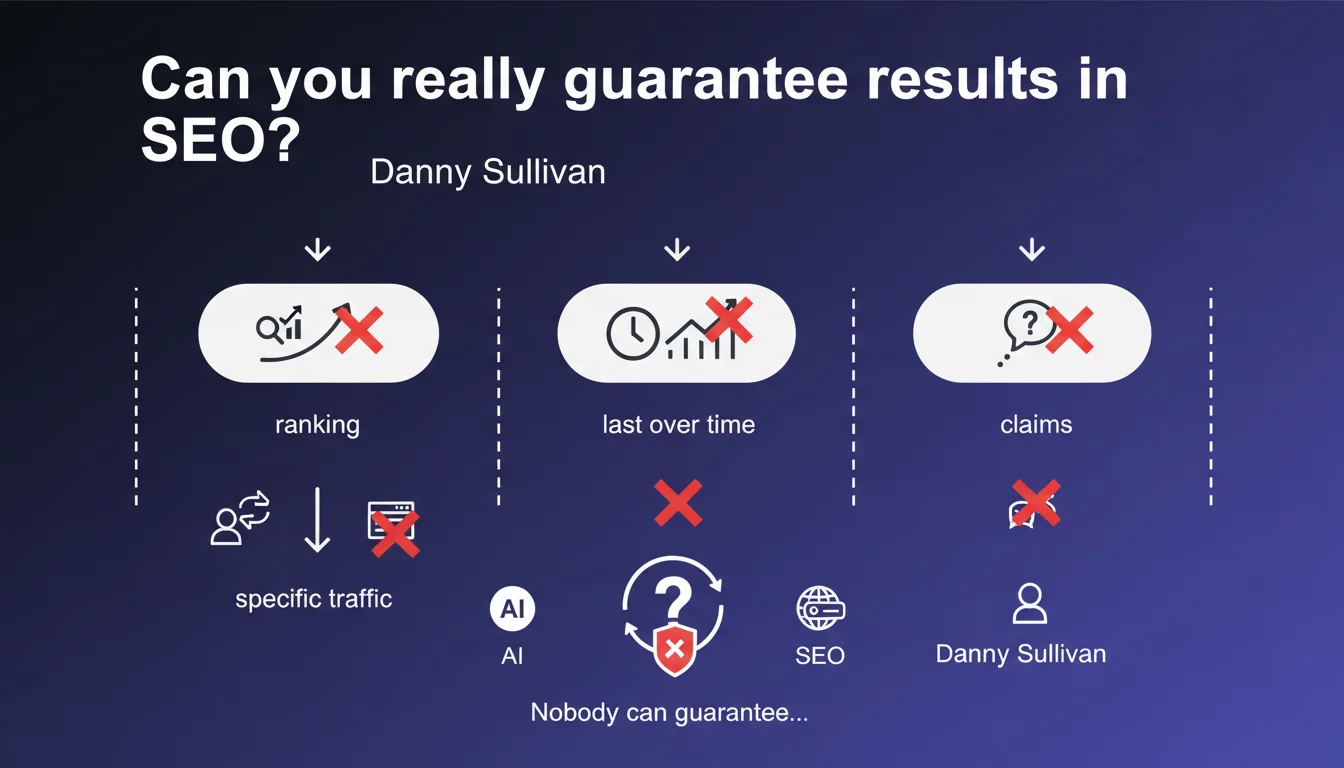
Google states that no ranking guarantee, traffic guarantee, or guarantee of sustainable results is possible in SEO. Firm promises before execution are merely unfounded claims. This official stance aims to protect advertisers against abusive business practices from certain agencies.
What you need to understand
Why does Google insist on the impossibility of guaranteeing results?
This statement reflects a desire to protect advertisers against exaggerated promises from certain SEO service providers. Google reminds us that its algorithm constantly evolves, competition varies, and hundreds of factors interact to determine rankings.
The search engine itself cannot predict with certainty how a site will perform in its results. Nobody else can either.
Does this statement mean SEO is ineffective?
Absolutely not. The distinction is crucial: there is a difference between guaranteeing a specific result and significantly improving a site's performance. A serious agency can fully commit to a methodology, deliverables, and realistic objectives based on the initial audit.
The inability to guarantee does not mean the inability to forecast or improve. It simply means that a contractual commitment like "position 1 guaranteed on this keyword" is a hollow promise.
What types of commitments remain legitimate?
A service provider can commit to measurable technical actions: fixing indexing errors, improving page load speed, creating optimized content, acquiring quality backlinks. These commitments relate to the means, not to raw ranking results.
- No guarantee of a specific position is technically possible
- Promises of exact traffic before intervention are unfounded claims
- The sustainability of results depends on uncontrollable external factors
- Legitimate commitments concern the means and deliverables, not SERP results
- Google itself cannot predict how a site will evolve in its rankings
SEO Expert opinion
Is this position consistent with what we observe in practice?
Yes and no. In principle, Danny Sullivan is right: nobody controls Google's algorithm, and no agency can force a ranking. Unpredictable updates (Core Updates, Product Reviews, Helpful Content) can turn well-optimized sites upside down overnight.
But in practice, an experienced expert can predict with reasonable reliability the impact of optimizations on given queries, especially in low-competition markets. Saying that no prediction is possible is excessive — we actually base our profession on observable correlations and reproducible patterns.
What nuance should we add to this statement?
Google conflates two distinct things: the contractual impossibility of guaranteeing and the practical impossibility of forecasting. The first is legally true, the second is technically false. [To verify]: Google never communicates about cases where SEO interventions actually produce predictable and sustainable results.
A site with established authority, clear thematic focus, and well-executed strategy will almost systematically see its performance improve. Certainly, we cannot guarantee "position 3 on this keyword," but we can easily anticipate a general progression.
This statement mostly serves to protect Google against complaints from dissatisfied advertisers who were misled by unrealistic promises. It does not reflect the reality of serious SEO work.
In what cases does this rule not really apply?
In niche markets with low competition, an expert can perfectly anticipate that a site will reach the first page — or even the first position — on certain long-tail queries. Uncertainty decreases proportionally to sector competitiveness.
Similarly, on obvious technical fixes (site unintentionally deindexed, massive duplicate content, catastrophic speed), we can predict with near-certainty that an intervention will improve ranking. Saying "no guarantee" in these cases is excessive caution.
Practical impact and recommendations
What should you do concretely faced with this reality?
First, avoid service providers who promise guaranteed rankings or specific traffic before even auditing your site. These promises are either dishonest or based on risky techniques (black hat) that could penalize you.
Next, demand a contract focused on deliverables rather than SERP results: number of content pieces produced, backlinks acquired, technical optimizations implemented, detailed monthly reports. These are the measurable elements a service provider can commit to.
How to evaluate a serious SEO service provider?
A good service provider presents documented case studies, explains methodology in detail, and sets realistic objectives based on thorough audit. They never promise results before analyzing your site, sector, and competition.
They must also be transparent about timelines: SEO generally requires 3 to 6 months before seeing significant results. Be wary of anyone promising first-page positions "in 30 days."
What mistakes should you avoid when selecting a service provider?
Don't fall for aggressive sales pitches. An experienced SEO expert knows they don't control the algorithm — they optimize chances of success, they don't guarantee them. Intellectual honesty is a crucial selection criterion.
Also avoid contracts that define no concrete deliverables. If the service provider commits to nothing measurable, how will you evaluate their work? Demand clear KPIs even if they don't concern exact positions.
- Reject any service provider guaranteeing specific positions before audit
- Require a contract detailing concrete and measurable deliverables
- Favor commitments to means rather than SERP results
- Request documented case studies and verifiable references
- Verify that the service provider understands your sector and competition
- Accept realistic timelines (3-6 months minimum for significant results)
- Establish measurable KPIs: organic traffic, conversion rate, average positions
- Maintain regular communication with detailed reporting
❓ Frequently Asked Questions
Un prestataire peut-il au moins garantir une amélioration du trafic organique ?
Pourquoi certaines agences continuent-elles à promettre des résultats garantis ?
Sur quoi un prestataire SEO peut-il réellement s'engager ?
Les résultats SEO sont-ils vraiment si imprévisibles ?
Cette déclaration signifie-t-elle que Google déconseille le SEO ?
🎥 From the same video 12
Other SEO insights extracted from this same Google Search Central video · published on 08/01/2026
🎥 Watch the full video on YouTube →
💬 Comments (0)
Be the first to comment.