
Official statement
Other statements from this video 12 ▾
- □ Is SEO still the right term when you're optimizing for ChatGPT or Gemini?
- □ Can you really succeed in SEO without experts or specialized tools?
- □ Why does Google refuse to endorse or recommend specific SEO tools?
- □ Why is knowing Google's guidelines non-negotiable before hiring an SEO specialist?
- □ Should you really trust the recommendations from SEO tools?
- □ Can you really guarantee results in SEO?
- □ Is your SEO tool recommending tactics that could trigger a Google penalty?
- □ Should you really ignore third-party domain metrics to optimize your SEO strategy?
- □ Should you adapt your content specifically for LLMs and generative AI?
- □ Should you stop optimizing for Google's ranking algorithms?
- □ Should you really stop obsessing over technical SEO details?
- □ Should small businesses really abandon SEO technical optimization?
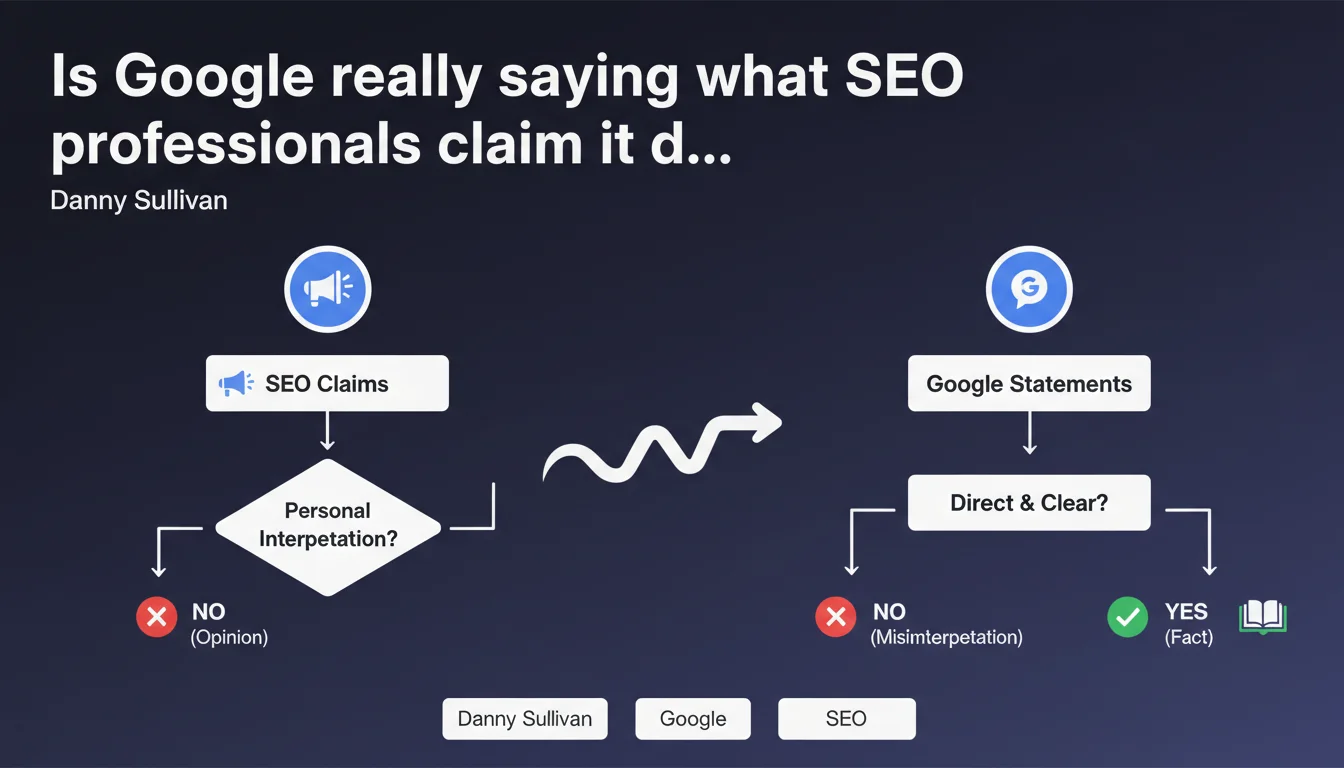
Danny Sullivan reminds us that many statements presented as official Google recommendations are merely personal interpretations. Before applying a supposed "Google best practice," you must systematically verify the direct source and clearly distinguish facts from opinions.
What you need to understand
Why is Google issuing this reminder now?
The SEO ecosystem is full of advice presented as revealed truths from Google. The problem? A large portion of these claims rest on subjective interpretations, extrapolations, or worse, deliberate distortions.
Danny Sullivan observes that too many professionals and publishers relay practices supposedly recommended by Google without ever citing a verifiable official source. This confusion damages the quality of SEO decisions.
What's the difference between an official recommendation and an interpretation?
An official recommendation comes from Google documentation (Search Central, official blog, Google Search Central YouTube videos), from an identified Googler on an official channel, or from a public statement at a Google event. Period.
An interpretation is everything else: expert analysis, field observations, statistical correlations, hypotheses based on tests. These interpretations can be relevant — but they're not Google speaking.
How do you verify that a claim really comes from Google?
The method is simple but rarely applied: demand a direct link to the source. If someone claims "Google recommends X," ask "where exactly?" No link? Then it's an opinion, not a fact.
Consult first and foremost the official Search Central documentation, statements from Danny Sullivan, John Mueller, or Gary Illyes on verified channels (Twitter/X, official forums, videos), and publications on the Google Search Central blog.
- Always ask for the direct source when someone cites a "Google recommendation"
- Clearly distinguish documented facts from expert interpretations
- Prioritize Search Central, official blogs, and verified Googler accounts
- Consider expert analyses as hypotheses to test, not dogmas
- Be wary of categorical statements without precise citations
SEO Expert opinion
Does this clarification really change anything in practice?
Let's be honest: not fundamentally. Seasoned SEO professionals already know how to distinguish between official sources and interpretations. This reminder mainly targets beginners and publishers who blindly relay "SEO tips" without verification.
The real problem remains that Google communicates in deliberately vague ways. Result? Experts fill the gaps with hypotheses — which others then transform into "revealed truths." Danny Sullivan points fingers at the latter, but Google maintains the ambiguity that fuels this phenomenon.
Can you really rely solely on official Google sources?
There's the catch. Google's official statements are often incomplete, contradictory, or evasive. A typical example: claims about the weight of UX signals, regularly qualified to the point of becoming incomprehensible. [To be verified] on each specific use case.
Field observations and A/B tests sometimes provide more actionable value than official generalities. The ideal approach? Cross-reference Google statements + empirical data + controlled tests on your own site. No single source is sufficient.
When are "interpretations" more reliable than official statements?
When they're based on statistically significant and reproducible tests. An expert who tests a hypothesis across 100 sites over 6 months often provides more precision than a Google statement like "speed may influence rankings in some cases."
The pitfall? Confusing correlation with causation. The fact that 90% of position 1 sites have high PageSpeed scores doesn't mean PageSpeed is the determining factor. Expert interpretations are only as good as their testing methodologies — demand these before changing your strategy.
Practical impact and recommendations
What should you concretely do when facing a new "Google recommendation"?
Adopt a systematic verification reflex. When someone claims "Google says that," immediately search for the exact quote with its context. An isolated John Mueller tweet doesn't constitute universal doctrine — verify the date, the question asked, the nuances provided.
Never make massive site changes based on a single unsourced claim. Test first on a controlled sample, measure actual impact, then deploy if results are conclusive. This empirical approach beats blind adherence to the current "best practices" of the moment.
How do you evaluate the credibility of an SEO source?
Prioritize professionals who cite their sources, share their testing methodologies, and acknowledge the limitations of their observations. Beware of categorical statements without nuance or proof.
A credible expert will say "in my tests across 50 e-commerce sites, I observed X" rather than "Google absolutely wants you to do Y." Methodological transparency is the only serious indicator of credibility.
What mistakes should you avoid when interpreting Google communications?
Never generalize a contextual response. When a Googler answers a specific question about a specific use case, don't extrapolate it to all sites. Nuances matter — especially those between "it can have an impact" and "it's a determining factor."
Stop looking for the universal magic recipe. Google will never provide it because it doesn't exist. The algorithm adjusts its criteria based on query type, search intent, industry verticals… What works for a news blog can be counterproductive for an e-commerce site.
- Demand a link to an official source for every "Google recommends"
- Verify the date and context of every Google statement cited
- Clearly distinguish documented facts from expert hypotheses
- Test recommendations on a sample before massive deployment
- Cross-reference official sources, field observations, and controlled A/B tests
- Never modify your strategy based on an isolated tweet
- Prioritize experts who share their testing methodologies
- Accept that certain algorithm mechanisms remain opaque
❓ Frequently Asked Questions
Comment distinguer une recommandation officielle Google d'une interprétation ?
Les interprétations d'experts SEO sont-elles inutiles alors ?
Pourquoi Google ne documente-t-il pas tous les critères de classement ?
Que faire quand deux sources officielles Google se contredisent ?
Les déclarations sur Twitter/X de John Mueller ou Danny Sullivan ont-elles valeur officielle ?
🎥 From the same video 12
Other SEO insights extracted from this same Google Search Central video · published on 08/01/2026
🎥 Watch the full video on YouTube →
💬 Comments (0)
Be the first to comment.