
Official statement
Other statements from this video 12 ▾
- □ Faut-il encore parler de SEO quand on optimise pour ChatGPT ou Gemini ?
- □ Peut-on vraiment réussir en SEO sans experts ni outils spécialisés ?
- □ Pourquoi Google refuse-t-il de recommander des outils SEO spécifiques ?
- □ Pourquoi connaître les guidelines Google est-il indispensable avant de recruter un prestataire SEO ?
- □ Faut-il vraiment faire confiance aux recommandations des outils SEO ?
- □ Google dit-il vraiment ce qu'on lui fait dire en SEO ?
- □ Peut-on vraiment garantir des résultats en SEO ?
- □ Votre outil SEO vous recommande-t-il des pratiques qui pourraient déclencher une pénalité Google ?
- □ Faut-il ignorer les métriques de domaine tierces pour optimiser son SEO ?
- □ Faut-il adapter son contenu spécifiquement pour les LLM et l'IA générative ?
- □ Faut-il arrêter d'optimiser pour les algorithmes de Google ?
- □ Faut-il vraiment arrêter de s'obséder sur les détails techniques en SEO ?
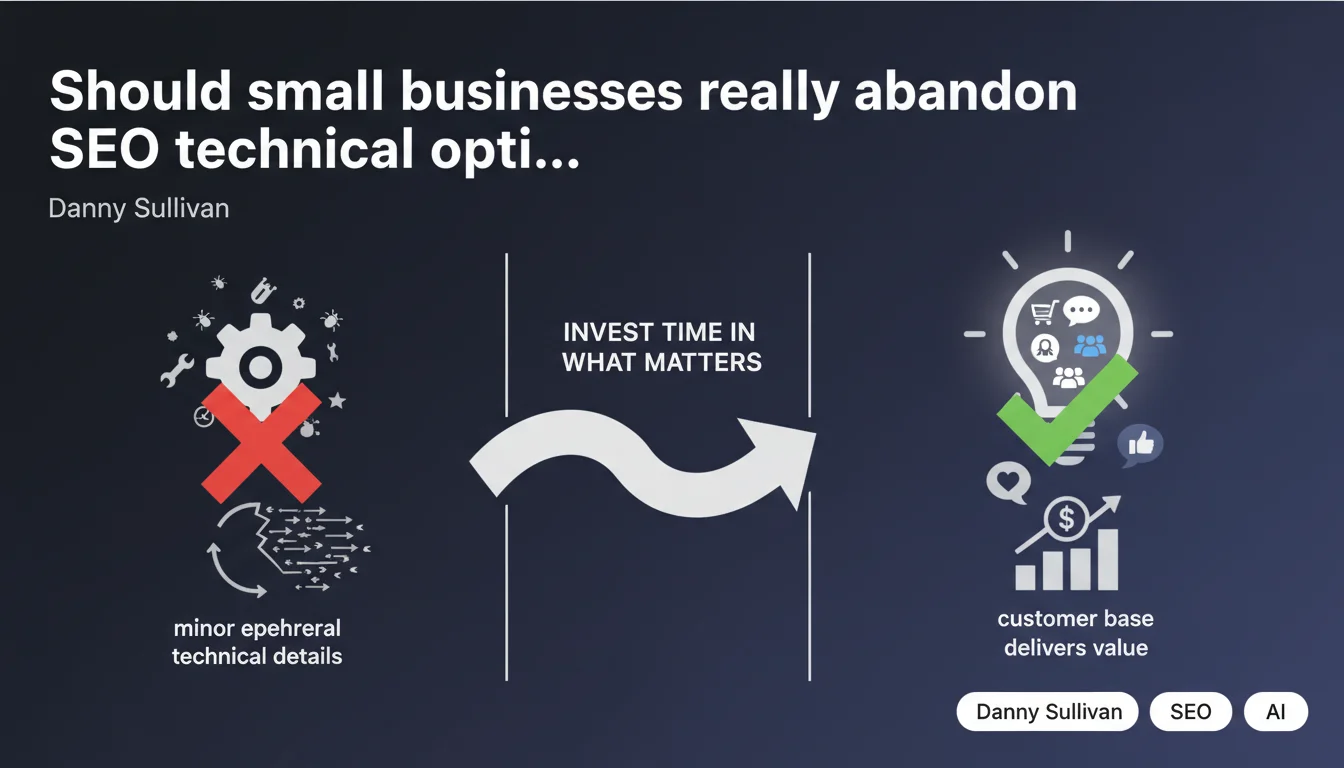
Google claims that small businesses should stop chasing technical details and focus on what delivers real value to their customers. Yet this statement raises more questions than it answers: where exactly is the line between neglecting technical fundamentals and pointless over-optimization?
What you need to understand
What does Google mean by "ephemeral technical details"?
Google is contrasting two approaches here: chasing constantly-changing micro-optimizations versus investing in what creates lasting user value. The underlying idea? A small business that spends three days fine-tuning Schema.org markup would be wasting time compared to a company that improves its product catalog or responds to customer reviews.
The problem with this statement: it stays vague about what constitutes a "minor detail" versus a technical fundamental. Is page load speed ephemeral or essential? Are title tags details or foundational?
Why is Google taking this stance now?
Google is likely trying to ease the SEO anxiety that small players feel when facing increasingly complex ranking signals. With hundreds of documented ranking factors, small businesses often find themselves paralyzed, running endless audits without ever taking action on the ground.
This message is part of a communication strategy aimed at removing guilt from those who lack the budget or resources to optimize everything. But be careful: this is not a free pass to neglect your site structure.
Does this approach apply to all industries?
No. A local restaurant doesn't have the same priorities as a niche e-commerce store with 500 products. For the first, a Google Business Profile and customer reviews carry infinitely more weight than JSON-LD markup.
On the other hand, an online shop selling automotive spare parts can't afford to ignore navigation facets, canonical tags, and mobile speed. For them, technical optimization becomes a direct business lever, not a luxury.
- Technical fundamentals (crawlability, indexation, structure) remain non-negotiable even for small operations
- Advanced optimizations (hreflang, JavaScript rendering, log analysis) can wait if resources are limited
- User-focused content and actual experience take priority over cosmetic tweaks
- Each industry has its own threshold: what's "detail" for one can be strategic for another
SEO Expert opinion
Is this statement consistent with what we observe in practice?
Partially. In hyper-local industries (hairdresser, plumber, bakery), we actually see that service quality, responsiveness, and customer reviews far outweigh perfect technical setup. A basic WordPress site with a few well-written pages is often enough to rank.
But as competition increases — e-commerce, lead generation, B2B services — technical factors become a critical differentiator again. Sites that neglect internal linking, URL structure, or crawl budget management consistently get outranked, regardless of content quality.
What nuances should we add to this advice?
First point: Google often conflates "technical" with "pointless over-optimization". No one disputes that adjusting keyword density to 0.1% is counterproductive. But calling mobile accessibility, heading hierarchy, or server response times "ephemeral details" would be a catastrophically misguided interpretation.
Second nuance — and it's rarely discussed: small businesses that neglect technical fundamentals on principle often get stuck when they try to scale. Rebuilding a site after years of technical neglect costs far more than laying proper foundations from the start. [To verify]: Google never clarifies at what point a small business should shift from a minimalist approach to structured technical strategy.
When does this advice become dangerous?
When it becomes a convenient excuse for inaction. I've seen clients interpret this kind of statement as "Google says technical stuff doesn't matter", which is exactly the opposite of the original message. A site that's inaccessible to crawlers, full of duplicate content, and with chaotic structure won't be saved by "quality content".
Finally, this approach completely ignores the competitive dimension. If your local competitors invest in technical optimization while you stay basic, you'll mechanically lose rankings — regardless of what Google says publicly.
Practical impact and recommendations
What should a small business actually do?
Build a priority matrix rather than abandoning everything or trying to optimize it all. Start with fundamentals: a mobile-responsive site, decent load times (under 3 seconds), logical navigation structure. You don't need perfection, but the baseline is non-negotiable.
Then identify quick-ROI levers for your industry. For local commerce: Google Business Profile, customer reviews, well-documented location pages. For content sites: coherent heading structure, internal linking, image optimization. For e-commerce: detailed product sheets, functional filters, stock availability management.
What mistakes must you absolutely avoid?
Don't confuse "prioritizing essentials" with "ignoring the fundamentals". A non-indexable site or one with critical errors (orphan pages, redirect loops, content blocked by robots.txt) will never recover with brilliant content. These aren't details — they're structural prerequisites.
Also avoid the opposite trap: spending three weeks on micro-data adjustments when your site has no clear value proposition. SEO technical work must serve content and user experience, never become an end in itself.
How do you verify your site covers the essentials without getting bogged down?
Set up a minimal SEO audit every six months. You don't need a 200-page report: focus on KPIs that matter for your business. Key pages indexed? Acceptable mobile load times? Unusually high bounce rates on certain pages?
- Check indexation of key pages via Google Search Console (site:yourdomain.com)
- Monitor load times with PageSpeed Insights — aim for at least 50/100 on mobile
- Ensure your site is mobile-friendly using Google's mobile-friendly test
- Validate consistency of title tags and meta descriptions on strategic pages
- Set up a clean XML sitemap and submit it to Search Console
- Eliminate critical 404 errors on old content with high value
- Implement basic Analytics tracking: organic traffic, top pages, conversion rate
For small businesses, SEO technical work must serve your business objective, not become a time-consuming obsession. Prioritize fundamentals, invest in what generates measurable value, and maintain light monitoring of major shifts.
If you find the balance between technical and content work becoming difficult to maintain — or simply don't have time to manage these aspects while growing your business — hiring a specialized SEO agency might make sense. Targeted support helps structure priorities without spreading your resources thin, while avoiding costly mistakes down the line.
❓ Frequently Asked Questions
Quels sont les fondamentaux techniques qu'une petite entreprise ne peut pas ignorer ?
Comment savoir si je dois investir dans la technique ou le contenu ?
Google pénalise-t-il les petits sites qui ne font pas de technique avancée ?
À quel moment une PME doit-elle passer d'une approche basique à une stratégie SEO structurée ?
Les outils SEO complexes sont-ils nécessaires pour une petite entreprise ?
🎥 From the same video 12
Other SEO insights extracted from this same Google Search Central video · published on 08/01/2026
🎥 Watch the full video on YouTube →
💬 Comments (0)
Be the first to comment.