
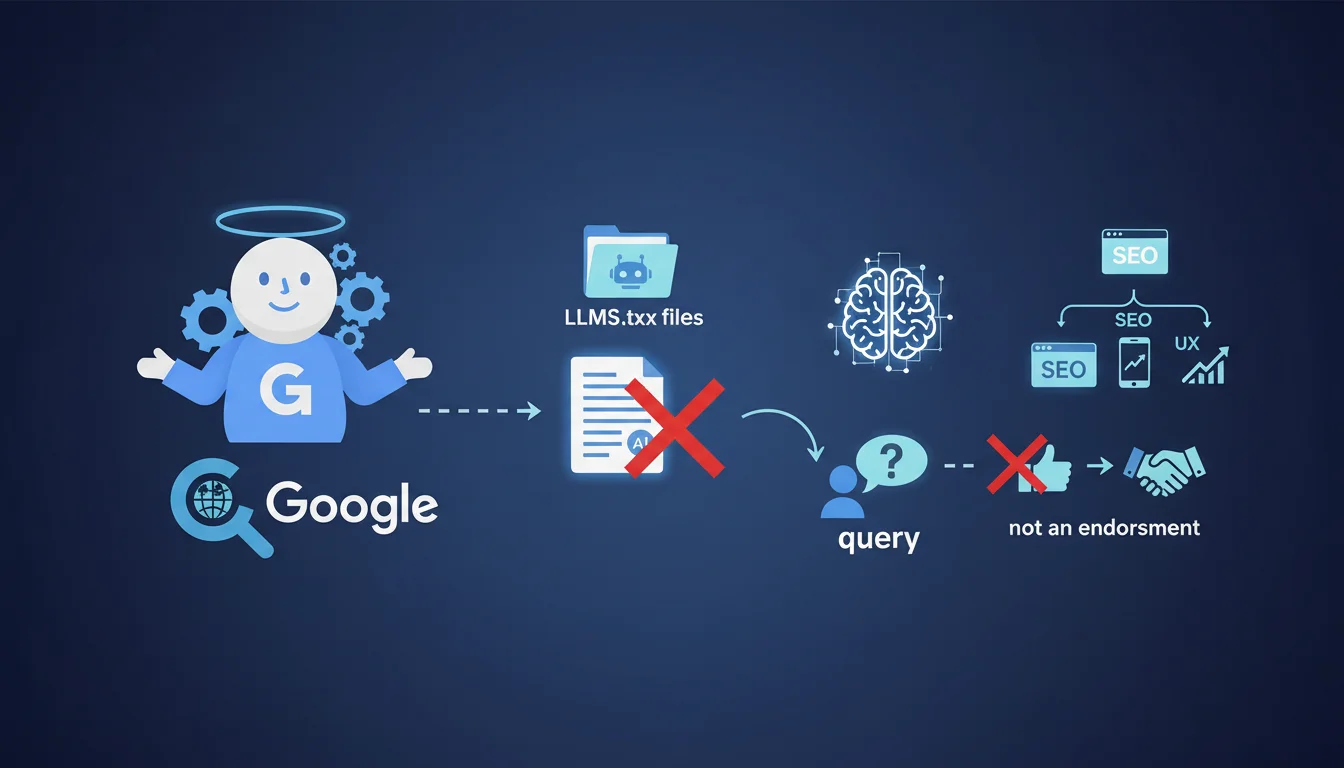
Official statement
When directly asked about this question, Mueller responded categorically on Bluesky: "I'm tempted to say something sarcastic since this comes up so often, but to be direct, no." This wording reveals a certain weariness with the recurrence of this question within the SEO community.
The context is important: a few weeks ago, the CMS used by Google began automatically supporting LLMs.txt files, which added them to many Google documentation sites. While Google's Search team quickly removed them from its own developer docs, other teams did not remove them, either due to lack of attention or indifference. John Mueller had also specified that these files had been added "for other reasons" than one might imagine.
What you need to understand
Google recently clarified its position regarding LLMs.txt files, these new files designed to guide artificial intelligences in content indexing. This clarification comes after the discovery of such files on certain official Google sites.
The context is revealing: the CMS used by Google started automatically generating these files on its documentation. The Search team quickly removed them from its own pages, while other internal teams kept them, without a coordinated strategy.
This situation creates legitimate confusion within the SEO community. If Google itself uses these files on certain sites, does this mean they constitute a ranking factor? The official answer is clear: absolutely not.
- The LLMs.txt files on Google sites are the result of automatic CMS generation, not a deliberate strategy
- Their presence does not in any way constitute a recommendation for webmasters
- Google's Search team has in fact removed these files from its own documentation
- The multiplication of these questions reveals a tendency to over-interpret every technical element discovered on Google properties
SEO Expert opinion
This statement perfectly illustrates a classic trap of modern SEO: believing that every technical element present on Google sites automatically constitutes a best practice to follow. This is a fundamental methodological error.
The reality is that Google is a massive and decentralized organization. The technical choices of one team do not necessarily reflect the recommendations of the Search team. In this specific case, it is simply a CMS feature enabled by default, without strategic reflection on its SEO impact.
Regarding LLMs.txt files in general, they remain relevant to their initial objective: guiding generative AI crawlers like those of ChatGPT or Perplexity. But for traditional Google SEO, their impact is zero. One must not confuse optimization for conversational AIs and optimization for the traditional search engine.
Practical impact and recommendations
This clarification invites you to refocus your SEO priorities on what actually works rather than on speculative trends. Here are the concrete actions to take:
- Do not consider LLMs.txt files as a ranking factor for Google Search
- If you have already implemented an LLMs.txt file for SEO, do not remove it but stop dedicating significant resources to it
- Focus your energy on confirmed signals: quality content, user experience, technical performance, domain authority
- Implement LLMs.txt files only if you have a specific strategy for conversational AIs (ChatGPT, Perplexity, Claude)
- Avoid blindly copying technical choices observed on Google sites without official confirmation of their impact
- Invest instead in optimizing Core Web Vitals, data structure, and content quality
- Document your technical choices based on official statements, not isolated observations
💬 Comments (0)
Be the first to comment.