
Official statement
Other statements from this video 12 ▾
- □ Faut-il encore parler de SEO quand on optimise pour ChatGPT ou Gemini ?
- □ Peut-on vraiment réussir en SEO sans experts ni outils spécialisés ?
- □ Pourquoi Google refuse-t-il de recommander des outils SEO spécifiques ?
- □ Pourquoi connaître les guidelines Google est-il indispensable avant de recruter un prestataire SEO ?
- □ Faut-il vraiment faire confiance aux recommandations des outils SEO ?
- □ Google dit-il vraiment ce qu'on lui fait dire en SEO ?
- □ Peut-on vraiment garantir des résultats en SEO ?
- □ Votre outil SEO vous recommande-t-il des pratiques qui pourraient déclencher une pénalité Google ?
- □ Faut-il ignorer les métriques de domaine tierces pour optimiser son SEO ?
- □ Faut-il adapter son contenu spécifiquement pour les LLM et l'IA générative ?
- □ Faut-il arrêter d'optimiser pour les algorithmes de Google ?
- □ Faut-il vraiment abandonner la technique SEO quand on est une petite entreprise ?
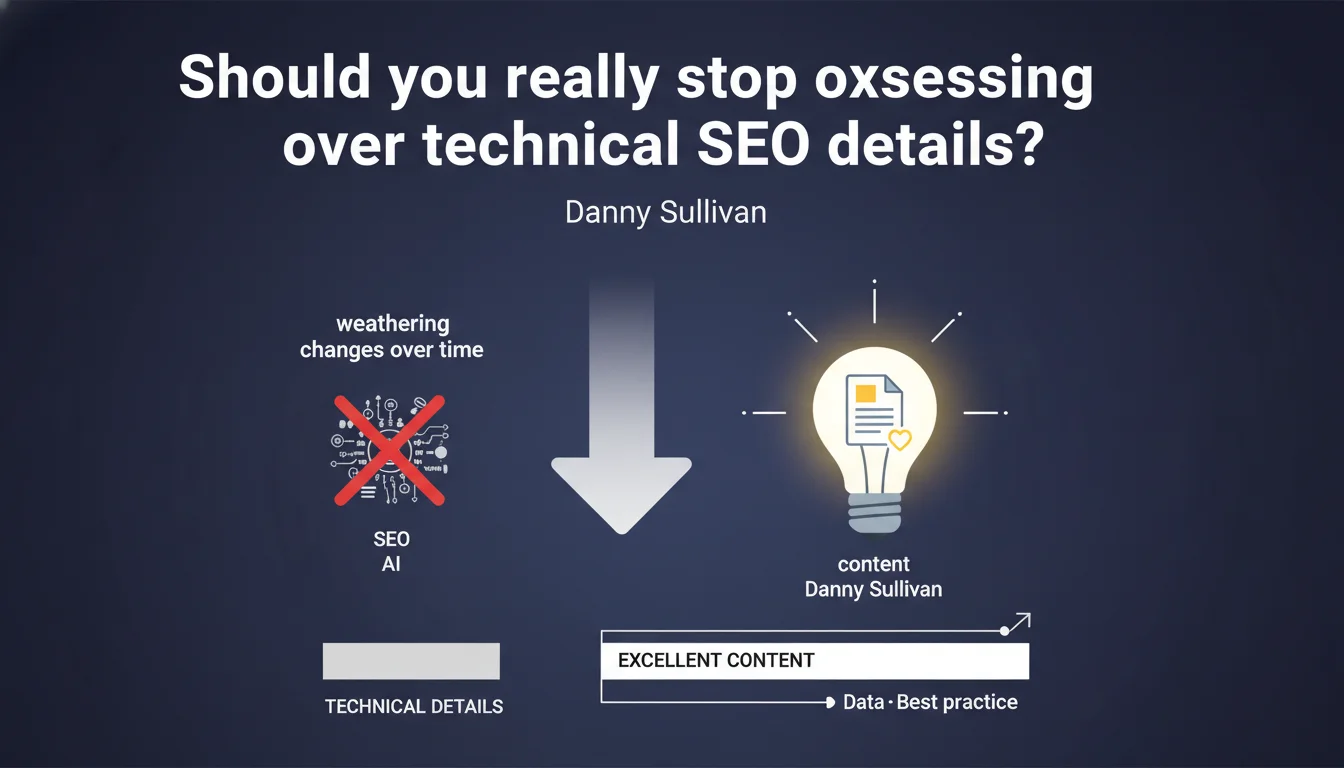
Google claims that focusing on SEO fundamentals and excellent content is more resistant to algorithm updates than optimizing granular technical details. Danny Sullivan relies on internal data to justify this position, without specifying which data. A statement that raises questions about real-world reality where technique often remains decisive.
What you need to understand
What does Google mean by "fundamental principles"?
Google contrasts SEO fundamentals — understanding search intent, creating relevant content, structuring information clearly — with granular technical optimizations. The idea: a site that truly meets user expectations will survive algorithm updates better than a technically over-optimized but hollow site.
The underlying message? Don't waste your time on marginal tag adjustments if your content is mediocre. Except this opposition is flawed — we'll come back to that.
What are these "data" that Google mentions?
Danny Sullivan mentions data showing that excellent content remains the best practice. Problem: no precise metrics, no shared dataset, no definition of what constitutes "excellent content."
[To verify] — Without details on methodology, this claim remains a principle position rather than a substantiated conclusion. Typically Google: reassuring but unverifiable claims.
Why this statement now?
This communication fits Google's usual strategy to recalibrate SEO practices. Facing an industry that deconstructs every algorithmic detail, Mountain View prefers to redirect attention toward more general, less scrutinizable principles.
It's also a way to shift responsibility from the algorithm: if your site drops after an update, it's not a technical bug — it's that your content wasn't "excellent" enough. Convenient.
- SEO fundamentals refer to user intent, content relevance, and information structure
- Google contrasts these principles with technical optimizations, without precisely defining the boundary
- No concrete data is provided to support this hierarchy between fundamentals and technique
- This statement serves to refocus the discussion on qualitative elements difficult to measure
SEO Expert opinion
Does this fundamentals vs. technique opposition hold up?
In principle, yes: a site with empty content will never catch up with perfect schema markup. But in real life, this dichotomy is artificial.
Fundamentals and technique are interdependent. "Excellent" content that loads in 8 seconds on mobile won't perform. User intent well understood but buried in an incomprehensible architecture won't either. Opposing the two ignores that Google is first and foremost a robot that crawls, indexes, and ranks according to technical criteria before even evaluating content "quality."
What do we actually observe in the field?
Sites dominating competitive SERPs master both content and technique. Not one or the other. Core Web Vitals, crawl budget, duplicate content management, internal linking — these "small details" regularly shift positions.
[To verify] — The claim that technique is secondary contradicts years of observations. E-commerce sites that neglect pagination, facets, or canonicals pay the price, even with "excellent" product content. Botched technical migrations destroy traffic regardless of content level.
Is Google being straight with this statement?
Let's be honest: Google has every incentive to simplify its message. Saying "create good content" is more marketable than "optimize your JavaScript rendering, manage your soft 404s, audit your orphaned 302 redirects."
But for a site with 50,000 URLs, dynamic filters, and complex architecture, "small technical details" are exactly what makes the difference between 100,000 and 500,000 organic visits per month. Reducing that to an afterthought denies the reality of SEO at scale.
Practical impact and recommendations
What should you do concretely after this statement?
Don't throw your technical audits in the trash. But revise your priorities: if you're spending 80% of your time on micro-optimizations and 20% on content strategy, you're probably backwards.
Start by auditing intent/content alignment on your strategic pages. Do your pages truly answer what users are searching for? Is the answer immediate, complete, better than the competition? If not, no technical optimization will compensate.
What mistakes should you avoid after this communication?
Don't fall into the trap of excessive overcorrection: abandoning technical rigor under the pretense that "Google says it's not important." That's not what Sullivan is saying — he's saying it resists less well to changes, not that it's useless.
Also avoid treating "excellent content" as a vague, subjective concept. Excellent for Google means: relevant to the query, comprehensive, up-to-date, well-structured, quick to consume. These are measurable criteria, not just "write nicely."
How can you ensure you stay aligned with this Google vision?
- Audit your top traffic pages: do they precisely answer the dominant search intent?
- Compare your content to the top 3 results: are you more comprehensive, clearer, more actionable?
- Verify that your technical optimizations serve user experience, not just crawlability
- Prioritize technical projects that directly impact content accessibility (speed, mobile, structure)
- Invest in regular updates to existing content rather than mass production
- Train your teams to understand user intent before writing
❓ Frequently Asked Questions
Google dit-il que les optimisations techniques ne servent plus à rien ?
Que signifie concrètement un « contenu excellent » pour Google ?
Cette déclaration change-t-elle mes priorités SEO à court terme ?
Les Core Web Vitals font-elles partie des « petits détails techniques » ?
Comment savoir si je suis trop focalisé sur la technique au détriment du contenu ?
🎥 From the same video 12
Other SEO insights extracted from this same Google Search Central video · published on 08/01/2026
🎥 Watch the full video on YouTube →
💬 Comments (0)
Be the first to comment.