
Official statement
Other statements from this video 12 ▾
- □ Faut-il encore parler de SEO quand on optimise pour ChatGPT ou Gemini ?
- □ Peut-on vraiment réussir en SEO sans experts ni outils spécialisés ?
- □ Pourquoi Google refuse-t-il de recommander des outils SEO spécifiques ?
- □ Pourquoi connaître les guidelines Google est-il indispensable avant de recruter un prestataire SEO ?
- □ Google dit-il vraiment ce qu'on lui fait dire en SEO ?
- □ Peut-on vraiment garantir des résultats en SEO ?
- □ Votre outil SEO vous recommande-t-il des pratiques qui pourraient déclencher une pénalité Google ?
- □ Faut-il ignorer les métriques de domaine tierces pour optimiser son SEO ?
- □ Faut-il adapter son contenu spécifiquement pour les LLM et l'IA générative ?
- □ Faut-il arrêter d'optimiser pour les algorithmes de Google ?
- □ Faut-il vraiment arrêter de s'obséder sur les détails techniques en SEO ?
- □ Faut-il vraiment abandonner la technique SEO quand on est une petite entreprise ?
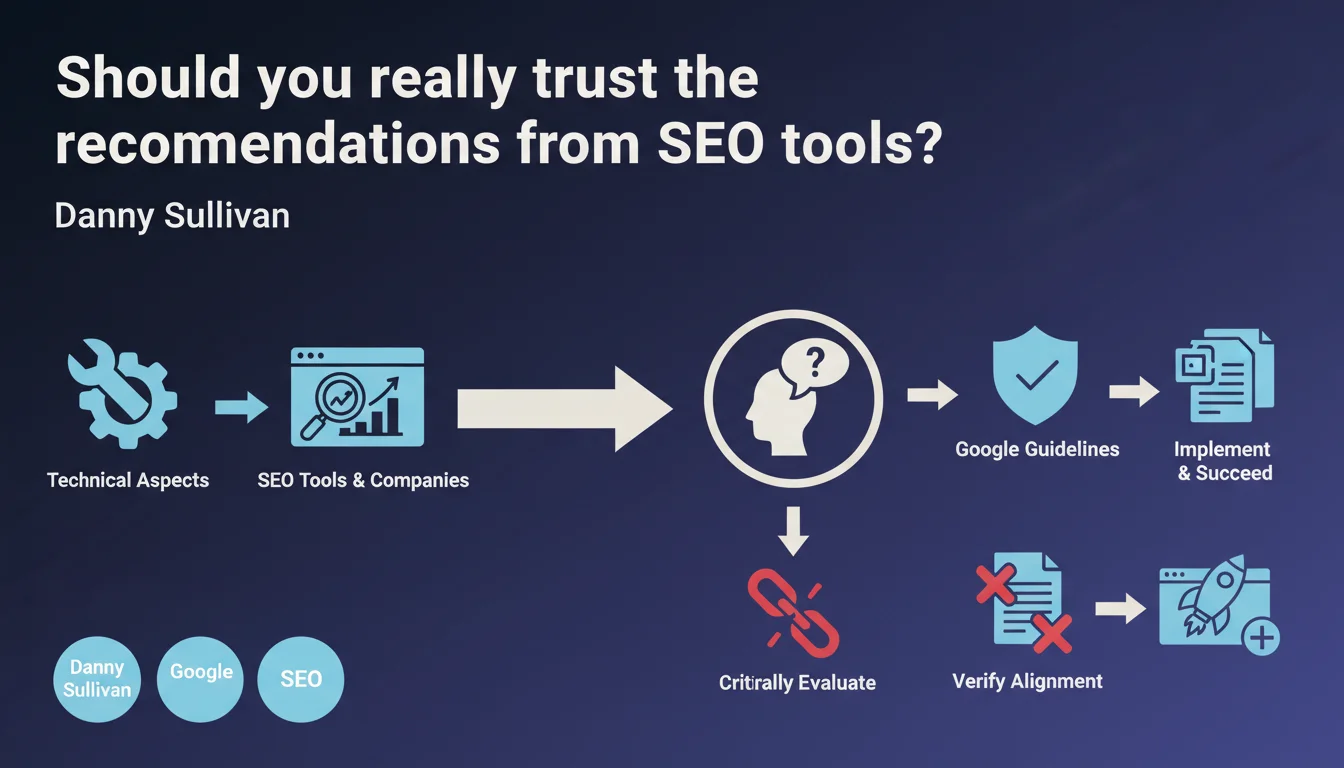
Google acknowledges the usefulness of SEO tools, especially for technical aspects, but calls for critical thinking. Danny Sullivan insists: systematically verify that tool recommendations match official guidelines before blindly applying them to your sites.
What you need to understand
Why does Google warn against SEO tools?
Google doesn't condemn SEO tools — on the contrary, Sullivan explicitly acknowledges their value for technical aspects. The message targets rather the mechanical application of their recommendations without discernment.
The fundamental problem: some tools rely on statistical correlations rather than official guidelines. They can suggest optimizations based on what they observe among well-ranking sites, without guaranteeing these are the true ranking factors.
What types of recommendations should raise red flags?
SEO tools excel at detecting objective technical errors: missing meta tags, 404 errors, loading times, invalid schema markup. This data is factual and verifiable.
Conversely, be wary of subjective recommendations about keyword density, "ideal" content length, or "optimal" number of internal links. These metrics don't appear in any official guidelines and often reflect persistent SEO myths.
How do you evaluate the reliability of a tool recommendation?
Sullivan suggests a simple method: cross-check every recommendation against Google's Search Essentials. If the tool suggests something that doesn't appear anywhere in official documentation, question its relevance.
Some proprietary tools create their own "quality" scores without transparency on their calculation. These metrics can be useful for tracking internal trends, but don't necessarily reflect what Google actually values.
- SEO tools are valuable for technical audits, less reliable for editorial recommendations
- Always verify that a recommendation has an equivalent in official guidelines
- Correlations observed by tools don't prove causality in ranking matters
- Develop critical thinking rather than mechanically applying suggestions
- Technical aspects (crawl errors, speed, mobile) are more objectively measurable than editorial aspects
SEO Expert opinion
Is this position consistent with Google's practices?
Let's be honest: this statement smacks more of shirking responsibility than revelation. Google knows full well that the majority of sites apply third-party tool recommendations — including Search Console and PageSpeed Insights, which are themselves... tools.
The underlying message? "If you follow bad advice, it's your fault, not the tool's." Convenient for Google, which thus avoids any responsibility for the excesses of the SEO industry it largely contributed to creating through lack of transparency.
What nuances should be added to this recommendation?
Sullivan implicitly distinguishes two categories: technical aspects (where tools excel) and everything else. But this boundary is blurry in practice.
Take Core Web Vitals. Tools measure LCP, FID, CLS with precision — that's technical, it's factual. But when they recommend moving from 2.4s to 2.3s LCP to "improve your ranking", that's already interpretation. Google has never communicated precise thresholds for ranking impact. [To verify]
Another example: tools detect duplicate content. Technical recommendation? Yes. But when they systematically suggest canonicalizing or noindexing, they oversimplify. Google handles internal duplicates very well in many cases.
In which cases does this rule not really apply?
Sullivan mentions official guidelines as the absolute reference. The problem: these guidelines remain deliberately vague on 80% of concrete situations that practitioners encounter.
What do the Search Essentials say about optimal internal linking? About ideal click depth? About the number of products per category page? Nothing concrete. Tools fill this void with their own heuristics — not always wrong, by the way.
Practical impact and recommendations
What should you actually do with your SEO tools?
First, establish a trust hierarchy. Raw data (crawl, server logs, analytics) is reliable. Automated interpretations are much less so.
Use tools to identify problems, not to dictate solutions. If Screaming Frog detects 500 pages with duplicate titles, that's factual. But the tool's recommendation on how to rewrite them falls to your expertise, not an algorithm.
Systematically cross-check recommendations against three filters: 1) Is it mentioned in Search Essentials? 2) Is it consistent with your on-the-ground experience? 3) Is it aligned with your business strategy?
What mistakes should you avoid when using tools?
The classic error: treating proprietary scores as absolute truths. An "SEO score" of 67/100 means nothing to Google. These metrics are useful for measuring your progress, not for predicting your ranking.
Another trap: optimizing for the tool rather than for the user. If you rewrite a perfectly clear title just to reach 60 characters because the tool demands it, you're on the wrong track.
Finally, don't overlook sector context. Generic tool recommendations often ignore your industry specifics, your audience, your business model. A media site doesn't optimize like an e-commerce site, which doesn't optimize like a B2B SaaS platform.
How do you build a reliable audit methodology?
Start from Search Console data — that's what Google actually sees. Identify pages with impressions but low CTR, queries losing positions, indexing errors.
Then use your third-party tools to dig into technical causes: loading times, HTML errors, click depth, internal linking. But always keep your eye on business objectives, not vanity metrics.
- Verify that each tool recommendation has an equivalent in Search Essentials
- Prioritize objective technical fixes (404 errors, missing tags, speed) over subjective optimizations
- Never mass-apply tool-suggested modifications without case-by-case analysis
- Cross-reference multiple tool sources to spot inconsistencies in their recommendations
- Document applied changes to measure their actual impact on traffic, not on tool scores
- Train teams to distinguish correlation from causality in SEO analysis
- Maintain an updated Google guidelines repository for quick challenge of recommendations
- Test optimizations on a sample of pages before global rollout
❓ Frequently Asked Questions
Google déconseille-t-il l'utilisation des outils SEO ?
Quels types de recommandations d'outils sont les plus fiables ?
Comment vérifier qu'une recommandation correspond aux guidelines Google ?
Les scores SEO des outils (type "67/100") ont-ils une valeur pour le ranking ?
Faut-il ignorer les recommandations qui ne figurent pas dans les guidelines ?
🎥 From the same video 12
Other SEO insights extracted from this same Google Search Central video · published on 08/01/2026
🎥 Watch the full video on YouTube →
💬 Comments (0)
Be the first to comment.