
Official statement
Other statements from this video 12 ▾
- □ Faut-il encore parler de SEO quand on optimise pour ChatGPT ou Gemini ?
- □ Peut-on vraiment réussir en SEO sans experts ni outils spécialisés ?
- □ Pourquoi Google refuse-t-il de recommander des outils SEO spécifiques ?
- □ Faut-il vraiment faire confiance aux recommandations des outils SEO ?
- □ Google dit-il vraiment ce qu'on lui fait dire en SEO ?
- □ Peut-on vraiment garantir des résultats en SEO ?
- □ Votre outil SEO vous recommande-t-il des pratiques qui pourraient déclencher une pénalité Google ?
- □ Faut-il ignorer les métriques de domaine tierces pour optimiser son SEO ?
- □ Faut-il adapter son contenu spécifiquement pour les LLM et l'IA générative ?
- □ Faut-il arrêter d'optimiser pour les algorithmes de Google ?
- □ Faut-il vraiment arrêter de s'obséder sur les détails techniques en SEO ?
- □ Faut-il vraiment abandonner la technique SEO quand on est une petite entreprise ?
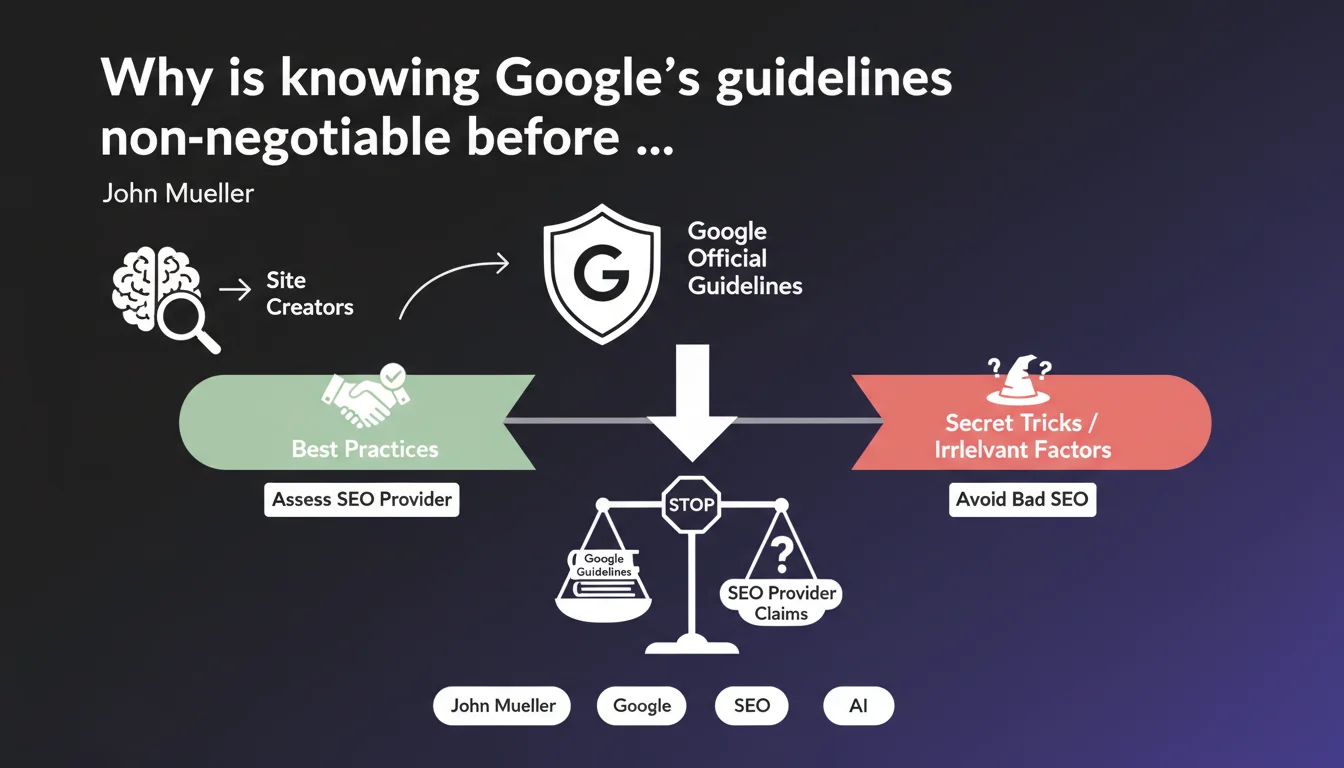
Mueller is clear: a site owner who doesn't master Google's official directives can't properly evaluate an SEO provider. The result? They risk paying for fancy optimizations marketed as "secret tricks." Knowledge of Google's fundamentals isn't optional—it's a prerequisite.
What you need to understand
What is Mueller really saying in this statement?
The message is straightforward: before even considering hiring an SEO specialist, a site creator must grasp the Search Essentials and understand how Google evaluates quality. Without this foundation, it's impossible to distinguish between an expert applying best practices and a charlatan charging for keyword stuffing while claiming to have "exclusive methods."
Mueller isn't saying you need to become an SEO expert—he's saying you need the minimum baseline knowledge to avoid being misled. Important distinction.
Why does Google push so hard on reading the guidelines?
Because most SEO scams exploit client ignorance. When a provider promises "page 1 guaranteed in 3 months" or sells backlinks in bulk, a site owner who knows the guidelines instantly recognizes it as nonsense. Google wants educated clients who challenge their providers—and who stop funding toxic practices.
Second reason: the Search Essentials define the playing field. If a provider optimizes factors Google doesn't recognize as relevant (outdated keyword density, meta keywords, etc.), that's wasted time and money.
What concrete risks does an uninformed site owner face?
Worst case scenario? Paying for black hat techniques disguised as premium strategy. Private blog networks, content spinning, cloaking—anything that triggers manual action or algorithmic demotion. The site owner discovers the truth when traffic crashes—too late.
Another frequent risk: investing in non-priority optimizations. A provider might spend weeks perfecting cosmetic details (meta descriptions to the pixel, over-optimized heading tags) while real problems—poor crawlability, duplicate content, terrible site speed—go unaddressed.
- Knowing the guidelines lets you filter out charlatans and challenge your provider's recommendations
- "Secret tricks" don't exist: everything that matters is either documented by Google or discoverable through rigorous testing
- An educated site owner immediately spots unrealistic promises and risky tactics
- Ignorance is expensive: poor investments, penalties, lost confidence in SEO
SEO Expert opinion
Is this recommendation realistic for all site owners?
Let's be honest: expecting an entrepreneur or marketing manager to read and understand the Search Essentials before hiring is legitimate—but not always practical. Someone launching an e-commerce store doesn't have the time or appetite to dig through 50 pages of technical Google documentation.
What's realistic is having a high-level overview. Understand the three pillars—quality content, user experience, healthy link profile—and know that Google punishes flagrant manipulation. That's enough to spot 90% of red flags during a sales pitch.
Are Google's guidelines really sufficient to evaluate a provider?
Not entirely. The Search Essentials define what NOT to do (spam, cloaking, schema abuse), but remain intentionally vague on what actually works. Google will never publish "here's how to rank #1 on a competitive query." [To verify]: a provider can meticulously follow the guidelines and still be completely ineffective.
Real evaluation also requires practical questions: How do you handle content overlap? What methodology for semantic audits? How do you measure optimization impact? A solid SEO specialist can explain their approach using the guidelines as a foundation, but also backed by data and experimentation.
What if a provider contradicts the guidelines but delivers results?
It happens—and that's where things get complicated. Some gray hat techniques (discreet PBNs, aggressive link building) can temporarily boost rankings. The problem? Those gains are fragile and risky. Google sometimes takes months to catch certain manipulations, but when it does, the penalty is brutal.
If a provider says "I know Google discourages X, but it works," ask yourself: are you willing to take that risk? On a high-stakes project, the answer is usually no. On a test site or secondary project, maybe—but with full awareness.
Practical impact and recommendations
How should a site owner prepare before hiring an SEO specialist?
Bare minimum: read the Search Essentials (30 minutes for a first pass), watch a few Search Central YouTube videos, and skim the "What not to do" sections of the official documentation. The goal isn't to become an expert, but to build the vocabulary and reference points to understand what you're being offered.
Then prepare a list of qualifying questions for your interviews. Not trick questions to impress, but questions that reveal the provider's methodology and ethics.
What alarm bells should you watch for during an SEO pitch?
First red flag: guaranteed ranking promises. "We'll get you #1 on Google in 60 days"—nobody can guarantee that except by buying ads. Second alert: a provider who talks exclusively about tactics (backlinks, keywords) without ever mentioning content, UX, or search intent.
Third signal: refusal to be transparent about methods. If a provider dodges when you ask "where do your backlinks come from?," they're probably from a network of fake sites. Finally, be wary of "we have contacts at Google" or "we know the secret algorithm" talk—that's low-grade marketing.
What should you do concretely after hiring a provider?
Even after signing the contract, keep watch over what's being done. Request detailed monthly reports with clear KPIs (organic traffic, rankings on key queries, conversions). If the provider can't simply explain why they made a specific optimization, that's suspicious.
Regularly check Google Search Console: manual actions, indexing errors, incoming link profile. A good provider will never hide this data—in fact, they'll use it to drive strategy.
- Read the Search Essentials and understand the three pillars (content, UX, links)
- Prepare a list of methodology questions before interviews
- Spot unrealistic promises and opaque messaging
- Demand complete transparency on techniques being used
- Regularly monitor Search Console and Google Analytics
- Require monthly reports with actionable KPIs
❓ Frequently Asked Questions
Dois-je devenir expert SEO pour recruter un bon prestataire ?
Les Search Essentials suffisent-elles pour évaluer la qualité d'une stratégie SEO ?
Que faire si un prestataire refuse d'expliquer ses méthodes ?
Un prestataire peut-il respecter les guidelines et être inefficace ?
Comment vérifier qu'un prestataire ne fait pas de black hat en douce ?
🎥 From the same video 12
Other SEO insights extracted from this same Google Search Central video · published on 08/01/2026
🎥 Watch the full video on YouTube →
💬 Comments (0)
Be the first to comment.