
Official statement
Other statements from this video 12 ▾
- □ Is SEO still the right term when you're optimizing for ChatGPT or Gemini?
- □ Can you really succeed in SEO without experts or specialized tools?
- □ Why does Google refuse to endorse or recommend specific SEO tools?
- □ Why is knowing Google's guidelines non-negotiable before hiring an SEO specialist?
- □ Should you really trust the recommendations from SEO tools?
- □ Is Google really saying what SEO professionals claim it does?
- □ Can you really guarantee results in SEO?
- □ Is your SEO tool recommending tactics that could trigger a Google penalty?
- □ Should you really ignore third-party domain metrics to optimize your SEO strategy?
- □ Should you adapt your content specifically for LLMs and generative AI?
- □ Should you really stop obsessing over technical SEO details?
- □ Should small businesses really abandon SEO technical optimization?
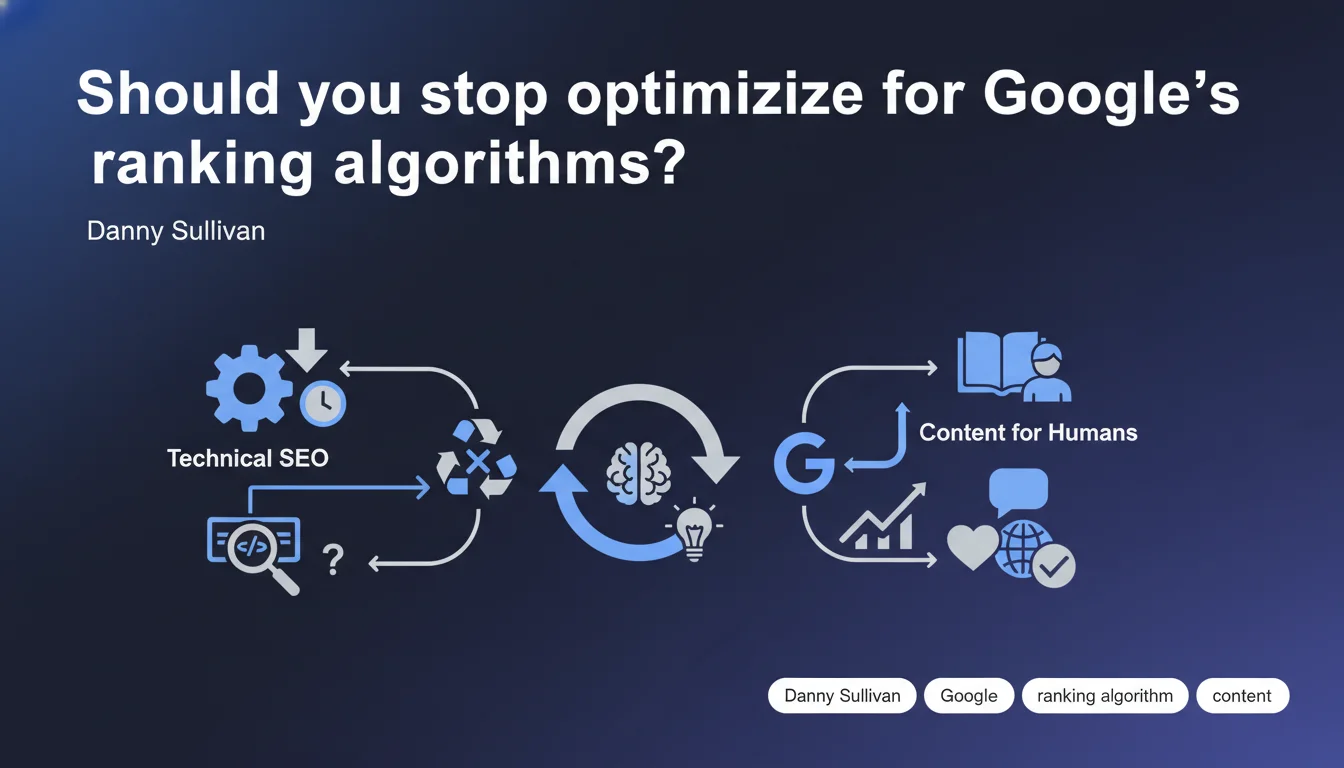
Google claims that optimizations targeting a specific ranking system quickly become outdated. Algorithms evolve to reward content created for humans, making temporary technical adjustments poorly cost-effective. The long-term approach: create for the user, not for today's algorithm.
What you need to understand
Why does Google declare that certain optimizations become obsolete?
Google's ranking systems are not fixed. They evolve constantly, and what worked six months ago can be neutralized or deprioritized today. When you optimize for a specific signal — say, stuffing exact keywords or multiplying FAQ sections — you're betting on a momentary configuration.
The problem? Google adjusts its weightings, introduces new signals, refines its models. A tactic that generated quick gains can lose its effectiveness overnight, even without an official update announcement.
What does "content written for humans" concretely mean?
This phrase keeps coming up in Google's communications. Behind the jargon, the idea is simple: prioritize real usefulness rather than compliance with an SEO checklist. An article that precisely answers a question, that structures information clearly, that avoids filler — that's what Google wants to reward.
Let's be honest: it remains vague. Google never gives an operational definition. But the underlying principle is that user experience takes precedence over blind technical optimization. If your content only serves to check off SEO boxes, it risks losing visibility as systems evolve.
What types of optimizations does this statement target?
Google likely targets micro-technical adjustments: over-optimization of schema tags, excessive repetition of target queries, structures artificially designed only for crawlers. Everything that brings nothing to the reader but aims to exploit an identified ranking signal.
The implicit message — stop chasing every algorithmic detail. Focus on editorial quality, relevance, and real authority. Technical signals remain important, but they should serve the experience, not replace it.
- Ranking systems evolve constantly, making certain optimizations obsolete
- Google values content created for users, not algorithms
- Temporary technical adjustments can become a waste of time and resources
- The sustainable strategy: prioritize real usefulness and user experience
SEO Expert opinion
Does this statement match what we observe in practice?
Yes and no. It's true that certain SEO tactics have a limited lifespan. Keyword stuffing techniques, link farms, mass-generated content — all of that has gradually lost effectiveness. Google has indeed strengthened its ability to detect manipulation.
But — and this is where it gets sticky — well-thought-out technical optimizations remain profitable. Clean semantic markup, coherent internal link architecture, optimized load times: all of this continues to make a difference. Saying that "focusing on technical details" is a poor use of resources is a misleading shortcut.
The real problem is obsession with one-off signals. If you spend hours adjusting a detail because an SEO blog said it boosted CTR by 0.3%, yes, that's probably wasted time. But structuring your site correctly — that remains fundamental. [To verify]: Google never specifies where to draw the line between useful optimization and pointless over-optimization.
What nuances should be added to this message?
Google tends to oversimplify in its public communications. "Create good content for users" — easy to say, but what does that concretely mean? A 500-word well-targeted article can outperform a poorly structured 3000-word block. And vice versa.
The reality of SEO is balance. Yes, you need to think about users. But no, that doesn't exempt you from mastering technical fundamentals. A slow site, poorly crawlable, with a shaky architecture will never rank, even if the content is great. Both dimensions are inseparable.
In what cases does this rule not apply?
There are ultra-competitive sectors where technical optimization makes all the difference. E-commerce, finance, health: on these verticals, everyone produces "good content." What sets positions 1 to 10 apart is precisely technical finesse — structured data, speed, internal linking, backlink authority.
In these contexts, ignoring technical details in favor of a naive "content for humans" approach is condemning yourself to page 3. Google's statement applies mainly to generalist content sites, less so to environments where every millisecond and every link counts.
Practical impact and recommendations
What should you concretely do following this statement?
Reorient your priorities. Instead of chasing every micro-algorithmic signal, invest in the real usefulness of your content. Ask yourself: does this article/page precisely answer a search intent? Is the information structured so the user quickly finds what they're looking for?
Concretely, that means less time on cosmetic adjustments (keyword density, exact meta description length) and more time on analyzing user needs, editorial enrichment, improving reading experience.
On the technical side, focus on lasting fundamentals: clear site architecture, optimized load times, clean semantic markup (not overloaded). Avoid opportunistic tactics aimed at exploiting a temporary flaw.
What mistakes should you avoid following this announcement?
First mistake: bet everything on content while neglecting technical aspects. Yes, content is central. No, that doesn't mean you can ignore load speed, HTML structure, or crawl budget. A poorly built site will never rank, even with Shakespearean content.
Second mistake: interpret this message as "Google no longer rewards optimization." False. Google rewards intelligent optimization, the kind that actually improves experience. It no longer rewards artificial patches that bring nothing to the user.
Third mistake: abandon all ranking signal analysis. Understanding how Google works remains essential. The message is not to get locked into static optimization for a fixed algorithm — it's not to renounce all technical understanding.
How do you verify that your strategy is aligned with this vision?
Test your content with a user perspective. Ask someone unfamiliar with the topic to read your page: do they quickly find the information? Is the structure clear? Is the tone useful or just stuffed with keywords?
Analyze your behavioral metrics: time spent, bounce rate, scroll depth. If your pages are well-optimized for Google but nobody reads them, that's an alarm signal. Google increasingly detects these engagement signals.
Finally, diversify your traffic sources. A healthy SEO strategy shouldn't rely solely on exploiting a temporary signal. If an update breaks everything, it means your approach was too fragile.
- Prioritize real usefulness of content over cosmetic adjustments
- Maintain technical fundamentals (speed, structure, clean markup)
- Avoid opportunistic tactics aimed at exploiting temporary flaws
- Test your content with a user perspective, not just SEO
- Analyze behavioral metrics (engagement, time spent, bounce)
- Don't neglect technical aspects under the guise of "content for humans"
- Diversify your traffic sources so you don't depend on a single signal
❓ Frequently Asked Questions
Google dit-il qu'il ne faut plus faire d'optimisation technique ?
Qu'est-ce qu'un « contenu écrit pour les humains » selon Google ?
Cette déclaration signifie-t-elle que les mises à jour d'algorithme n'impactent plus le SEO ?
Faut-il abandonner l'analyse des signaux de classement Google ?
Comment savoir si mon optimisation est trop technique ou juste nécessaire ?
🎥 From the same video 12
Other SEO insights extracted from this same Google Search Central video · published on 08/01/2026
🎥 Watch the full video on YouTube →
💬 Comments (0)
Be the first to comment.