
Official statement
Other statements from this video 12 ▾
- □ Is SEO still the right term when you're optimizing for ChatGPT or Gemini?
- □ Why does Google refuse to endorse or recommend specific SEO tools?
- □ Why is knowing Google's guidelines non-negotiable before hiring an SEO specialist?
- □ Should you really trust the recommendations from SEO tools?
- □ Is Google really saying what SEO professionals claim it does?
- □ Can you really guarantee results in SEO?
- □ Is your SEO tool recommending tactics that could trigger a Google penalty?
- □ Should you really ignore third-party domain metrics to optimize your SEO strategy?
- □ Should you adapt your content specifically for LLMs and generative AI?
- □ Should you stop optimizing for Google's ranking algorithms?
- □ Should you really stop obsessing over technical SEO details?
- □ Should small businesses really abandon SEO technical optimization?
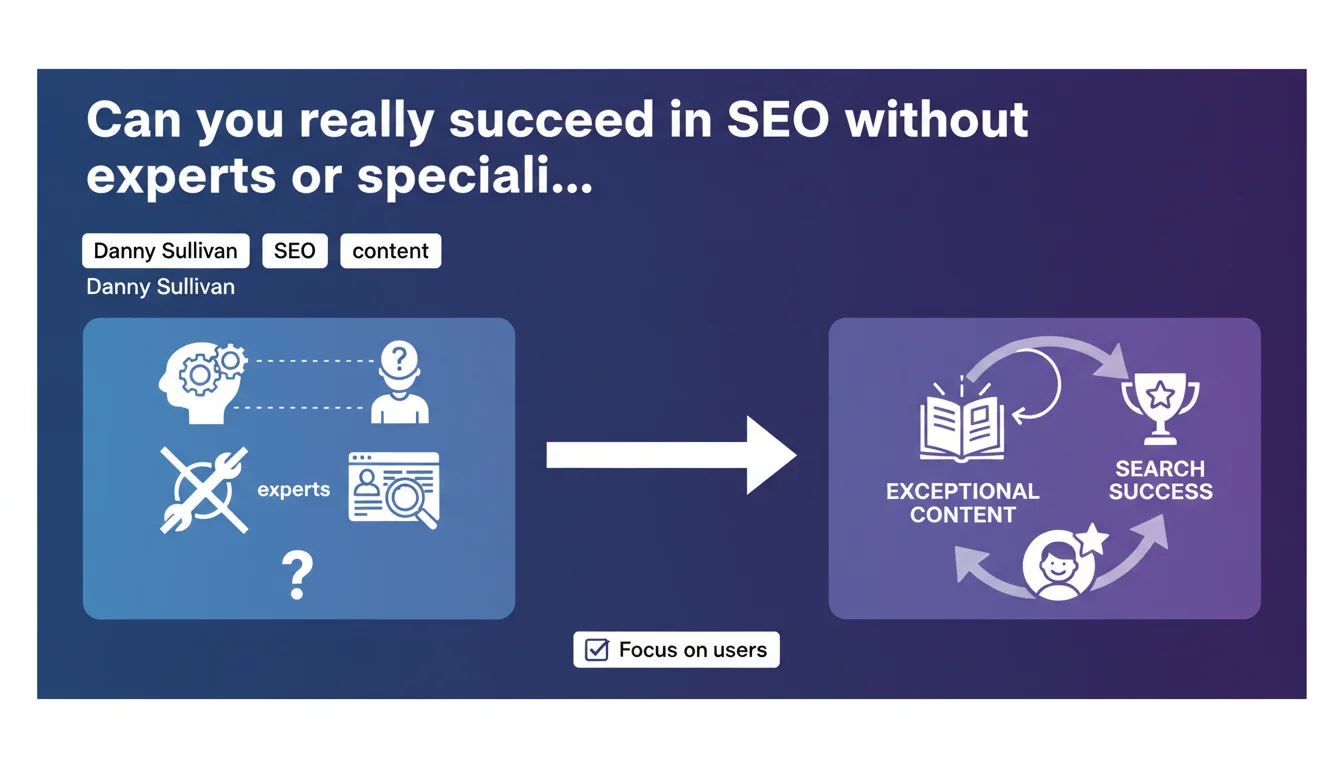
Google claims that many sites perform well in search without ever thinking about SEO, focusing solely on creating exceptional content for users. This statement positions high-quality content as the only true foundation for organic success, downplaying the role of SEO tools and experts.
What you need to understand
What is Google really trying to say with this statement?
Danny Sullivan insists on a user-centered vision rather than a search engine-centered one. The underlying message: if you create exceptional content that answers people's real needs, technical signals will follow naturally.
This position is consistent with Google's official discourse for years — prioritizing user intent over technical optimizations. However, it masks a reality: these sites that "don't think about SEO" often intuitively respect the fundamentals without realizing it.
Which sites actually succeed without conscious SEO?
Typical examples include reference media, platforms with a captive audience, or brands already established offline. A site like Le Monde or Wikipedia doesn't need to optimize its title tags — its authority and content quality more than compensate.
But these cases represent a minority. The majority of sites — e-commerce, specialized blogs, local businesses — operate in ultra-competitive environments where exceptional content alone is not enough to stand out.
Is Google intentionally downplaying the technical role of SEO?
This statement may seem simplistic or even naive to those who understand field realities. Google prefers to promote an idealized vision where the best content always wins, but ignores dynamics around crawl budget, information architecture, page load speed, or internal linking.
A site with exceptional content but catastrophic architecture, 8-second load times, and non-existent internal linking will never perform well. Content is necessary, but rarely sufficient.
- High-quality content remains the foundation of any viable SEO strategy
- Sites with pre-existing authority can afford to neglect certain technical aspects
- For most sites, ignoring technical SEO amounts to voluntarily handicapping visibility potential
- Google values the "content first" narrative to prevent algorithmic manipulation
SEO Expert opinion
Is this statement consistent with real-world observations?
Let's be honest: it's a half-truth. Yes, some sites perform without formal SEO strategy. But saying that "many sites" succeed this way hides a more complex reality.
Sites that succeed "naturally" often have structural advantages: established domain authority, massive organic backlinks, brand recognition, intuitive architecture by default. They do SEO without knowing it — and that's very different from saying SEO isn't necessary.
In which cases does this rule absolutely not apply?
For an e-commerce site with 10,000 product sheets, ignoring facet optimization, duplicate content management, or URL structure means leaving 80% of your catalog invisible. Exceptional content doesn't compensate for disastrous architecture.
Same for a local site competing against competitors who optimize their Google Business Profile, local citations, and schema.org markup. The world's best content won't get you into the Local Pack if Google doesn't understand your geographic location.
What is the real intention behind this discourse?
Google seeks to discourage manipulative practices — keyword stuffing, link farms, mass-generated content without value. By insisting on "exceptional content," they attempt to refocus webmasters on quality rather than excessive optimization.
But this communication creates a deliberate blind spot. Google will never publicly acknowledge that its algorithm is influenceable through specific technical levers — that would be admitting the system remains manipulable. [To verify]: no Google study actually quantifies how many sites "succeed without thinking about SEO" or what "succeeding" means in this context.
Practical impact and recommendations
What should you concretely do with this information?
Don't fall into the binary opposition trap of content vs. technique. Both are inseparable. Exceptional content that's poorly structured, slow to load, or invisible to Googlebot serves no one.
The real lesson: always start with content and user intent, then ensure your technical infrastructure doesn't sabotage your efforts. Technical SEO isn't there to "artificially inflate" your rankings — it ensures your quality content can be crawled, indexed, understood, and served for the right queries.
What mistakes should you avoid following this statement?
Classic mistake: interpreting this message as "I can ignore technical optimizations." That's wrong. A site with exceptional content but catastrophic loading speed, flat architecture, or missing canonical tags leaves tens of thousands of visitors on the table.
Another trap: believing that "exceptional content" means "long content." Google values relevance and usefulness, not volume. A 500-word guide perfectly targeted will beat a 3000-word article off-topic.
How do you verify that your site benefits from this content-technique balance?
- Audit your actual indexation rate: how many submitted pages are actually indexed? A significant gap signals a technical issue.
- Analyze user behavior on your content: bounce rate, time on page, scroll depth. "Exceptional" content generates measurable engagement.
- Check your Core Web Vitals — degraded technical experience handicaps even the best content.
- Compare your organic rankings with the perceived quality of your content. If you're consistently on pages 2-3 despite solid content, the issue is technical or authority-related.
- Evaluate your internal linking: are your strategic pieces receiving enough internal link juice to be valued?
❓ Frequently Asked Questions
Un site peut-il vraiment ranker sans aucune optimisation SEO ?
Que signifie exactement « contenu exceptionnel » selon Google ?
Dois-je arrêter d'utiliser des outils SEO après cette déclaration ?
Cette déclaration signifie-t-elle que Google pénalise les optimisations techniques ?
Comment Google identifie-t-il qu'un contenu est « exceptionnel » ?
🎥 From the same video 12
Other SEO insights extracted from this same Google Search Central video · published on 08/01/2026
🎥 Watch the full video on YouTube →
💬 Comments (0)
Be the first to comment.