
Official statement
Other statements from this video 12 ▾
- □ Is SEO still the right term when you're optimizing for ChatGPT or Gemini?
- □ Can you really succeed in SEO without experts or specialized tools?
- □ Why does Google refuse to endorse or recommend specific SEO tools?
- □ Why is knowing Google's guidelines non-negotiable before hiring an SEO specialist?
- □ Should you really trust the recommendations from SEO tools?
- □ Is Google really saying what SEO professionals claim it does?
- □ Can you really guarantee results in SEO?
- □ Is your SEO tool recommending tactics that could trigger a Google penalty?
- □ Should you really ignore third-party domain metrics to optimize your SEO strategy?
- □ Should you stop optimizing for Google's ranking algorithms?
- □ Should you really stop obsessing over technical SEO details?
- □ Should small businesses really abandon SEO technical optimization?
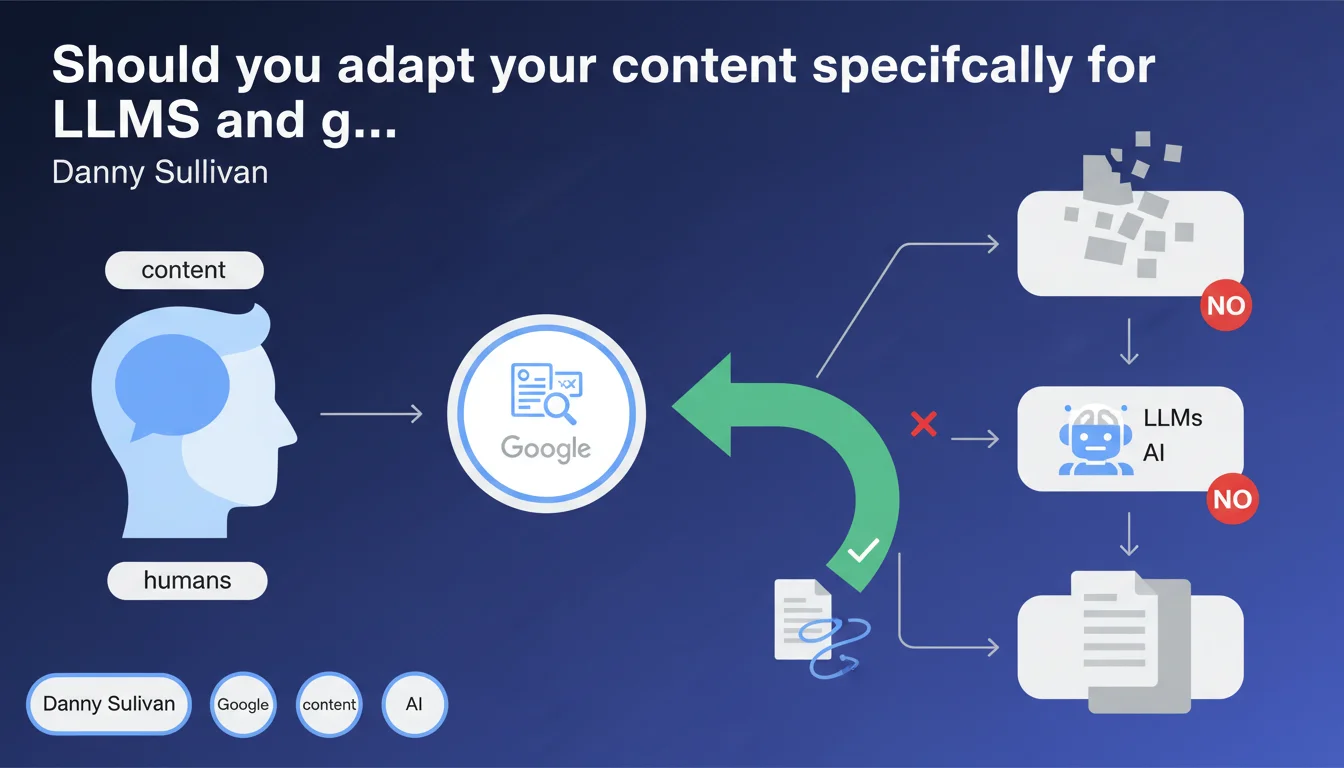
Google explicitly asks you not to break up your content into fragments to please LLMs, nor to create two distinct versions of the same page. The approach remains unchanged: create for humans first, not for search systems — whether traditional or generative.
What you need to understand
Why is Google issuing this warning now?
With the rise of AI Overviews and generative systems, some publishers have started fragmenting their content into hyper-targeted chunks. The idea: increase the chances of being cited in an AI-generated answer by offering perfectly calibrated content fragments.
Google is putting an end to this logic. The algorithm doesn't want you to pre-chew the work for LLMs by artificially breaking up information. This approach risks degrading user experience in favor of questionable technical optimization.
What does "not breaking content into tiny pieces" actually mean?
It's not about banning short paragraphs or structured sections. The target is excessively fragmented content: pages split into dozens of micro-sections without narrative coherence, or worse, creating parallel versions optimized differently depending on the bot type.
Well-structured content with clear headings and logical paragraphs remains perfectly valid. It's the artificial over-optimization that poses a problem — the kind that sacrifices reading flow to mechanically serve a parsing logic.
What's the red line you shouldn't cross?
Maintaining two versions of the same content is the most blatant violation. One version for traditional crawlers, another for LLMs: this is exactly what Google has always tried to prevent with cloaking.
The signal is clear: stop playing games with content architecture to manipulate systems. [To verify]: remains to be seen whether Google actually has the technical means to detect all these practices at scale.
- Don't create micro-fragment content in isolation solely for LLMs
- Avoid parallel versions optimized differently depending on which system is crawling
- Prioritize narrative coherence and human user experience
- Logical structures (H2, H3, short paragraphs) remain recommended if they serve readability
- Google maintains its historical doctrine: content for humans first
SEO Expert opinion
Is this instruction really applicable in practice?
Let's be honest: the line between "well-structured content" and "content fragmented for LLMs" is blurry. An article with short sections, embedded FAQs, bullet point lists — what exactly is that? Optimized for humans or for automatic parsing?
In reality, no one has structured content purely for humans for 15 years. We think SEO, Featured Snippets, People Also Ask… and now AI Overviews. Claiming you shouldn't adapt your format to search systems is hypocrisy — it's the core of SEO work itself.
What's missing from this statement?
Google provides no concrete examples of what crosses the line. Breaking a 5000-word guide into 10 thematic sections — is that forbidden? And creating pillar pages with detailed sub-pages, is that problematic fragmentation or intelligent architecture?
[To verify]: this statement feels like a principle-based message without clear evaluation methodology. Until Google publishes case studies showing penalties for "over-fragmentation," it's hard to precisely calibrate the risk.
In what cases doesn't this rule really apply?
Knowledge bases, internal wikis, FAQ pages by nature: their purpose is to be fragmented. It's impossible to treat these formats like traditional blog articles.
Similarly, e-commerce sites with short product sheets and broken-down technical specs: that's the format's inherent nature. Google can't demand 2000-word product descriptions to avoid "fragmentation." Common sense must prevail — but that's precisely where the rule's fuzziness creates problems.
Practical impact and recommendations
What do you concretely need to change in your editorial strategy?
First check: if you've created alternative versions of your main pages to specifically target LLMs — with ultra-short formats or isolated chunks — delete them. This is the riskiest use case.
Next, audit your recent content to identify pages broken into micro-sections without narrative flow. If an article looks like a series of short answers without transitions or context, rework the flow. The goal: a human should be able to read from start to finish without effort.
How do you distinguish good structure from over-optimization?
Ask yourself this simple question: does the structure serve the human reader first, or did I break it up thinking only about algorithms? If removing a section makes the content incomprehensible to a human, you're probably in the acceptable zone.
Positive signals: natural transitions between sections, sufficient context in each part, variable paragraph length, presence of concrete examples. Negative signals: mechanical breaking up, repetitions to match queries, sections that can be isolated without loss of meaning.
- Remove any parallel version of content optimized differently for LLMs
- Verify that each page maintains narrative coherence from start to finish
- Keep logical structures (H2, H3, lists) if they truly help comprehension
- Avoid mechanical breaks like "one section = one short question"
- Test readability: can a human read the article without effort?
- Prioritize depth of analysis over multiplication of micro-answers
Google maintains its historical line: create for humans, adapt intelligently for systems without sacrificing user experience. The distinction remains complex to calibrate — between legitimate SEO structuring and over-optimization for LLMs, the margin for error is narrow.
These editorial adjustments can prove tricky to implement at scale, especially on sites with thousands of pages. Working with a specialized SEO agency often allows you to benefit from precise auditing and customized support to balance technical structure and editorial quality without risk of drift.
❓ Frequently Asked Questions
Utiliser des balises structurées comme FAQ schema est-il considéré comme du découpage problématique ?
Peut-on encore optimiser spécifiquement pour les Featured Snippets ?
Comment Google peut-il détecter qu'on a créé deux versions de contenu pour LLM vs crawlers classiques ?
Les sites de questions-réponses comme les forums sont-ils concernés par cette consigne ?
Faut-il rallonger tous mes contenus courts pour éviter d'être considéré comme fragmenté ?
🎥 From the same video 12
Other SEO insights extracted from this same Google Search Central video · published on 08/01/2026
🎥 Watch the full video on YouTube →
💬 Comments (0)
Be the first to comment.