
Official statement
Other statements from this video 12 ▾
- □ Is SEO still the right term when you're optimizing for ChatGPT or Gemini?
- □ Can you really succeed in SEO without experts or specialized tools?
- □ Why does Google refuse to endorse or recommend specific SEO tools?
- □ Why is knowing Google's guidelines non-negotiable before hiring an SEO specialist?
- □ Should you really trust the recommendations from SEO tools?
- □ Is Google really saying what SEO professionals claim it does?
- □ Can you really guarantee results in SEO?
- □ Is your SEO tool recommending tactics that could trigger a Google penalty?
- □ Should you adapt your content specifically for LLMs and generative AI?
- □ Should you stop optimizing for Google's ranking algorithms?
- □ Should you really stop obsessing over technical SEO details?
- □ Should small businesses really abandon SEO technical optimization?
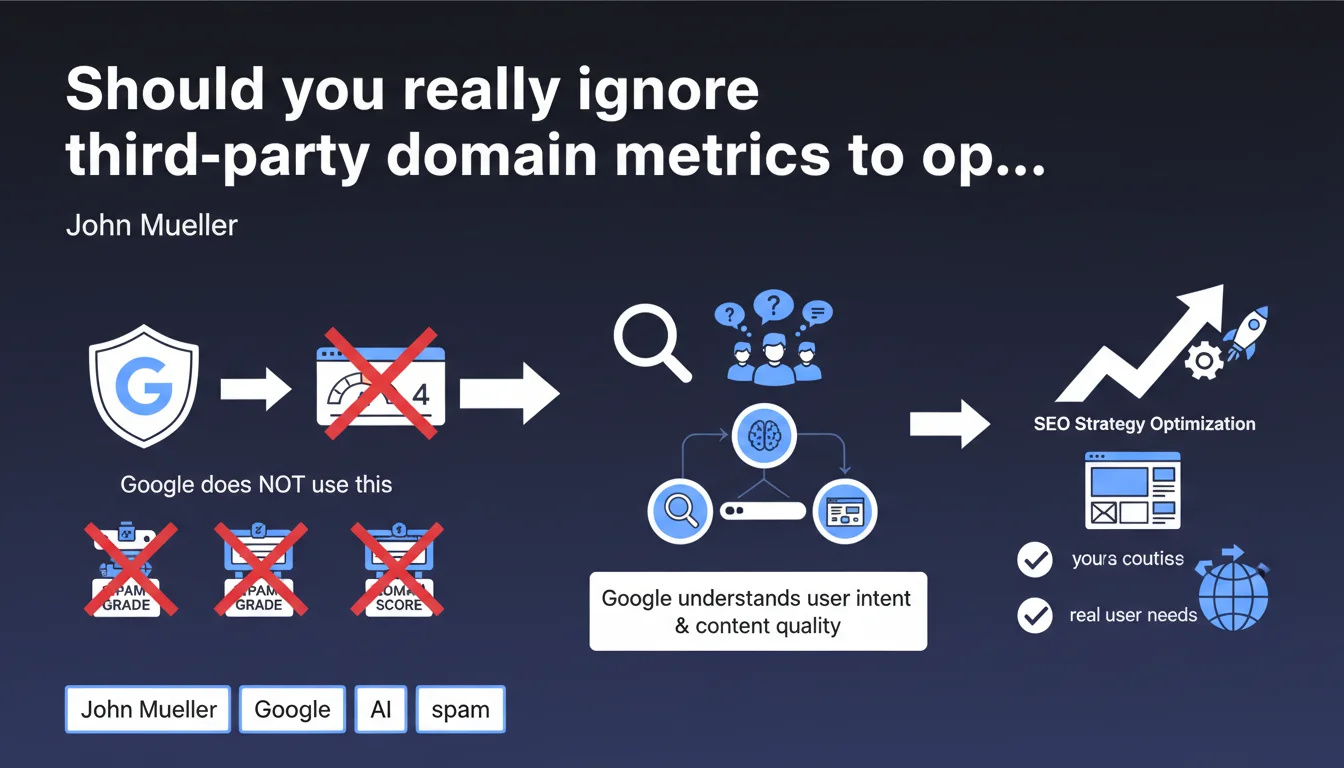
Google does not take into account domain scores, spam grades, or other metrics created by third-party tools. The algorithm analyzes individual signals from a website without ever reducing it to a single score. These metrics can serve as comparative benchmarks, but have no direct impact on rankings.
What you need to understand
Why does Google reject third-party domain metrics?
SEO tools create oversimplified metrics to allow practitioners to quickly compare websites. Domain Authority (Moz), Domain Rating (Ahrefs), Trust Flow (Majestic): all attempts to condense the "strength" of a domain into a single number.
The problem? Google uses hundreds of signals to evaluate the relevance of a page in a given context. Reducing this complexity to a single score fundamentally contradicts the logic of the algorithm, which seeks to understand search intent and content quality — not to rank domains in absolute terms.
Are these metrics useless then?
No, but their use must be structured and critical. A high Domain Rating can indicate a solid backlink profile, but guarantees nothing about content relevance or the ability to rank for a specific query.
These scores mainly serve as comparative indicators: analyzing the evolution of your own domain over time, comparing direct competitors, prioritizing prospects in a link-building campaign. They provide a trend — never an absolute truth.
Concretely, how does Google evaluate a website?
The algorithm examines signals page by page, query by query. Content, backlinks, user experience, freshness, expertise: each factor weighs differently depending on the search context.
A site can have mediocre Domain Authority and rank in the top position for a specific niche thanks to ultra-targeted content and quality contextual backlinks. Conversely, a domain with a high score can stagnate if it produces generic content or ignores user intent.
- Google never sums up a website to a single number — each page is evaluated individually
- Third-party metrics measure correlations, not direct ranking factors
- A high score does not compensate for mediocre content or a flawed SEO strategy
- Third-party tools use their own algorithms, which only imperfectly reflect Google's logic
SEO Expert opinion
Is this statement consistent with real-world observations?
Yes, and it's verifiable. Sites with low Domain Authority regularly rank at the top for niche queries, while "powerful" domains struggle on certain topics. The nuance: these third-party metrics often correlate with good results because they reflect real signals — such as the quality of the backlink profile.
The trap is treating them as objectives in themselves. Some SEOs optimize to increase a Domain Rating rather than to answer search intent. This is cognitive bias: we optimize what measures easily, not what really matters.
In what cases do these metrics remain relevant?
For link building, their practical usefulness is undeniable. Analyzing a competitor's link profile, filtering prospects by Domain Rating, tracking the evolution of your own domain: these metrics speed up time-consuming tasks.
But you must cross-reference them with other indicators — actual organic traffic, positioning on strategic keywords, conversion rate. A Domain Rating of 60 is worthless if the site generates zero qualified traffic. [To verify]: some tools claim their metrics predict SEO performance, but independent studies show variable correlation depending on the sector.
What mistakes should you avoid with these metrics?
First mistake: buying backlinks solely based on high Domain Rating criteria. A link from a DR 70 site that's off-topic can be less relevant than a DR 30 link that's ultra-contextual. Google analyzes thematic relevance, anchor text, context — not a third-party tool's score.
Second mistake: neglecting page-level signals. A domain can have a low overall score but specific pages that are ultra-authoritative. Conversely, a powerful site can host weak sections. Analysis must drill down to the URL level, not stop at the domain.
Practical impact and recommendations
What should you concretely do with these metrics?
Use them as secondary indicators, never as objectives. In a link-building strategy, a Domain Rating allows you to quickly filter prospects — but the final decision is made on qualitative criteria: thematic relevance, content quality, actual audience.
For performance tracking, prioritize real metrics: positions on strategic keywords, organic traffic, click-through rates, conversions. If your Domain Authority goes up but your traffic stagnates, you're optimizing the wrong lever.
How do you audit the use of these metrics in your strategy?
Check whether your SEO decisions are based on correlations or causality. Example: you reject a backlink because the source site has a DR of 25. Does this site generate qualified traffic? Does its audience match your target? A relevant link always beats a "powerful" but off-topic link.
Conversely, if you accept all backlinks from DR 50+ sites without checking editorial quality, you're building an artificially inflated link profile that risks triggering a manual action or algorithmic devaluation.
Which Google metrics should you prioritize instead?
Focus on signals that Google actually measures: organic click-through rates (Search Console), engagement signals (time on page, bounce rate), Core Web Vitals, crawl depth, content freshness.
For backlinks, analyze the distribution of anchors, diversity of referring domains, thematic relevance. Google doesn't count links — it evaluates their context and their actual contribution to user experience.
- Never make an SEO decision solely on a Domain Rating or Trust Flow
- Cross-reference third-party metrics with Search Console data (traffic, impressions, CTR)
- Analyze backlinks at the page level, not just domain
- Prioritize thematic relevance over domain "power"
- Track the evolution of third-party metrics over time to detect trends, not to set objectives
- Regularly audit your link profile to identify toxic backlinks, regardless of their Domain Rating
❓ Frequently Asked Questions
Un Domain Authority élevé aide-t-il indirectement mon SEO ?
Dois-je ignorer complètement les métriques d'outils comme Ahrefs ou Moz ?
Google utilise-t-il un équivalent interne du Domain Authority ?
Un backlink depuis un site à faible DR peut-il vraiment aider mon SEO ?
Comment expliquer qu'un concurrent avec un DA plus faible me dépasse en ranking ?
🎥 From the same video 12
Other SEO insights extracted from this same Google Search Central video · published on 08/01/2026
🎥 Watch the full video on YouTube →
💬 Comments (0)
Be the first to comment.