
Official statement
Other statements from this video 12 ▾
- □ Is SEO still the right term when you're optimizing for ChatGPT or Gemini?
- □ Can you really succeed in SEO without experts or specialized tools?
- □ Why is knowing Google's guidelines non-negotiable before hiring an SEO specialist?
- □ Should you really trust the recommendations from SEO tools?
- □ Is Google really saying what SEO professionals claim it does?
- □ Can you really guarantee results in SEO?
- □ Is your SEO tool recommending tactics that could trigger a Google penalty?
- □ Should you really ignore third-party domain metrics to optimize your SEO strategy?
- □ Should you adapt your content specifically for LLMs and generative AI?
- □ Should you stop optimizing for Google's ranking algorithms?
- □ Should you really stop obsessing over technical SEO details?
- □ Should small businesses really abandon SEO technical optimization?
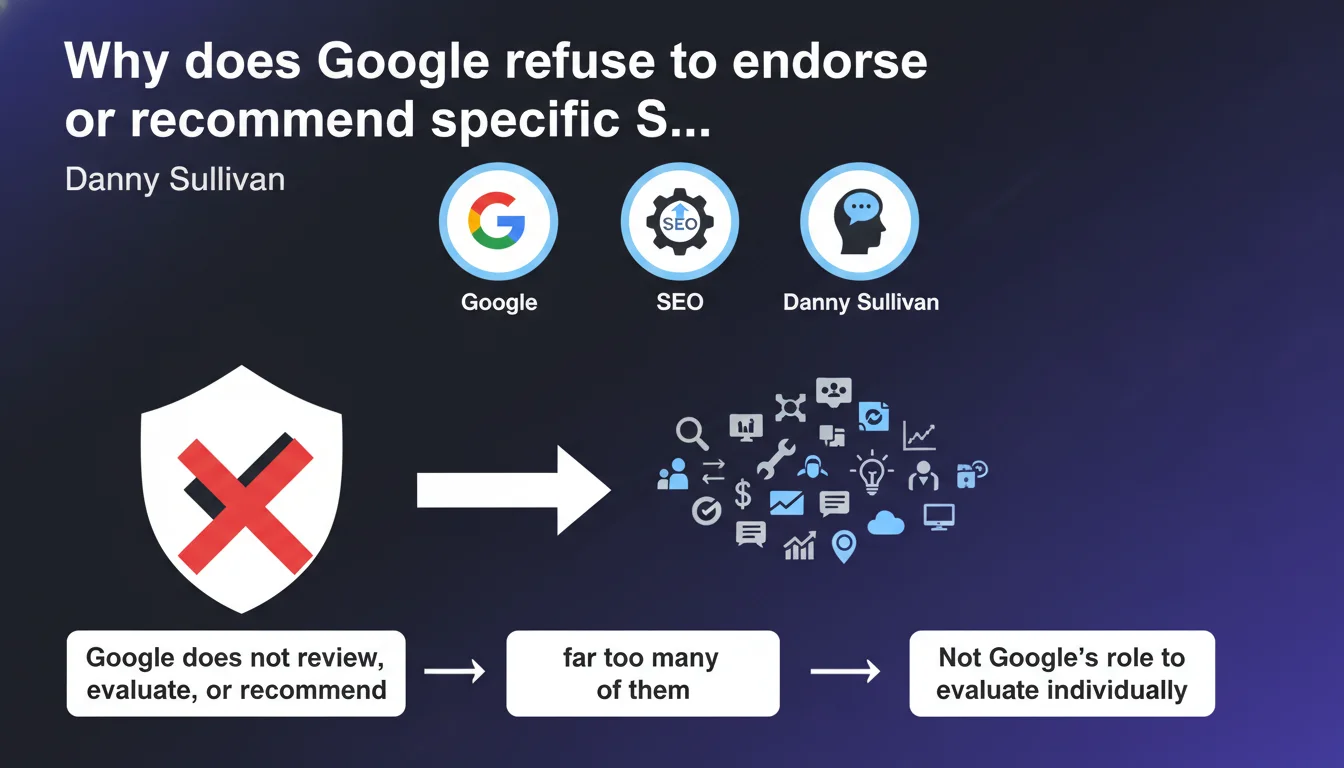
Google does not review, evaluate, or recommend any specific SEO tool or agency. There are too many of them and it's not Google's role to audit each one individually. This official neutrality forces practitioners to develop their own evaluation framework without any external guarantee.
What you need to understand
Danny Sullivan is crystal clear: Google validates no SEO tools whatsoever, regardless of their reputation. No gold star, no label, no official top 10.
This statement likely responds to a recurring request from the SEO community seeking Google's endorsement to justify costly tool purchases or the selection of a service provider. The message is unambiguous.
Why does Google adopt this position of neutrality?
First, the sheer volume. Hundreds of tools crawl the web, analyze backlinks, and simulate SERPs. It's materially impossible for Google to evaluate each solution and keep that evaluation current.
Second, potential conflicts of interest. If Google recommended a tool, it would create an artificial competitive advantage and expose itself to accusations of favoritism. Not to mention the legal implications if that tool later caused problems.
What are the consequences for SEO professionals?
This neutrality imposes increased responsibility on practitioners. You must evaluate the reliability of the data yourself, the methodology of the tools, and their compliance with guidelines.
No Google shield to justify a technical choice to a client or management. You are the sole judge of the relevance of Screaming Frog, SEMrush, or Ahrefs for your specific context.
- Google endorses no tools – not Screaming Frog, not SEMrush, not Ahrefs, or any other
- This neutrality protects Google from conflicts of interest and legal liabilities
- Practitioners must develop their own evaluation framework for tools and service providers
- No external guarantee exists – due diligence rests entirely with you
SEO Expert opinion
Is this neutrality truly absolute in practice?
Let's be honest: Google officially recommends no tools, but its own solutions occupy a privileged place. Search Console, PageSpeed Insights, Lighthouse – all Google tools that every SEO uses daily.
The nuance? Google never presents them as recommendations but as sources of truth. Search Console doesn't help you rank – it shows you how Google sees your site. A subtle but important difference in positioning.
Why this statement now?
The timing is probably not random. The SEO market has become considerably more professionalized, with a proliferation of premium tools and agencies wielding often hollow or paid "Google certifications."
[To be verified] – We can assume Google received endorsement requests or complaints about tools misusing its name. This clarification cuts through any ambiguity.
What evaluation framework should you build without Google's endorsement?
Focus on verifiable criteria. A crawl tool? Test it on your own site where you know the issues. A backlinks tool? Compare its data with Search Console and your server logs.
For agencies, ignore badges and certifications. Ask for verifiable case studies, access to their client dashboards (anonymized), and contactable references. Expertise is demonstrated, not decreed.
Practical impact and recommendations
How do you select an SEO tool without official recommendation?
Prioritize an empirical approach. Test free versions or trials on your own sites before any investment. Systematically compare with Search Console data – that's your truth reference.
Beware of proprietary metrics (Domain Authority, Trust Flow, etc.) that you cannot verify. They have indicative value but don't necessarily reflect Google's vision.
What criteria should you prioritize when evaluating an SEO service provider?
Forget Google Partner certifications (related to Ads only). Focus on methodological transparency: which tools do they use, how do they interpret the data, which sources do they cross-reference?
Ask for concrete examples of diagnostics performed, with access to anonymized reports. A good service provider explains why they choose a particular tool in a specific context, not just that they use "the best tools on the market."
Should you avoid certain tools that violate Google's guidelines?
Google recommends no tools, but some clearly violate its rules. Services for paid backlinks, content spinners, automated PBNs – everything that breaches Spam Policies remains prohibited, with or without official statement.
The nuance concerns the analysis tools themselves. A crawler that mimics Googlebot isn't problematic – the use you make of it is what can be. Crawl your own sites, not competitors excessively.
- Test every tool on your own sites before purchase – verify consistency with Search Console
- Compare data from multiple tools to identify methodological biases
- Ignore "Google Partner" certifications for organic SEO – they concern Ads only
- Require verifiable case studies and contactable references from any service provider
- Avoid proprietary, unverifiable metrics as your sole decision criterion
- Focus on methodological transparency rather than marketing badges
- Definitively ban tools that violate Spam Policies (paid backlinks, PBNs, spinners)
Google's lack of recommendation transfers all evaluation responsibility to practitioners. Build your analysis framework around verifiable criteria, test empirically, cross-reference sources.
This complexity of evaluation – between technical tools, data interpretation, and guideline compliance – explains why many companies prefer to delegate to a specialized SEO agency. An experienced partner already has a proven tool stack, a methodology validated across dozens of projects, and critical perspective that only hands-on experience truly builds.
❓ Frequently Asked Questions
Les outils Google (Search Console, PageSpeed Insights) sont-ils considérés comme des recommandations ?
Un outil qui affiche un partenariat Google est-il plus fiable pour le SEO ?
Comment vérifier la fiabilité d'un outil de backlinks sans caution Google ?
Google peut-il pénaliser l'utilisation de certains outils SEO ?
Faut-il privilégier les outils les plus chers pour obtenir de meilleurs résultats SEO ?
🎥 From the same video 12
Other SEO insights extracted from this same Google Search Central video · published on 08/01/2026
🎥 Watch the full video on YouTube →
💬 Comments (0)
Be the first to comment.