
Official statement
What you need to understand
Why Does This Question About Rare Languages Come Up in SEO?
Many site owners offering content in minority languages fear penalization by Google. This concern stems from the idea that the search engine might misinterpret or undervalue these less common contents.
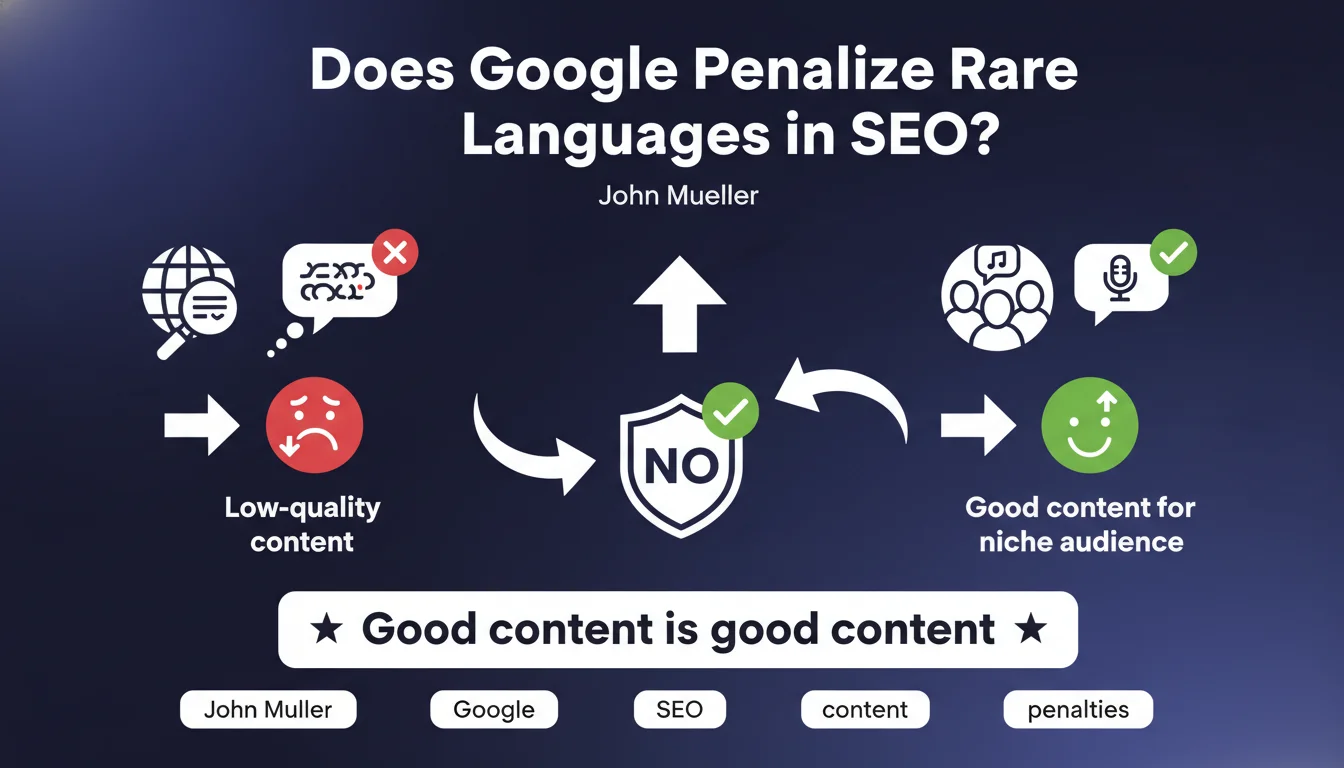
John Mueller responds clearly: no automatic penalty is applied to lesser-used languages. Quality content remains quality content, regardless of the language used.
What About Languages Without an ISO 639-1 Code?
Some ancient or very rare languages don't have a standardized ISO code. This can raise questions for technical implementation, particularly with the hreflang attribute.
Mueller clarifies that it's not necessary to use hreflang if no ISO code exists. The example of Ancient Greek illustrates that these contents have their rightful place on the web without specific technical configuration.
Should You Deindex Pages in Minority Languages?
The answer is clearly no. If the content meets the needs of a specific audience, even a small one, it should remain indexed.
- Rare languages are not considered low-quality content
- No automatic penalty is applied to these languages
- The hreflang attribute is not mandatory without an ISO 639-1 code
- Deindexing is only justified if the content provides no value
- Content quality always takes precedence over the language used
SEO Expert opinion
Is This Statement Consistent With Observed Practices?
Field experience confirms this position. Google is indeed capable of indexing and ranking content in dozens of languages, even those with limited training data.
However, the search engine's ability to semantically interpret content varies considerably depending on the language. Very rare languages may encounter difficulties with contextual understanding, impacting rankings without necessarily causing a penalty.
What Important Nuances Should Be Considered?
Mueller's statement must be nuanced by a crucial aspect: the absence of a penalty doesn't equal good rankings. If Google doesn't properly understand the content, it simply won't rank.
Additionally, search volumes in these languages are often very low. Even with excellent rankings, the generated traffic may be negligible. You must therefore evaluate the real objective: SEO visibility or serving a specific community?
In Which Cases Could This Approach Be Counterproductive?
Creating content in rare languages solely for SEO, without a real audience, would be a strategic mistake. The invested resources will likely yield no measurable return.
Similarly, using approximate machine translations into rare languages could produce low-quality content, damaging the site's credibility with native speakers, even without algorithmic penalties.
Practical impact and recommendations
What Should You Actually Do With Content in Rare Languages?
Start by identifying the real audience for each language offered. Analyze your statistics to determine whether these pages generate qualified traffic or conversions.
If an audience exists, even a modest one, maintain and improve this content. Ensure that the editorial quality is impeccable, as every visitor counts in a restricted niche.
For technical aspects, properly configure the lang tag in the HTML, even without a standard ISO code. Use the closest code or create a consistent convention if necessary.
What Critical Mistakes Should You Avoid?
Never deindex quality content out of fear of a hypothetical penalty. This is the main mistake to avoid according to this statement.
Also avoid neglecting the technical structure on the grounds that the language is rare. Meta tags, Hn hierarchy, and internal linking remain essential.
Don't use low-quality automated content simply to "fill" language versions. Fewer well-treated languages are better than many poorly served ones.
How Can You Optimize Your Multilingual Strategy With Minority Languages?
- Audit the actual performance of each language version (traffic, engagement, conversions)
- Prioritize quality over quantity: favor languages with an identified audience
- Properly implement lang tags in the HTML code of each page
- Create coherent internal linking between different language versions
- Document your language code strategy for languages without ISO standards
- Monitor user behavior to validate the relevance of each language
- Invest in professional rather than automated translations for rare languages
- Regularly evaluate the ROI of each language version to adjust your strategy
💬 Comments (0)
Be the first to comment.