
Official statement
What you need to understand
Why does referral traffic from spammy sites increase after anti-spam updates?
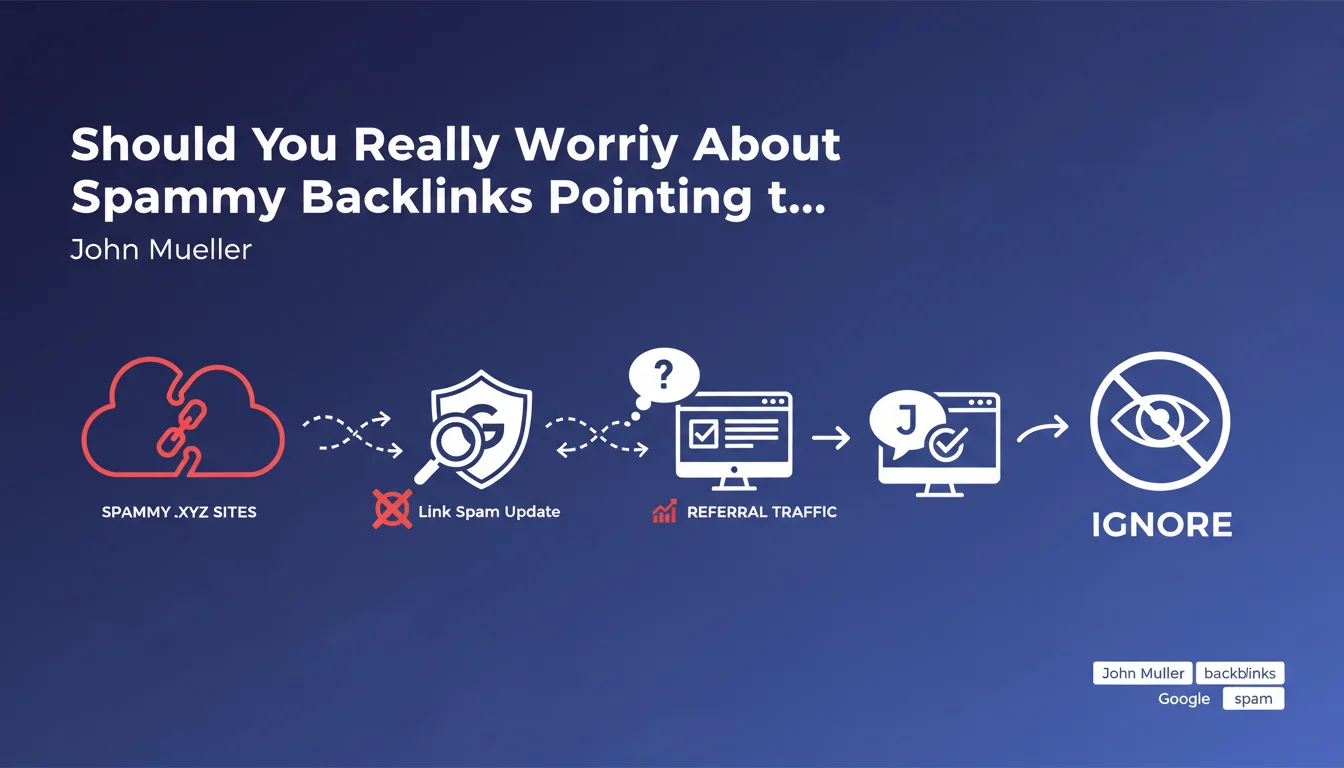
Paradoxically, Google's Link Spam updates can generate a temporary increase in traffic from low-quality sites. This phenomenon is explained by the fact that spammers intensify their tactics to bypass the new filters.
Google now detects more than 40 billion spam contents per day. Despite this relentless fight, some parasitic links manage to emerge temporarily before being neutralized by the algorithms.
Can inbound spammy links penalize my site?
Google's official position is clear: unsolicited spammy backlinks generally don't penalize your site. The algorithm is designed to automatically identify and ignore these low-quality links.
Google has considerably improved its ability to distinguish natural links from artificial links. The search engine differentiates between links you create voluntarily and those that point to you without your consent.
What does the advice to ignore these spammy links mean?
John Mueller explicitly recommends not wasting time monitoring or dealing with these parasitic backlinks. This pragmatic approach reflects Google's confidence in its own filtering systems.
- Google automatically handles the devaluation of spammy links
- No need for constant monitoring of your link profile
- The disavow tool is no longer recommended in the majority of cases
- Focus your efforts on acquiring quality links rather than defending against spam
- Spammy referral traffic doesn't impact your SEO ranking
SEO Expert opinion
Is this statement consistent with practices observed in the field?
My 15 years of experience confirms this position. I've observed hundreds of sites receive massive waves of spammy backlinks without suffering any penalty. In 95% of cases, these links have no measurable impact, neither positive nor negative.
However, the reality is more nuanced than a simple "ignore them". Some spam patterns can reveal negative SEO attempts or security vulnerabilities on your site that shouldn't be neglected.
In which exceptional cases should you still take action?
If you notice a massive and sudden influx of thousands of links from sites with sensitive themes (adult, pharmaceutical, gambling) when your sector has no connection, vigilance is required. This may indicate a hack of your site being used to create parasitic pages.
Similarly, if you receive a manual action from Google specifically related to artificial links, you will then need to use the disavow tool. But this concerns less than 1% of sites.
What's the real priority when it comes to links?
Rather than spending time fighting spam, invest in a proactive link building strategy. A strong and natural link profile automatically dilutes the potential impact of a few parasitic links.
The best defense remains the regular acquisition of quality editorial backlinks. The healthier and more diversified your link profile, the less relative importance parasitic signals have in the overall evaluation of your site.
Practical impact and recommendations
What should you do concretely when faced with spammy backlinks?
The main recommendation is to do nothing in the vast majority of cases. Instead, devote your energy to improving your content and developing legitimate partnerships to obtain quality links.
Set up minimal monthly monitoring rather than obsessive daily checking. A periodic check via Google Search Console is sufficient to identify any major anomalies.
Which mistakes should you absolutely avoid?
Don't fall into the trap of preventive disavowing. Too many webmasters panic and massively disavow domains without valid reason, sometimes compromising their own SEO.
Also avoid paying for services promising to "clean" your link profile. These services are generally useless and expensive, taking advantage of site owners' lack of knowledge.
- Don't use the disavow tool except for manual action from Google
- Don't spend hours analyzing every suspicious backlink
- Don't contact webmasters of spammy sites to request link removal
- Don't invest in expensive tools solely to track spam
- Don't neglect real SEO priorities (content, technical, UX)
How can you focus your efforts on what really matters?
Redirect your time budget towards technical optimization of your site, improving your content and developing a white hat link building strategy. These are the elements that generate tangible results.
Establish a process for creating high-value content that naturally attracts editorial links. This organic approach remains the most sustainable and most effective in the long term.
💬 Comments (0)
Be the first to comment.