
Official statement
Other statements from this video 21 ▾
- □ Faut-il créer une nouvelle URL ou mettre à jour la même page pour du contenu quotidien ?
- □ Faut-il arrêter d'utiliser l'outil de soumission manuelle dans Search Console ?
- □ Les balises H2 dans le footer posent-elles un problème pour le référencement ?
- □ Faut-il vraiment se fier au validateur schema.org pour optimiser ses données structurées ?
- □ La vitesse de page améliore-t-elle vraiment le classement aussi vite qu'on le croit ?
- □ Google crawle-t-il tous les sitemaps au même rythme ?
- □ Google continue-t-il vraiment de crawler un sitemap supprimé de Search Console ?
- □ Pourquoi Google n'indexe-t-il pas une page crawlée régulièrement si elle ne présente aucun problème technique ?
- □ Peut-on utiliser des canonical bidirectionnels entre deux versions d'un site sans risque ?
- □ Les structured data peuvent-elles remplacer le maillage interne classique ?
- □ Pourquoi un seul x-default suffit-il pour toute votre configuration hreflang multi-domaines ?
- □ Faut-il vraiment éviter le structured data produit sur les pages catégories ?
- □ Faut-il vraiment choisir une langue principale pour chaque page si vous visez plusieurs marchés ?
- □ Pourquoi Google ignore-t-il complètement votre version desktop en mobile-first indexing ?
- □ Le contenu 'commodity' peut-il vraiment survivre dans les résultats Google ?
- □ Faut-il isoler ses FAQ dans des pages séparées pour mieux ranker ?
- □ Pourquoi Google réduit-il drastiquement l'affichage des FAQ dans les résultats de recherche ?
- □ Pourquoi Google n'indexe-t-il qu'une infime fraction de vos URLs ?
- □ Peut-on héberger son sitemap XML sur un domaine différent de son site principal ?
- □ Les Core Web Vitals : pourquoi le passage de « Bad » à « Medium » change tout pour votre ranking ?
- □ La vitesse serveur impacte-t-elle vraiment le crawl budget des gros sites ?
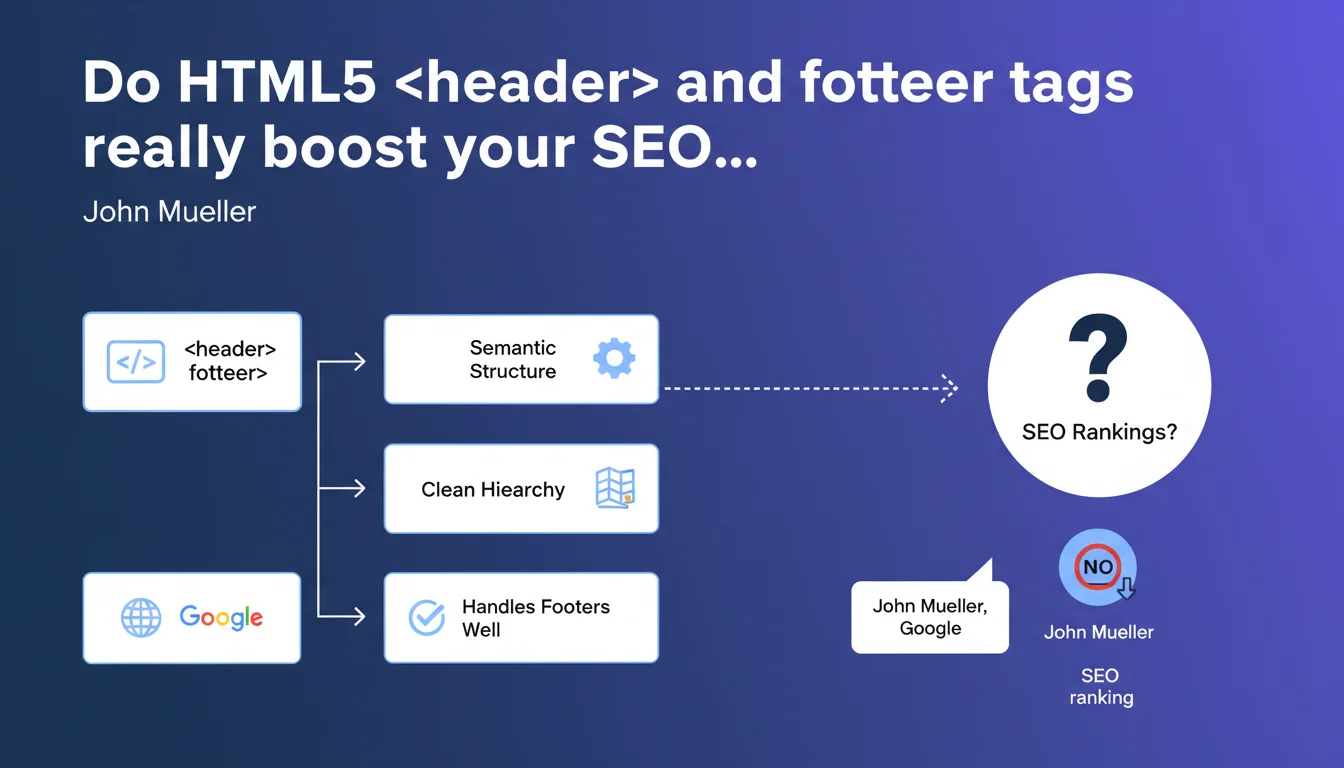
Google recognizes the semantic value of HTML5 <header> and <footer> tags, which enable clean heading hierarchies within each section. But in practice, the search engine already handles footers very well without these tags — so their SEO impact remains marginal, even if they do clarify structure for the crawler.
What you need to understand
Why is Google bringing up these structural tags now?
HTML5 introduced semantic tags (<header>, <footer>, <article>, <section>) to replace generic divs. The idea: give browsers and bots a clear understanding of each zone's purpose.
Mueller points out that these tags enable proper structuring of heading hierarchies. For example, an <h1> within an <article> and another <h1> in the <footer> no longer create theoretical ambiguity — each section has its own context.
Is Google actually leveraging this for rankings?
Here's the nuance: « Google already handles footers well without these tags ». Translation — the engine has developed robust heuristics to identify main content areas, navigation, footer, sidebar, even without semantic markup.
Using <header> and <footer> helps, but it's not a ranking factor in the strict sense. It's more of an extra layer of clarity that can, in certain contexts, make the crawler's job easier — without any guarantee of visible impact.
What are the concrete benefits of this structuring?
- Clean heading hierarchies: each section can have its own
<h1>-<h6>without confusion. - Enhanced accessibility: screen readers exploit these landmarks for navigation.
- Easier maintenance: code becomes more readable for developers and audit tools.
- Future compatibility: if Google refines its semantic processing, you're already well positioned.
SEO Expert opinion
Is this statement consistent with real-world observations?
Let's be honest — most high-ranking sites don't systematically use <header> and <footer>. Many still run with legacy <div class="header"> structures from pre-HTML5 days.
And that's where it pinches: Google doesn't penalize the absence of these tags. Mueller says it himself — footers are already well handled without explicit markup. So if your site works fine with standard divs, don't panic.
When does this recommendation become actually relevant?
The real question is: when do these tags make a difference? Mainly on sites with complex structures — news portals, editorial platforms, SaaS with multiple nested sections.
In these contexts, helping Google distinguish main content from peripheral elements (global navigation, footer with legal links, sidebar widgets) becomes strategic. The less time the crawler wastes on noise, the better.
[To verify]: Mueller provides no data on measured impact. We don't know if Google assigns different weight to headings within a <header> versus a <div>. A/B tests on this topic yield inconclusive results — the impact is likely negligible in 80% of cases.
Practical impact and recommendations
Should you overhaul your entire site's HTML structure?
No. If your site is stable and performing well, don't touch anything just to add these tags. The ROI would be close to zero. But during a migration, major redesign, or new project launch, you might as well start with clean HTML5 from the beginning.
Practically? Use <header> for the logo/main navigation area, <footer> for legal mentions/secondary links, <main> for central content, <article> for each self-contained editorial block, <aside> for sidebars.
What mistakes should you avoid during implementation?
- Don't multiply
<main>elements — one per page is the rule. - Don't scatter
<header>or<footer>everywhere just for looks — reserve them for actual structural zones. - Don't forget to check your heading hierarchy with a tool like HeadingsMap — an
<h1>in the footer can create confusion if mismanaged. - Test with a screen reader (NVDA, VoiceOver) to ensure landmark navigation works properly.
- Avoid duplicating the same headings between
<header>,<main>, and<footer>— Google might interpret them as internal duplicate content.
How do you verify that the structure is correct?
Several tools let you audit HTML5 semantics. The W3C validator catches syntax errors. The HeadingsMap extension (Chrome/Firefox) visualizes heading hierarchy and landmarks. Screaming Frog SEO Spider can also extract HTML structure for analysis.
On Google's side, no Search Console report will tell you if your structural tags are optimal — because it's simply not a ranking criterion. But if you want to see how Googlebot interprets your page, use the URL inspection tool and examine the HTML rendering.
In summary: <header> and <footer> tags add semantic clarity, but their direct SEO impact remains negligible. Prioritize them on new projects or major redesigns — no need to refactor a site that's already performing well.
If these technical optimizations seem complex to prioritize within your broader SEO roadmap, it may be wise to work with a specialized agency that can prioritize high-impact initiatives and avoid false good ideas.
❓ Frequently Asked Questions
Est-ce que Google pénalise les sites qui n'utilisent pas les balises HTML5 structurelles ?
Peut-on avoir plusieurs balises <header> ou <footer> sur une même page ?
Ces balises améliorent-elles les chances d'obtenir des rich snippets ?
Faut-il changer la hiérarchie des titres si on ajoute <header> et <footer> ?
Ces balises ont-elles un impact sur le temps de crawl ?
🎥 From the same video 21
Other SEO insights extracted from this same Google Search Central video · published on 05/03/2022
🎥 Watch the full video on YouTube →
💬 Comments (0)
Be the first to comment.