
Official statement
Other statements from this video 21 ▾
- □ Faut-il créer une nouvelle URL ou mettre à jour la même page pour du contenu quotidien ?
- □ Faut-il arrêter d'utiliser l'outil de soumission manuelle dans Search Console ?
- □ Les balises H2 dans le footer posent-elles un problème pour le référencement ?
- □ Les balises <header> et <footer> HTML5 améliorent-elles vraiment le SEO ?
- □ Faut-il vraiment se fier au validateur schema.org pour optimiser ses données structurées ?
- □ La vitesse de page améliore-t-elle vraiment le classement aussi vite qu'on le croit ?
- □ Google crawle-t-il tous les sitemaps au même rythme ?
- □ Google continue-t-il vraiment de crawler un sitemap supprimé de Search Console ?
- □ Pourquoi Google n'indexe-t-il pas une page crawlée régulièrement si elle ne présente aucun problème technique ?
- □ Peut-on utiliser des canonical bidirectionnels entre deux versions d'un site sans risque ?
- □ Les structured data peuvent-elles remplacer le maillage interne classique ?
- □ Pourquoi un seul x-default suffit-il pour toute votre configuration hreflang multi-domaines ?
- □ Faut-il vraiment éviter le structured data produit sur les pages catégories ?
- □ Faut-il vraiment choisir une langue principale pour chaque page si vous visez plusieurs marchés ?
- □ Pourquoi Google ignore-t-il complètement votre version desktop en mobile-first indexing ?
- □ Le contenu 'commodity' peut-il vraiment survivre dans les résultats Google ?
- □ Faut-il isoler ses FAQ dans des pages séparées pour mieux ranker ?
- □ Pourquoi Google n'indexe-t-il qu'une infime fraction de vos URLs ?
- □ Peut-on héberger son sitemap XML sur un domaine différent de son site principal ?
- □ Les Core Web Vitals : pourquoi le passage de « Bad » à « Medium » change tout pour votre ranking ?
- □ La vitesse serveur impacte-t-elle vraiment le crawl budget des gros sites ?
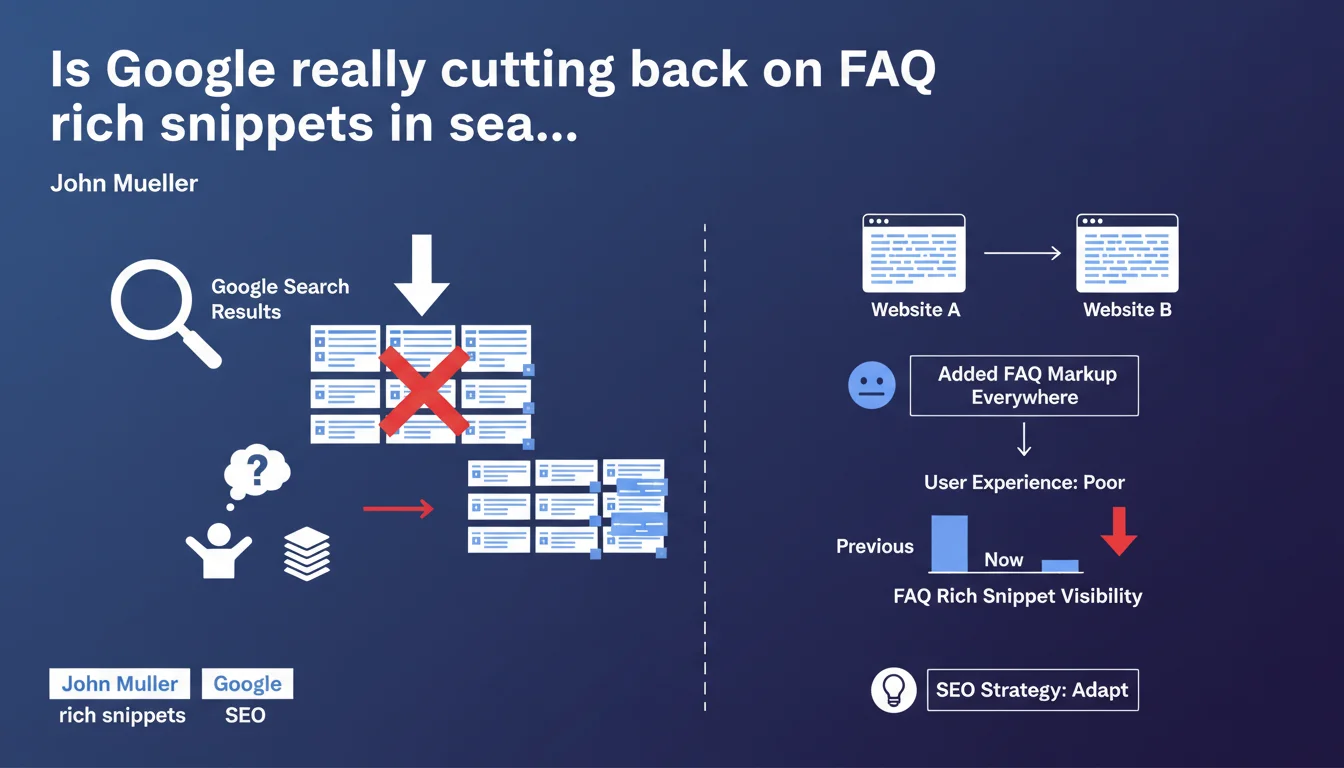
Google is now limiting the display of FAQ rich snippets in SERPs. The reason: too many websites are abusing FAQ markup solely to occupy more visual space without providing real user value. This decision aims to clean up search results and restore relevance to rich snippets.
What you need to understand
Is Google penalizing FAQ markup or simply its display?
Essential nuance: Google is not penalizing sites that use FAQ schema. The search engine is simply reducing its propensity to display these rich snippets in SERPs. The markup remains valid, but its visual impact decreases significantly.
Practically speaking? You can keep your FAQ structured markup without risk of algorithmic penalty. However, don't count on it anymore to boost your click-through rate with an oversized snippet that crushes the competition.
What abuse was Google observing?
The abuse had become systematic. E-commerce sites were adding FAQs to every product page, blogs to every article — even when no questions were actually being asked by users. The goal: monopolize vertical space in search results.
The problem is that this inflation made SERPs less readable and less useful. When every result displays 3-4 expandable questions, the user loses time instead of saving it.
Which pages are still likely to display an FAQ rich snippet?
Google doesn't provide precise criteria — classic. But we can anticipate that pages that are genuinely FAQ-oriented (help pages, customer support, comprehensive guides) retain their chances of being displayed. Standard product pages and blog articles, much less so.
The underlying logic: markup should reflect the intrinsic nature of the page, not serve as a SERP hack.
- FAQ schema remains technically valid and carries no penalty risk
- Google is reducing its display to limit abusive occupation of space in search results
- Authentically FAQ-centric pages likely retain an advantage
- The abuse primarily concerned product pages and blog articles with forced FAQs
SEO Expert opinion
Is this statement consistent with practices observed in the field?
Absolutely. For several months now, feedback from consultants has confirmed a drastic decline in FAQ display in SERPs — even for historically well-ranked sites with this type of snippet. Some clients saw their CTR drop by 15-20% without any change in their organic ranking.
This announcement by Mueller formalizes an already well-documented reality. Google had begun filtering FAQ displays without prior communication — a classic progressive rollout strategy.
What nuances should be added to Google's position?
First point: Google talks about "reducing," not eliminating. So there remains a gray zone where certain pages will continue to benefit from rich display. But the selection criteria remain opaque. [To be verified]: Is it linked to domain authority, semantic relevance, user engagement?
Second point: this measure only affects Google SERPs. Bing, Yandex, and other search engines may have different policies. Don't delete your FAQ markup just because it's no longer appearing on Google — it also serves to structure your data for other uses (voice assistants, aggregators, etc.).
Should you remove all FAQ markup from your site?
No. Let's be honest: the problem is the artificial and systematic use of FAQ markup to inflate snippets. If your pages contain genuine questions/answers actually asked by your users, the schema remains relevant.
On the other hand, if you had added FAQs to 100% of your product pages "just in case," now is the time to clean house. Keep the markup only where it makes sense — and measure the real impact on your KPIs.
Practical impact and recommendations
What should you concretely do with your existing FAQ markup?
First step: audit your current pages tagged with FAQ. Identify those still displaying the rich snippet in SERPs (use Search Console or a real-time SERP crawler). You'll probably find that the majority no longer benefit from it.
Second step: segment your pages. Those that are genuinely FAQ-oriented (support pages, guides, help center) keep their markup. For the others — product pages, standard blog articles — two options: either remove the schema, or keep it for other search engines/uses, but without expecting Google SERP gains.
What mistakes should you avoid in this transition?
Don't remove FAQ markup brutally and massively without measuring impact. Some pages may still benefit from rich display — and hasty removal could tank your residual CTR.
Common mistake: replacing FAQ schema with other markup types (HowTo, Q&A) hoping to bypass the limitation. Google quickly detects these attempts and could tighten its filters. Stay aligned with the semantic logic of your content.
- Audit current FAQ pages and measure their actual snippet display rate
- Keep markup only on pages that are genuinely FAQ-centric
- Remove or disable the schema on product pages and articles where it was artificially added
- Don't try to work around the limitation with other unsuitable schema types
- Monitor CTR evolution post-modification to validate your choices
- Explore other SERP levers (reviews, breadcrumb, product schema) to offset visibility loss
❓ Frequently Asked Questions
Le markup FAQ peut-il encore générer du trafic organique en 2025 ?
Faut-il supprimer le schema FAQ de toutes mes pages produits ?
Cette limitation touche-t-elle aussi les autres types de rich snippets ?
Google peut-il pénaliser un site qui garde son markup FAQ malgré cette annonce ?
Comment savoir si mes pages FAQ s'affichent encore en rich snippet ?
🎥 From the same video 21
Other SEO insights extracted from this same Google Search Central video · published on 05/03/2022
🎥 Watch the full video on YouTube →
💬 Comments (0)
Be the first to comment.