
Official statement
Other statements from this video 21 ▾
- □ Should you update the same page or create a new URL every day for frequently refreshed content?
- □ Should you stop using the manual submission tool in Google Search Console?
- □ Do H2 tags in your footer actually hurt your SEO rankings?
- □ Do HTML5 <header> and <footer> tags really boost your SEO rankings?
- □ Should you really rely on the schema.org validator to optimize your structured data?
- □ Does improving page speed really boost your rankings as fast as everyone claims?
- □ Does Google really crawl all your sitemaps at the same pace?
- □ Does Google really keep crawling a sitemap after you remove it from Search Console?
- □ Is Google really refusing to index your pages even though they're crawled regularly and have no technical issues?
- □ Can you safely use bidirectional canonicals between two site versions without any risk?
- □ Can structured data really replace traditional internal linking strategy?
- □ Why is one x-default enough for your entire multi-domain hreflang configuration?
- □ Should you really avoid product structured data on category pages?
- □ Do you really need to pick one primary language per page if you're targeting multiple markets?
- □ Why is Google completely ignoring your desktop version once mobile-first indexing kicks in?
- □ Can commodity content really survive in Google search results?
- □ Should you isolate your FAQs on separate pages to rank better?
- □ Is Google really cutting back on FAQ rich snippets in search results, and what does that mean for your SEO strategy?
- □ Is Google really ignoring 95% of your submitted URLs—and what does that say about your content?
- □ Can you host your XML sitemap on a different domain than your main website?
- □ Does server speed really impact the crawl budget of large websites?
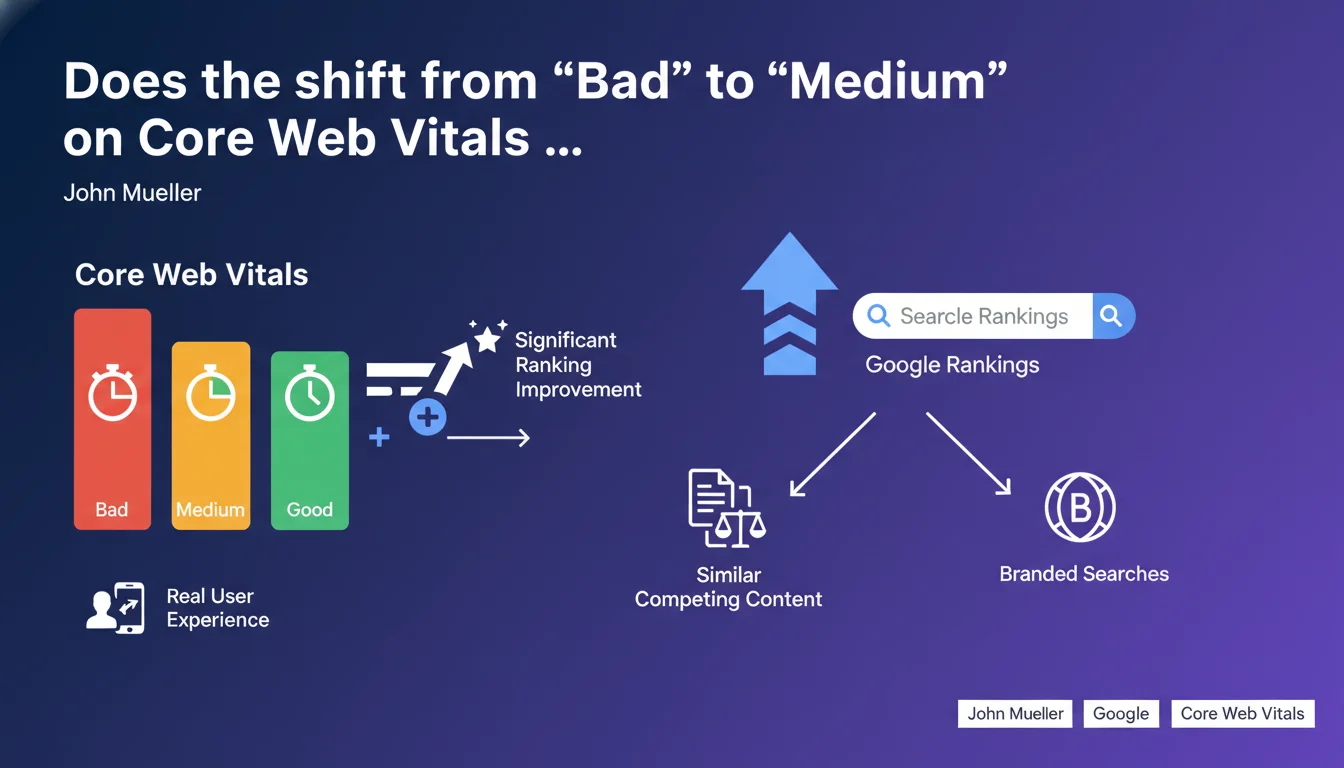
Google uses Core Web Vitals measured on real users as a ranking factor, not the PageSpeed Insights score. The most critical improvement occurs when moving from 'Bad' to 'Medium' — that's where ranking impact is strongest. These improvements are mostly felt on competitive queries, not on branded searches where your authority takes priority.
What you need to understand
Why does Google ignore the 0-100 PageSpeed score?
The PageSpeed Insights score is a synthetic indicator designed for diagnostics, not ranking. Google has stated this repeatedly: what matters for rankings are the Core Web Vitals measured in the Chrome User Experience Report (CrUX).
These metrics reflect what real users actually experience. Not what a lab test simulates. CWV relies on three measurements: LCP (Largest Contentful Paint), FID/INP (First Input Delay / Interaction to Next Paint), and CLS (Cumulative Layout Shift). Each is categorized as Good, Medium, or Bad according to specific thresholds.
What's the actual difference between 'reasonably OK' and 'very slow'?
Google classifies performance into three categories. Good means 75% of users experience fast performance. Medium is a gray area: acceptable, but not exemplary. Bad indicates that most users experience excessive wait times.
The key nuance here: Google isn't chasing technical perfection. It's trying to distinguish sites that are truly harmful from the rest. The critical threshold lies between Bad and Medium — where user experience shifts from unacceptable to tolerable.
Why does ranking impact only show up on certain queries?
CWV functions as a tie-breaker. If two pieces of content are equally relevant, the one offering better user experience takes the edge. On branded queries, you already dominate through authority — the performance gap changes nothing.
It's on competitive queries, where multiple sites offer similar content, that CWV becomes decisive. Google then prioritizes user experience as the differentiating factor.
- CWV is measured on real data (CrUX), not in lab settings
- The PageSpeed Insights score (0-100) is not a ranking factor
- The most significant improvement occurs when moving from Bad to Medium
- CWV primarily impacts competitive queries, not branded searches
- Three key metrics: LCP, FID/INP, CLS
SEO Expert opinion
Is this statement consistent with real-world observations?
Yes, overall it is. SEO practitioners consistently observe that ranking gains from CWV are not proportional to technical improvements. A site jumping from 40 to 80 on PageSpeed doesn't necessarily see a ranking boost. Conversely, a site escaping the 'Bad' zone often experiences gradual improvement.
However — and this is where it gets complicated — quantifying this impact remains difficult. Google claims the improvement is 'significant' but provides no hard data. A/B tests isolating only CWV are rare and challenging to conduct. [To be verified]: the actual magnitude of this boost remains an open question.
What nuances should we add to this claim?
First, the concept of 'similar competing content' is vague. Google doesn't explain how it evaluates this similarity. Two pieces of content can cover the same topic without being perceived as equivalent by the algorithm. Domain authority, backlinks, freshness — all of that still plays a role.
Second, the shift from 'Bad' to 'Medium' isn't binary. Thresholds are calculated on the 75th percentile of visitors. If you're just below the 'Good' threshold, optimizing further won't grant you an additional boost. Returns diminish sharply beyond 'Medium'.
When does this rule not apply?
On queries where your site holds overwhelming authority, CWV won't change anything. If you're the established reference on a topic, even with average LCP, you'll keep your position. Google always prioritizes relevance and authority before user experience.
Similarly, on navigation queries (brand searches or URL searches), the intent is clear: the user wants *your* site. Whether you're 'Medium' or 'Good' makes no difference, you'll stay first. It's on informational or commercial queries where the competition truly matters.
Practical impact and recommendations
What should I concretely do to escape the 'Bad' zone?
Focus on the three CWV metrics in order of ease: CLS first, then LCP, finally FID/INP. CLS is often the simplest to fix — just reserve space for images, ads, and embeds. Add width/height attributes to your <img> tags, set container sizes for banners.
For LCP, identify your largest visible element above the fold. It's often a hero image or banner. Preload it with <link rel="preload">, serve it in WebP, and activate a CDN. If it's text, ensure your web font loads quickly via font-display: swap.
FID/INP requires more technical work: reduce render-blocking JavaScript, defer non-critical scripts, break up long tasks. This is where developer resources become costly.
What mistakes should you avoid when optimizing CWV?
Don't fixate on the PageSpeed Insights lab score. This score can be excellent while your actual CWV (CrUX) stays in 'Bad' — especially if your users are on slow mobile or 3G networks. Look at real-world data in Google Search Console, 'Core Web Vitals' section.
Another classic mistake: optimizing for the sake of optimization, without prioritizing. If you're already 'Medium' on all three metrics, reaching 'Good' brings only marginal gains. Your time is better spent on content or backlinks. Let's be honest: a 'Good' site with weak content will never beat a 'Medium' site with solid content.
How do I verify my site meets CWV thresholds?
Three official sources: Google Search Console ('Core Web Vitals' section), PageSpeed Insights ('Field Data' tab), and the CrUX Dashboard on Data Studio. Search Console gives you an aggregate view by page groups — handy for identifying problematic sections.
PageSpeed Insights displays CrUX metrics for a specific URL if enough data exists. The CrUX Dashboard lets you track evolution over a 28-day rolling window and compare desktop vs mobile.
- Check CWV in Google Search Console, not PageSpeed score
- Prioritize moving from 'Bad' to 'Medium' before any other optimization
- Fix CLS first (often the quickest to resolve)
- Optimize LCP by preloading critical resources
- Reduce render-blocking JavaScript to improve FID/INP
- Track progress over the 28-day rolling window in CrUX
- Don't expect immediate ranking boosts: CWV impact unfolds progressively
❓ Frequently Asked Questions
Le score PageSpeed Insights influence-t-il le ranking Google ?
Dois-je viser « Good » sur les trois métriques CWV pour un impact ranking ?
Les CWV affectent-ils les recherches de marque ?
Combien de temps faut-il pour voir l'impact d'une amélioration CWV ?
Quelle métrique CWV optimiser en priorité ?
🎥 From the same video 21
Other SEO insights extracted from this same Google Search Central video · published on 05/03/2022
🎥 Watch the full video on YouTube →
💬 Comments (0)
Be the first to comment.