
Official statement
Other statements from this video 21 ▾
- □ Should you update the same page or create a new URL every day for frequently refreshed content?
- □ Should you stop using the manual submission tool in Google Search Console?
- □ Do H2 tags in your footer actually hurt your SEO rankings?
- □ Do HTML5 <header> and <footer> tags really boost your SEO rankings?
- □ Should you really rely on the schema.org validator to optimize your structured data?
- □ Does improving page speed really boost your rankings as fast as everyone claims?
- □ Does Google really keep crawling a sitemap after you remove it from Search Console?
- □ Is Google really refusing to index your pages even though they're crawled regularly and have no technical issues?
- □ Can you safely use bidirectional canonicals between two site versions without any risk?
- □ Can structured data really replace traditional internal linking strategy?
- □ Why is one x-default enough for your entire multi-domain hreflang configuration?
- □ Should you really avoid product structured data on category pages?
- □ Do you really need to pick one primary language per page if you're targeting multiple markets?
- □ Why is Google completely ignoring your desktop version once mobile-first indexing kicks in?
- □ Can commodity content really survive in Google search results?
- □ Should you isolate your FAQs on separate pages to rank better?
- □ Is Google really cutting back on FAQ rich snippets in search results, and what does that mean for your SEO strategy?
- □ Is Google really ignoring 95% of your submitted URLs—and what does that say about your content?
- □ Can you host your XML sitemap on a different domain than your main website?
- □ Does the shift from 'Bad' to 'Medium' on Core Web Vitals really transform your Google rankings?
- □ Does server speed really impact the crawl budget of large websites?
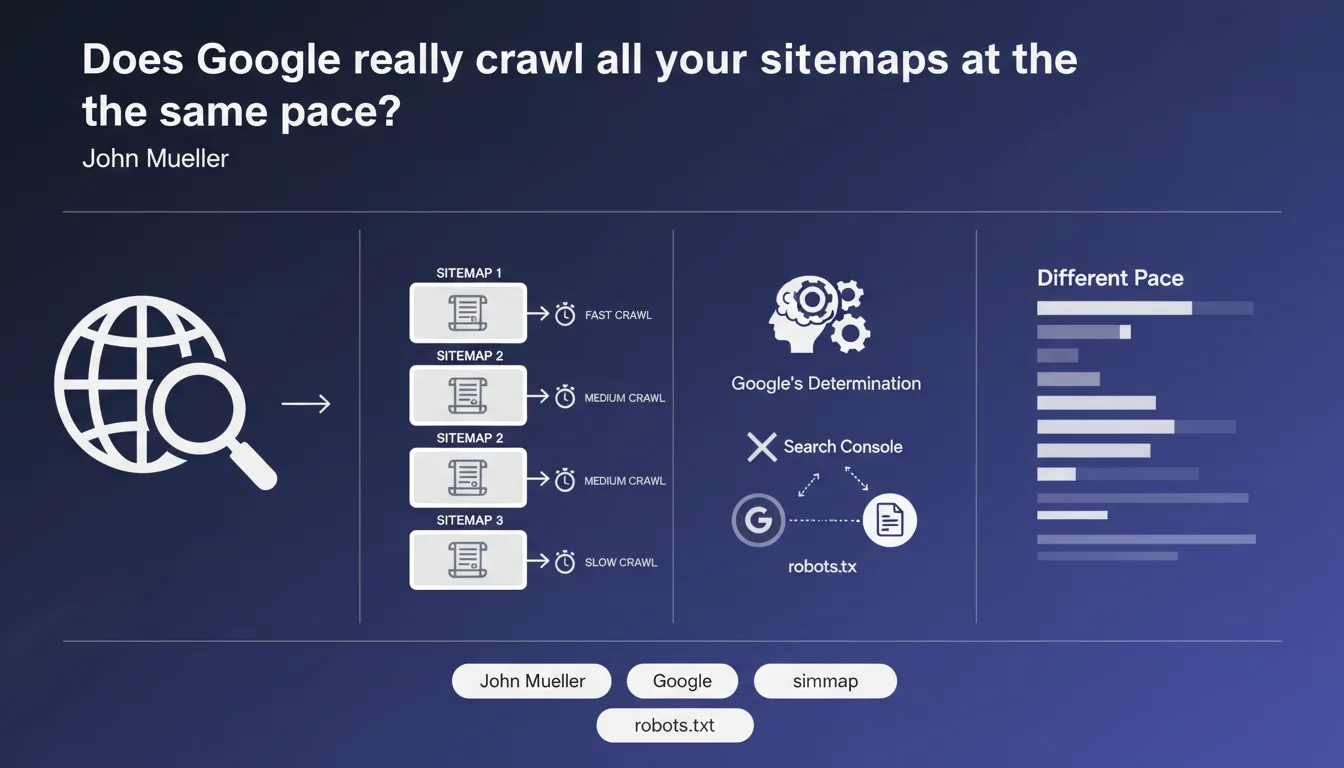
Google does not crawl all sitemaps uniformly. Each sitemap file is evaluated individually based on its change frequency and perceived value, which determines its crawl rate. The submission method (Search Console or robots.txt) does not influence this frequency.
What you need to understand
Google applies differentiated logic to sitemap crawling. Contrary to what many believe, there is no uniform crawl cycle where all files would be processed at the same time.
This approach relies on individual evaluation of each sitemap, regardless of how many files you manage.
How does Google determine a sitemap's crawl frequency?
Google analyzes two main criteria: the actual change frequency of content (not what you declare in the file) and the perceived value of the referenced content.
If your sitemap lists URLs that rarely change or point to content deemed less relevant, Google will crawl it less frequently. Conversely, a dynamic sitemap with frequently updated URLs and high-value content will be revisited more regularly.
Does the submission method really influence crawling?
No. Whether you submit your sitemap via Search Console or declare it in robots.txt, it makes no difference to the crawl frequency.
This Mueller clarification debunks a persistent misconception: some SEO professionals believed active submission via GSC triggered priority treatment. That's not the case — only the file's content matters.
- Google evaluates each sitemap individually, not in batches
- Crawl frequency depends on the actual content freshness, not changefreq tags
- Perceived content value plays a major role in prioritization
- The submission method (GSC vs robots.txt) has no impact on crawl rate
SEO Expert opinion
Does this statement align with real-world observations?
Yes, largely. We do indeed observe significant gaps in crawl frequency between different sitemaps on the same site. A daily-updated blog sitemap will be crawled far more frequently than a sitemap of static institutional pages.
However, Mueller remains vague about what he means by "value." Are we talking about URL popularity (backlinks, traffic)? Thematic relevance? Click-through rate in SERPs? [To verify] — Google provides no precise metrics, making optimization approximate.
What nuances should we add?
The "change frequency" Mueller refers to is what Google detects itself, not what you declare. The changefreq tags in XML sitemaps have been notoriously ignored by Google for years — Mueller indirectly confirms this here.
Also be careful not to confuse sitemap crawling with URL crawling. Google might crawl your sitemap daily but only visit the URLs once a week if they don't actually change.
In what cases does this rule not apply?
Low crawl budget sites may observe different behaviors. If Google allocates few resources to your domain, even a high-value sitemap won't be crawled frequently — the overall budget takes precedence.
Practical impact and recommendations
How can I optimize my sitemaps' crawl frequency?
Segment your sitemaps by actual update frequency. Separate dynamic content (blog, news, product sheets) from static pages (legal, about). Google can then intelligently allocate its crawl budget.
Avoid "catch-all" sitemaps with tens of thousands of mixed URLs. The more granular and coherent your structure, the better Google can assess each segment's value.
What mistakes should you absolutely avoid?
Don't bloat your sitemaps with low-quality URLs (empty pages, duplicate content, redirects). This dilutes the file's perceived value and slows its crawl.
Don't use changefreq and priority tags as optimization levers — Google ignores them. Focus on actual content updates rather than declarative signals.
How can you verify your sitemaps are being crawled properly?
- Check the Sitemaps report in Search Console and verify the last crawl date for each file
- Analyze server logs to identify frequency gaps between your different sitemaps
- Segment your sitemaps by content type (blog, products, categories, static pages)
- Remove obsolete, error, or redirected URLs from sitemaps — only 200 indexable URLs should be listed
- Test the correlation between actual update frequency and observed crawl frequency
❓ Frequently Asked Questions
La balise <changefreq> dans le sitemap a-t-elle un impact sur la fréquence de crawl ?
Dois-je soumettre mes sitemaps via Search Console ou robots.txt ?
Combien de temps faut-il attendre pour qu'un nouveau sitemap soit crawlé ?
Un sitemap de 50 000 URLs sera-t-il crawlé moins souvent qu'un sitemap de 100 URLs ?
Peut-on forcer Google à crawler un sitemap plus souvent ?
🎥 From the same video 21
Other SEO insights extracted from this same Google Search Central video · published on 05/03/2022
🎥 Watch the full video on YouTube →
💬 Comments (0)
Be the first to comment.