
Official statement
Other statements from this video 21 ▾
- □ Faut-il créer une nouvelle URL ou mettre à jour la même page pour du contenu quotidien ?
- □ Faut-il arrêter d'utiliser l'outil de soumission manuelle dans Search Console ?
- □ Les balises H2 dans le footer posent-elles un problème pour le référencement ?
- □ Les balises <header> et <footer> HTML5 améliorent-elles vraiment le SEO ?
- □ Faut-il vraiment se fier au validateur schema.org pour optimiser ses données structurées ?
- □ La vitesse de page améliore-t-elle vraiment le classement aussi vite qu'on le croit ?
- □ Google crawle-t-il tous les sitemaps au même rythme ?
- □ Google continue-t-il vraiment de crawler un sitemap supprimé de Search Console ?
- □ Pourquoi Google n'indexe-t-il pas une page crawlée régulièrement si elle ne présente aucun problème technique ?
- □ Peut-on utiliser des canonical bidirectionnels entre deux versions d'un site sans risque ?
- □ Les structured data peuvent-elles remplacer le maillage interne classique ?
- □ Pourquoi un seul x-default suffit-il pour toute votre configuration hreflang multi-domaines ?
- □ Faut-il vraiment éviter le structured data produit sur les pages catégories ?
- □ Faut-il vraiment choisir une langue principale pour chaque page si vous visez plusieurs marchés ?
- □ Pourquoi Google ignore-t-il complètement votre version desktop en mobile-first indexing ?
- □ Faut-il isoler ses FAQ dans des pages séparées pour mieux ranker ?
- □ Pourquoi Google réduit-il drastiquement l'affichage des FAQ dans les résultats de recherche ?
- □ Pourquoi Google n'indexe-t-il qu'une infime fraction de vos URLs ?
- □ Peut-on héberger son sitemap XML sur un domaine différent de son site principal ?
- □ Les Core Web Vitals : pourquoi le passage de « Bad » à « Medium » change tout pour votre ranking ?
- □ La vitesse serveur impacte-t-elle vraiment le crawl budget des gros sites ?
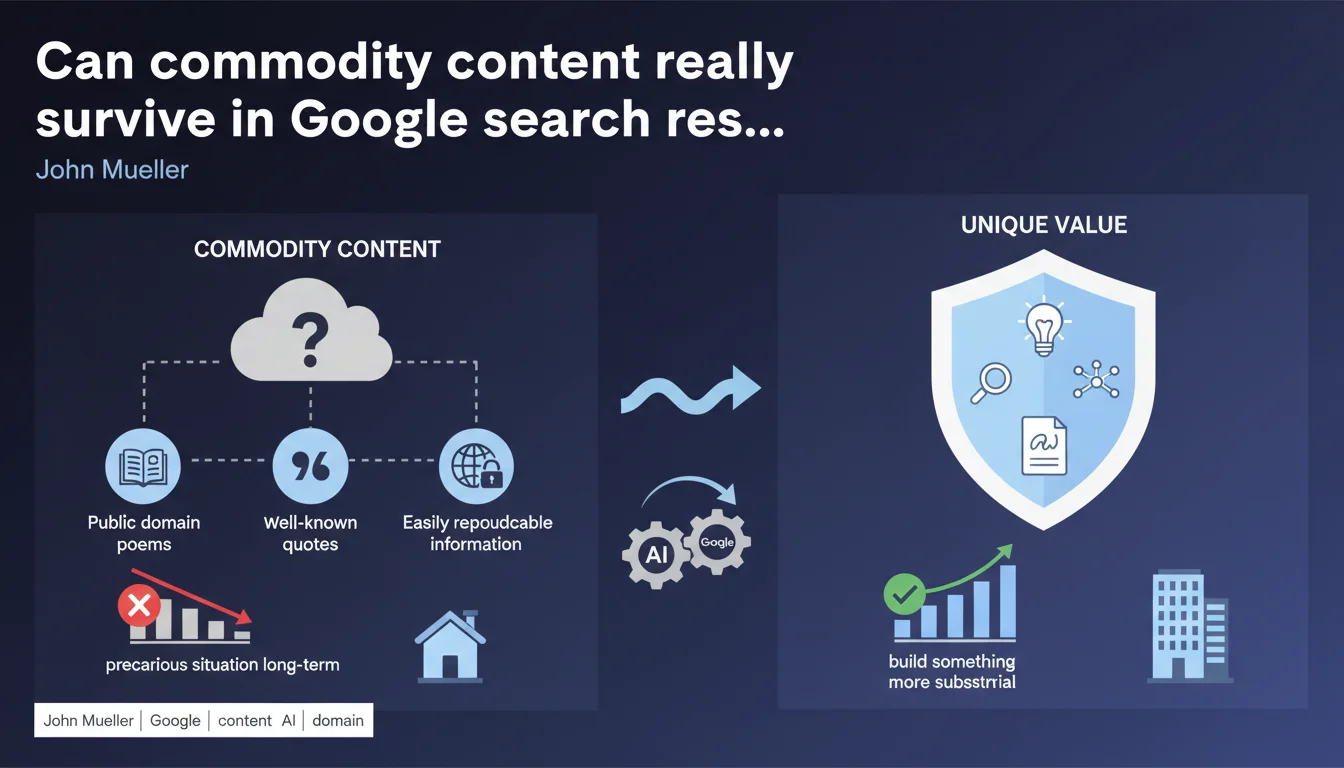
Google warns: publishing generic reproducible content (public domain poems, famous quotes) without unique added value is a losing strategy. Major players can integrate this same content anytime. The only solution: build substantial differentiation while you still can.
What you need to understand
What does Google mean by 'commodity content'?
The term 'commodity' here refers to interchangeable content, available everywhere, without original creation. Public domain poems, famous quotes, dictionary definitions, song lyrics — anything you can copy-paste from existing sources.
This type of content has no barrier to entry. Anyone can republish it tomorrow. And most importantly: major players (Wikipedia, authority sites, even Google itself via featured snippets) can integrate it instantly.
Why does Google insist on 'unique value'?
Because without differentiation, these sites are vulnerable by nature. They offer nothing that another site couldn't provide. Their traffic relies solely on temporary algorithmic arbitrage from Google — which can disappear at the next algorithm update or when a better-established competitor arrives.
Mueller talks about 'a precarious situation long-term': this isn't a penalty threat, it's an economic reality check. These sites survive on algorithmic life support, without any defensible asset.
What concretely means 'providing significant unique value'?
Google deliberately stays vague — as usual. But we can translate: contextualization, editorial curation, expert analysis, innovative organization, superior user experience, expert commentary, interactive tools.
In short: anything that transforms mundane content into an irreplaceable resource. A public domain poem accompanied by sharp literary analysis? Added value. The same poem copy-pasted 50 times with ads around it? Pure commodity.
- Commodity content: reproducible effortlessly, available everywhere, no barrier to entry
- Main risk: major players can integrate this content anytime and crush the competition
- Google's solution: provide unique substantial value (expertise, contextualization, curation, tools)
- Time horizon: these sites are living on borrowed time — you must build differentiation during traffic periods
SEO Expert opinion
Is this statement consistent with real-world observations?
Absolutely. We regularly see MFA sites (Made For Adsense) based on scraped or public domain content abruptly lose traffic. Not necessarily via manual penalty — just an algorithmic reevaluation favoring more solid sources.
The typical case: a quotes site that ranked well for 2-3 years, then collapses when Goodreads or BrainyQuote optimize their SEO. No penalty, just natural replacement by a better-established player.
What nuances should we add to this position?
Mueller talks about 'a precarious situation long-term', but some commodity sites survive for years. The issue isn't binary — it's a spectrum of risk.
A site can start with commodity content then evolve toward differentiated content. The reverse works too: an authority site that rests on its laurels and starts publishing generic content eventually declines. [To verify]: Google has never specified exactly when the balance tips.
In what cases doesn't this rule really apply?
Historic aggregators with established brand authority can survive even with commodity content — because their name itself becomes the added value. Think IMDb for movie fact sheets: it's reproducible factual content, but nobody looks elsewhere.
Let's be honest: this rule mainly targets small opportunistic sites. Big players have inertia protecting them temporarily. But even they aren't eternal — ask the SEO directories from the 2000s.
Practical impact and recommendations
What concretely should you do if your content is 'commodity'?
First step: honestly audit your content. Ask yourself: could anyone reproduce this page in 10 minutes? If yes, you're in the risk zone.
Next, identify exploitable differentiation vectors. Sector expertise? Proprietary data? Unique editorial angle? Interactive presentation? You need to build something that doesn't copy with a single click.
What mistakes should you absolutely avoid?
Don't settle for cosmetic variations. Changing the layout or adding some keywords doesn't transform commodity content into unique content. Google is looking for substantial value, not window dressing.
Another trap: believing that large quantity compensates for low quality. Publishing 10,000 public domain poems doesn't protect you better than publishing 100. It's actually worse — it dilutes your resources without creating differentiation.
How do you verify your site is no longer in 'precarious situation'?
Ask yourself this simple question: if Google decided tomorrow to integrate this content into a featured snippet or knowledge panel, would your site still have a reason to exist? If not, you're still vulnerable.
Another test: analyze your engagement metrics. A site with real differentiated content generates time on page, pages per session, natural backlinks. A commodity site generates bounces — people get the info and leave.
- Audit each content section: can it be reproduced easily?
- Identify exploitable differentiation angles (expertise, proprietary data, unique presentation)
- Invest in original creation, not just cosmetic variations
- Monitor engagement metrics (time on page, pages/session, bounce rate)
- Build brand authority that becomes a defensible asset itself
- Diversify traffic sources to avoid relying solely on Google
❓ Frequently Asked Questions
Est-ce que republier du contenu du domaine public est interdit par Google ?
Qu'est-ce qui compte comme 'valeur significative unique' aux yeux de Google ?
Un site commodity peut-il ranker temporairement avant de s'effondrer ?
Est-ce que cette règle s'applique aussi aux gros sites établis ?
Comment transformer un site commodity en site différencié ?
🎥 From the same video 21
Other SEO insights extracted from this same Google Search Central video · published on 05/03/2022
🎥 Watch the full video on YouTube →
💬 Comments (0)
Be the first to comment.