
Official statement
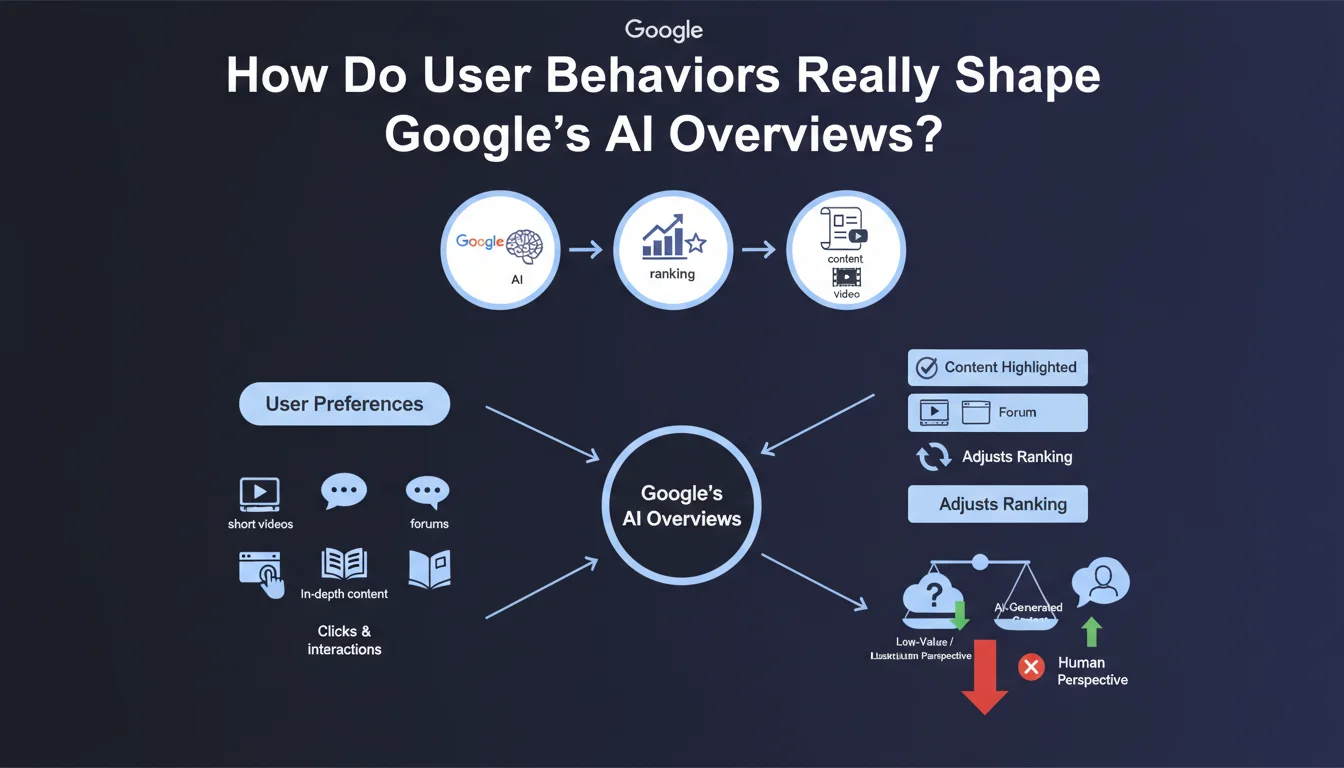
Regarding AI-generated content, Google does not automatically consider it spam. Only content deemed "low-value" or lacking human perspective is demoted. Reid specifies that what matters is the quality, depth, and uniqueness of the content, regardless of its origin (human or AI).
Click data shows that users favor content that offers a human perspective—rich and original—rather than superficial or repetitive texts. Google therefore prioritizes pages that demonstrate real expertise, thorough work, and unique added value.
Finally, Reid indicates that the definition of "spam" has been broadened: it now includes any redundant content that merely repeats already known information. Conversely, Google strengthens the ranking weight of content that brings a personal perspective, industry expertise, or detailed analysis.
What you need to understand
Google officially announces a major shift in how it classifies and displays content in AI Overviews. The search engine no longer relies solely on traditional technical signals.
The system now centrally integrates real user behaviors: clicks, interactions, preferences for certain formats (short videos, forums, long articles). These behavioral signals directly guide the nature of content being highlighted.
Regarding AI-generated content, Google clarifies its position: content origin matters less than its intrinsic quality. Text produced by artificial intelligence is not automatically penalized, but it must demonstrate real added value.
The definition of spam is also evolving. Google now considers as spam any redundant content that simply repeats information already widely available, even if the text is well written.
- User interactions become a direct ranking factor for AI Overviews
- AI content is not discriminated against if it brings a unique perspective and real value
- Redundancy is penalized: repeating existing information is no longer enough, even with technically original content
- Human perspective and expertise are favored by users according to click data
SEO Expert opinion
This statement confirms what we've been observing for several months: Google is refining its ability to measure real engagement and integrating it as a quality signal. This isn't new per se, but the official announcement for AI Overviews marks an acceleration.
The important nuance concerns AI-generated content. Google doesn't systematically penalize it, which is consistent: many sites use AI as an assistance tool. The real criterion remains the depth and originality of the content, not the tool used to produce it.
However, be careful: "human perspective" remains difficult to define algorithmically. Google likely relies on indirect signals such as time spent, shares, external citations, and patterns of reformulation rather than simple paraphrasing.
Practical impact and recommendations
- Audit your existing content to identify pages that merely repeat information available elsewhere, then enrich them with unique perspectives or remove them
- Systematically integrate industry expertise into your content: case studies, experience feedback, proprietary data, original industry analyses
- If you use AI to produce content, consider it as a writing assistant, not as the final author: always add a layer of human expertise and differentiating editorial angle
- Optimize for user engagement: structure your content to encourage time spent, interactions, and complete consultation (not just the initial click)
- Develop diversified formats according to search intents: short videos for quick tutorials, long content for in-depth expertise, conversational formats for Q&A
- Measure real engagement metrics (scroll rate, time spent, adjusted bounce rate) and not just raw traffic: this data foreshadows what Google values
- Avoid mass production without differentiation: 10 truly expert and unique pieces of content are better than 100 generic articles, even if technically well-optimized
- Document your expertise through proof elements: detailed author bios, qualification mentions, industry references, demonstrations of competence
These developments require a strategic overhaul of the editorial approach, often difficult to manage internally without dedicated expertise. Companies wishing to quickly adapt to these new criteria can benefit from specialized support to audit their existing content, define a differentiating editorial line, and implement production processes adapted to these increased requirements for quality and originality.
💬 Comments (0)
Be the first to comment.