
Official statement
Other statements from this video 21 ▾
- □ Faut-il créer une nouvelle URL ou mettre à jour la même page pour du contenu quotidien ?
- □ Faut-il arrêter d'utiliser l'outil de soumission manuelle dans Search Console ?
- □ Les balises H2 dans le footer posent-elles un problème pour le référencement ?
- □ Les balises <header> et <footer> HTML5 améliorent-elles vraiment le SEO ?
- □ Faut-il vraiment se fier au validateur schema.org pour optimiser ses données structurées ?
- □ La vitesse de page améliore-t-elle vraiment le classement aussi vite qu'on le croit ?
- □ Google crawle-t-il tous les sitemaps au même rythme ?
- □ Google continue-t-il vraiment de crawler un sitemap supprimé de Search Console ?
- □ Pourquoi Google n'indexe-t-il pas une page crawlée régulièrement si elle ne présente aucun problème technique ?
- □ Les structured data peuvent-elles remplacer le maillage interne classique ?
- □ Pourquoi un seul x-default suffit-il pour toute votre configuration hreflang multi-domaines ?
- □ Faut-il vraiment éviter le structured data produit sur les pages catégories ?
- □ Faut-il vraiment choisir une langue principale pour chaque page si vous visez plusieurs marchés ?
- □ Pourquoi Google ignore-t-il complètement votre version desktop en mobile-first indexing ?
- □ Le contenu 'commodity' peut-il vraiment survivre dans les résultats Google ?
- □ Faut-il isoler ses FAQ dans des pages séparées pour mieux ranker ?
- □ Pourquoi Google réduit-il drastiquement l'affichage des FAQ dans les résultats de recherche ?
- □ Pourquoi Google n'indexe-t-il qu'une infime fraction de vos URLs ?
- □ Peut-on héberger son sitemap XML sur un domaine différent de son site principal ?
- □ Les Core Web Vitals : pourquoi le passage de « Bad » à « Medium » change tout pour votre ranking ?
- □ La vitesse serveur impacte-t-elle vraiment le crawl budget des gros sites ?
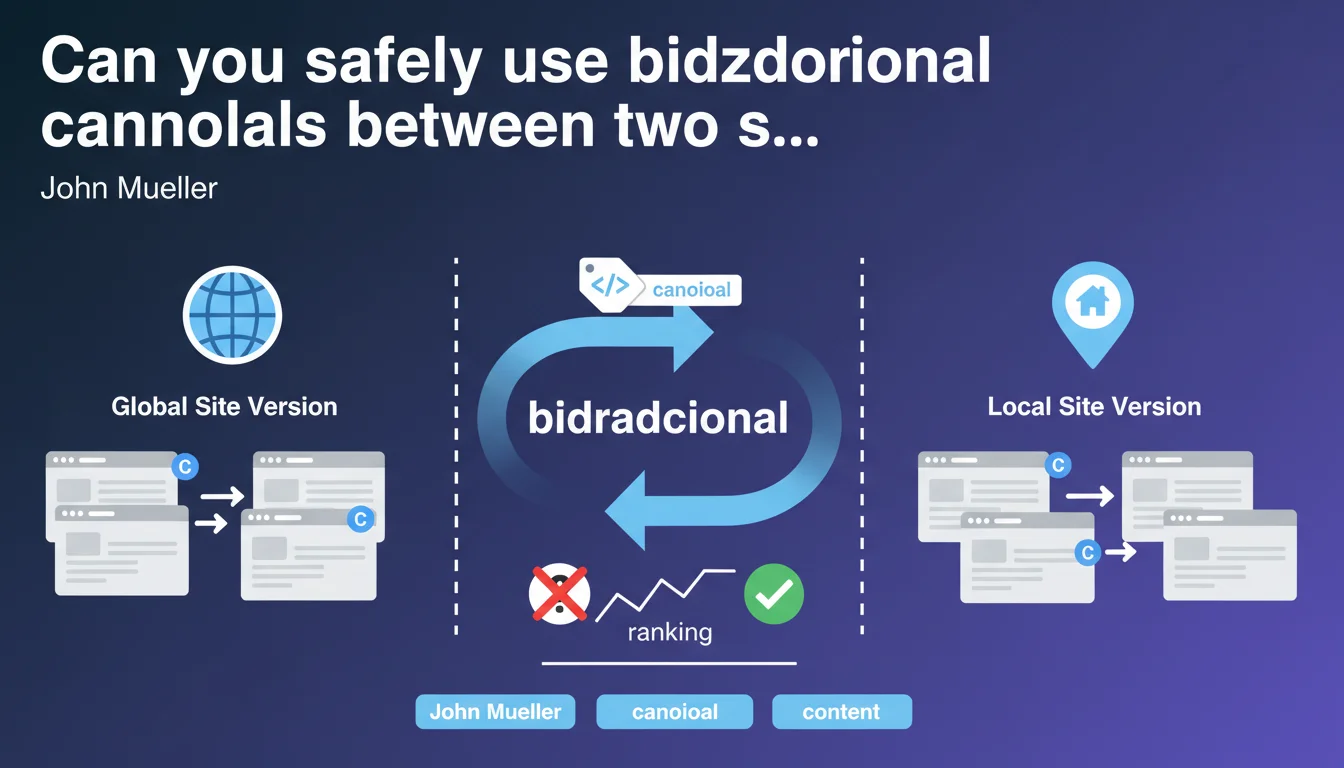
Google confirms that duplicating content between a global site and a local site while using canonical tags is a legitimate use. You can set up cross-domain canonicals: some pages from site A point to B, others from B to A. This only impacts the specific pages involved, not the overall ranking of the domains.
What you need to understand
Why does this question about canonicals across domains come up so often?
International groups or franchises regularly find themselves with multiple versions of a site: a global corporate site, local sites by country, variations by market. The same content (product sheets, corporate pages) exists on multiple domains.
Without proper management, it's wide open to duplicate content across domains. Google has to choose which version to index, and that choice can be unpredictable. Hence the use of the canonical tag to indicate which URL is the authoritative one.
What exactly does Mueller say about using canonicals across domains?
He explicitly validates that duplicating content between two sites (global and local for example) while providing a canonical tag is a perfect use. No need to unify the direction: site A can canonicalize certain pages to B, and B can canonicalize other pages to A.
The key point: this configuration doesn't affect the overall ranking of the sites. Only the individual pages involved are impacted — the one receiving the canonical becomes the indexed version, the other is ignored.
What are the concrete use cases?
- Global site + local sites: the corporate site hosts institutional pages (About, History), local sites canonicalize toward it for these pages. Local product sheets remain canonical on local sites.
- Multiple brands: two brands from the same group share certain technical content (guides, product specs). Each brand canonicalizes toward the other depending on who owns the "master" version.
- Progressive restructuring: migration from an old domain to a new one, page by page. During the transition, cross-domain canonicals based on progress status.
SEO Expert opinion
Is this statement consistent with practices observed in the field?
Yes, and it's even reassuring. We regularly see configurations where two domains canonicalize to each other for different pages without Google losing its mind. But — and this is a big "but" — it requires rigorous implementation.
The risk? Creating canonical loops or inconsistencies. If page A from site 1 canonicalizes to page B from site 2, which itself canonicalizes back to A, Google gives up and chooses arbitrarily. Or worse: you canonicalize a page to one domain, but your hreflang points to the other. That's chaos.
What nuances need to be added to this rule?
Mueller says "this won't affect the overall ranking of the sites." Technically true, but needs nuancing. If you canonicalize 80% of your content to another domain, you deprive your own site of its indexable pages. Result: less visibility, less organic traffic, perception of an "empty" site by Google.
Another point: he speaks of "two versions of a site." What about three, four, ten versions? [To verify]: no official data on the scalability of this approach. The more you multiply domains and cross-domain canonicals, the more you increase the risk of human error and contradictory signals.
In what cases does this rule not apply or become risky?
If your two sites aren't clearly related (same group, same brand, same topic), canonicalizing between them might seem suspicious. Google could see it as an attempt at manipulation — even if Mueller doesn't explicitly say so.
Practical impact and recommendations
What should you do concretely to manage canonicals across domains?
First, precisely map out which pages from which domain canonicalize to which other domain. An Excel spreadsheet or centralized management tool is essential once you go beyond a handful of pages. Otherwise, you're guaranteed to forget canonicals or create contradictory ones.
Next, synchronize teams. If the global site and local sites are managed by different teams, make sure everyone knows who canonicalizes what. A content change on site A should trigger a review of site B's canonicals.
What mistakes should you absolutely avoid?
- Canonical loops: A to B, B to A. Google gives up and chooses arbitrarily.
- Canonicals + inconsistent hreflang: you canonicalize to .com but hreflang points to .fr. Result: confusion.
- Canonical pointing to a 404 or redirected page: the canonical must point to a valid, stable URL.
- XML sitemap including non-canonical pages: if you canonicalize to another domain, remove the page from your sitemap.
- Non-reciprocal canonicals without reason: if you canonicalize page A from site 1 to site 2, make sure site 2 doesn't canonicalize that same page elsewhere.
How to verify your configuration is correct?
Use Google Search Console for each domain. Look at "Excluded" pages with the reason "Alternate page with correct canonical tag." If you see pages you didn't plan to canonicalize, that's a red flag.
Crawl both your sites with Screaming Frog or Oncrawl. Export all canonicals, verify that none point to a 404, a redirect, or a loop. Cross-reference with your hreflang if you have any.
Cross-domain canonicals are a powerful tool for managing legitimate duplicate content. But their implementation requires absolute rigor: precise mapping, consistency with hreflang and sitemaps, continuous monitoring in Search Console.
If you manage multiple domains with hundreds of pages, this orchestration becomes complex quickly. A configuration error can deprive an entire site of visibility. In this context, consulting a specialized SEO agency may be wise to guarantee flawless implementation and regular monitoring of signals sent to Google.
❓ Frequently Asked Questions
Peut-on utiliser des canonical entre deux domaines totalement différents ?
Faut-il retirer de mon sitemap XML les pages qui canonicalisent vers un autre domaine ?
Les canonical croisés peuvent-ils impacter le PageRank entre mes sites ?
Que se passe-t-il si je canonicalise une page vers un domaine, mais que je garde un hreflang vers cette même page ?
Puis-je changer la direction d'une canonical entre domaines sans risque ?
🎥 From the same video 21
Other SEO insights extracted from this same Google Search Central video · published on 05/03/2022
🎥 Watch the full video on YouTube →
💬 Comments (0)
Be the first to comment.