
Official statement
Other statements from this video 12 ▾
- □ Does Google really follow every HTTP status code in a chain, or does it stop at the first one?
- □ Does a CDN really improve your Google rankings?
- □ Should you block API endpoint crawling to optimize your crawl budget?
- □ Should you really ban nofollow from your internal links?
- □ Should you stop relying on the site: command to measure indexation?
- □ Why does Google really prefer server-side redirects over JavaScript redirects?
- □ Should you really care about the difference between 301 and 302 redirects for SEO?
- □ Should you really isolate your archived content to boost your SEO performance?
- □ Can you really force Google to display sitelinks in search results?
- □ Should you really abandon PDFs and iframes if you want your text content to rank properly?
- □ Does Google really favor certain CMS platforms for SEO rankings?
- □ Does Google really crawl URLs found in your structured data?
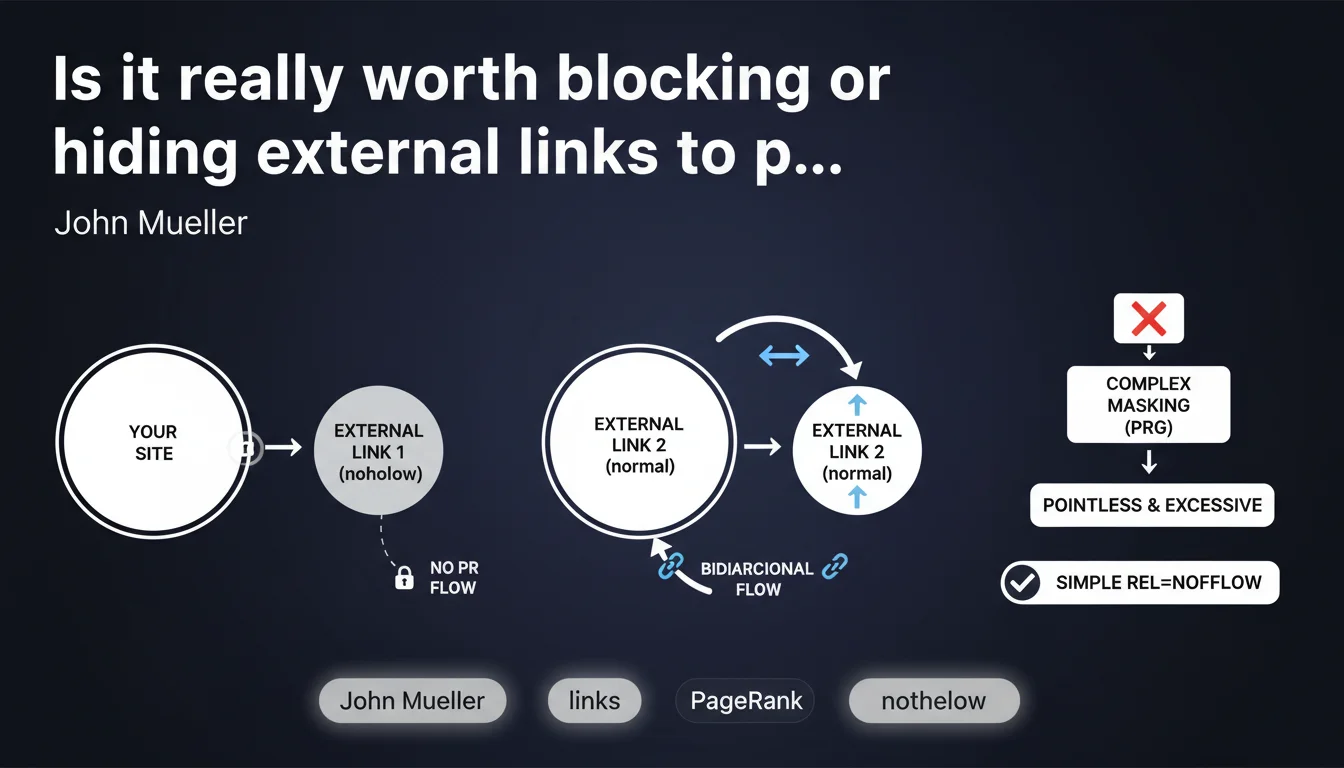
Google states that masking external links with complex patterns (like PRG) is pointless and excessive. A simple rel=nofollow is sufficient if needed. Systematically blocking all outgoing links goes against the philosophy of the web and provides no SEO advantage.
What you need to understand
Why do some sites attempt to hide their external links?
The idea stems from an obsession with PageRank: keeping all the "SEO juice" internally rather than "leaking" it to the outside. Some webmasters use techniques like Post-Redirect-Get (PRG) or JavaScript redirects so Google doesn't directly follow external links.
The reasoning? If Google doesn't see the outgoing link, it won't transfer PageRank. Except this logic completely ignores the reality of the web ecosystem — and Google's position on the matter.
What exactly does Google recommend?
John Mueller is categorical: using rel=nofollow (or rel=sponsored, rel=ugc depending on context) is more than enough if you don't want to transfer PageRank. No need for complex technical setups.
Blocking all external links doesn't "make sense" according to Google. The web operates on bidirectional links — you link, you get linked to. This dynamic is what feeds relevance and discoverability.
What's the risk of this defensive approach?
By isolating your site, you send a negative signal to Google: you're not participating in the ecosystem, you're just trying to siphon traffic without giving anything back. This is the opposite of what Google values.
Moreover, masking links can be interpreted as an attempt at manipulation, especially if the patterns used are detected as suspicious.
- rel=nofollow (or sponsored/ugc) is the official solution for controlling outgoing PageRank
- Blocking or masking external links with complex techniques is counterproductive
- Google values sites that participate naturally on the web with bidirectional links
- Complete isolation can be perceived as a negative signal by the algorithm
SEO Expert opinion
Is this statement consistent with field observations?
Yes, largely. Sites that link intelligently to the outside — to quality sources, studies, references — don't lose rankings. On the contrary, they gain credibility and thematic relevance.
Google has always said that PageRank is just one signal among hundreds. The obsession with preserving it at all costs is a reflex from another era, when the number of backlinks and PageRank were king.
In what cases doesn't this rule apply?
Let's be honest: there are contexts where limiting outgoing links makes sense. A directory site, a community forum, a massive UGC site — there, you don't want to transfer PageRank to just any URL submitted by a user.
But even in these cases, the solution remains rel=ugc or rel=nofollow. No need for convoluted redirects. Google understands these attributes very well and respects them.
[To verify]: Google remains vague about the exact impact of a completely isolated site (zero outgoing links) in highly competitive verticals. Some e-commerce sites barely link to the outside at all and do very well — but that's not a recommended strategy nonetheless.
Do you really need to avoid PRG or JavaScript redirects for external links?
Yes. These techniques add unnecessary complexity, degrade user experience (loading time, extra redirects) and can raise red flags with Google.
If your only goal is to not transfer PageRank, rel=nofollow does exactly that, without friction. Why overcomplicate things?
Practical impact and recommendations
What should you concretely do on your site?
Audit your outgoing links. Identify those pointing to quality sources (studies, references, legitimate partners) and leave them as dofollow. Those pointing to user-generated content or commercial partners? Switch them to rel=ugc or rel=sponsored.
Abandon any masking technique (PRG, JS redirects, link cloaking). You gain nothing, you lose clarity — and potentially Google's trust.
What mistakes should you absolutely avoid?
Don't fall into the trap of systematic nofollow on everything. Some SEOs put all their external links on nofollow by defensive reflex. Result: Google sees no outgoing editorial signals, which impoverishes the thematic understanding of your site.
Another mistake: believing that blocking external links via robots.txt or meta nofollow will "keep the PageRank." That's not how it works. PageRank dilutes anyway, whether you block or not.
How can you verify that your site complies with Google's recommendations?
- List all external links from your strategic pages (via Screaming Frog or a crawler)
- Check if you're using PRG, JS redirects or other masking patterns — and remove them
- Identify outgoing links to commercial content or UGC and apply rel=sponsored or rel=ugc
- Keep dofollow for links to quality editorial sources (studies, references, legitimate partners)
- Analyze your outgoing link profile: an isolated site (zero external links) sends a negative signal
- Monitor your crawl budget: unnecessary redirects on external links can waste it
❓ Frequently Asked Questions
Dois-je passer tous mes liens externes en nofollow pour protéger mon PageRank ?
Les redirections JavaScript ou PRG pour masquer les liens externes sont-elles pénalisantes ?
Un site sans aucun lien externe peut-il bien ranker ?
Quelle différence entre rel=nofollow, rel=sponsored et rel=ugc ?
Bloquer les liens externes via robots.txt conserve-t-il le PageRank ?
🎥 From the same video 12
Other SEO insights extracted from this same Google Search Central video · published on 08/06/2022
🎥 Watch the full video on YouTube →
💬 Comments (0)
Be the first to comment.